Cargo Solidarity Union "Will Not Hesitate to Take Hardline Action"
Possibility of Striking Workers Refusing to Return
If Administrative Litigation and Constitutional Complaints Follow
The Rift Between Labor and Government Will Only Deepen
[Asia Economy Reporters Kim Min-young, Bae Kyung-hwan] The government has decided to issue a work commencement order against those refusing transportation in the cement sector. This is the first case since the concept of the work commencement order was introduced in 2004. Once the order is issued, public authority will be exercised to forcibly end the strike without resolving the underlying issue related to the 'Safe Freight Rate System' that triggered the strike. The Cargo Solidarity Union has declared the government's move 'unconstitutional' and vowed to take hardline action, so it is uncertain whether the order will be effective even if forcibly implemented. In particular, the likelihood of legal disputes such as administrative litigation and constitutional complaints is high, and the conflict between both sides is expected to deepen.
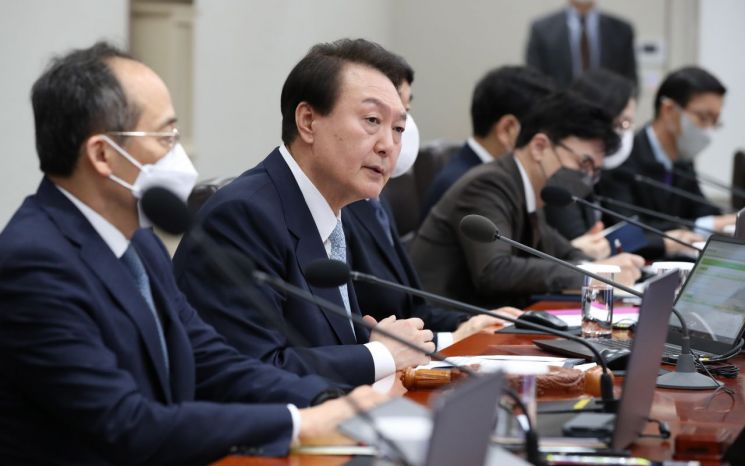
◆First-ever Work Commencement Order... Applied First to Ready-Mix Concrete Transportation= On the morning of the 29th, President Yoon Suk-yeol presided over a Cabinet meeting at the Yongsan Presidential Office in Seoul and deliberated and approved the 'Work Commencement Order for Those Refusing Cargo Transportation.' President Yoon stated, "Today, the government will inevitably issue a work commencement order against those refusing transportation in the cement sector to prevent a more serious crisis that could affect our people's livelihoods and the national economy," adding, "During my term, I will firmly establish the rule of law between labor and management and will never compromise with illegality."
The reason the government has issued this unprecedented work commencement order is due to disagreements surrounding the Safe Freight Rate System. Initially, the government claimed to have reached an agreement with the Cargo Solidarity Union after the first strike on June 1, but conflicts arose during the process of negotiating the contentious Safe Freight Rate issue. The government insists on extending the Safe Freight Rate System for only three years without expanding the applicable items, while the Cargo Solidarity Union demands the system be made permanent and the scope expanded.
In particular, President Yoon's mention of his 'term' while pushing forward the work commencement order against the Cargo Solidarity Union's general strike is interpreted as a reflection of his determination to break the vicious cycle of illegal strikes. On the day, President Yoon emphasized, "We will strictly hold those responsible for illegal acts accountable to the end," and added, "We aim to uphold law and principles and break the vicious cycle of illegal strikes to prevent burdens on the public. Although the public will experience considerable inconvenience and hardship, I earnestly ask for your understanding."
This is also influenced by the repetition of the situation during the Cargo Solidarity Union's general strike in June. At that time, the government responded with hardline measures such as work commencement orders and license cancellations but eventually made significant concessions. However, the government's concessions led to a strike at Daewoo Shipbuilding & Marine Engineering, and the Cargo Solidarity Union repeated the vicious cycle with a re-strike.
The work commencement order will first apply to the Bulk Cement Trailer (BCT, ready-mix concrete transport vehicles) sector. This is because the construction sites suffered the greatest damage from the strike. Following the approval of the work commencement order, the Ministry of Land, Infrastructure and Transport must deliver the order verbally or in writing to specific operators or workers identified through on-site investigations. The order takes effect through this procedure. Minister of Land, Infrastructure and Transport Won Hee-ryong stated, "From the moment the Cabinet's resolution is completed, the work commencement order will be enforced against those refusing transportation."
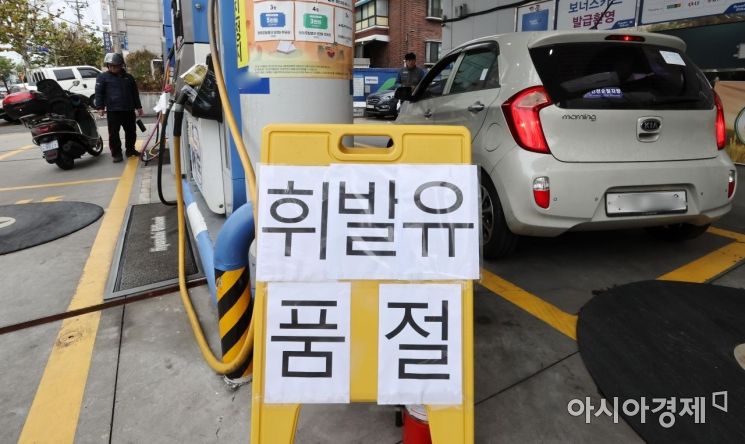 On the 29th, due to the aftermath of the Cargo Solidarity strike disrupting gasoline supply, a sign indicating a shortage of gasoline is placed at a gas station in Seoul. Since 70-80% of the vehicles of the four major oil refiners (SK, GS Caltex, S-Oil, Hyundai Oilbank) are members of the Cargo Solidarity union, it is expected that the supply of gasoline and diesel at gas stations with depleted inventory will also be affected. Photo by Hyunmin Kim kimhyun81@
◆Cargo Solidarity Union "There Are Grounds for Unconstitutionality"... High Possibility of Noncompliance= Once the work commencement order is issued, transport workers must return to work by the day after receiving the order. The Ministry of Land, Infrastructure and Transport plans to deliver the work commencement order individually to cargo workers using previously secured information such as truck owners, contact numbers, and addresses. Failure to comply may result in a 30-day license suspension (first penalty) or license cancellation (second penalty), and refusal without just cause may lead to imprisonment of up to three years or a fine of up to 30 million won.
However, even if the government enforces the work commencement order, the Cargo Solidarity Union has stated it will not accept it, citing "grounds for unconstitutionality," which is expected to deepen the rift between labor and government. If the strike issue is resolved through public authority rather than dialogue, the solution is likely to be only partial. If the Safe Freight Rate issue is not properly settled this time, Cargo Solidarity Union strikes could recur at any time.
Lee Eung-joo, Director of Education and Propaganda at the Cargo Solidarity Union, said, "We believe there are grounds for unconstitutionality based on violations of the constitutional prohibition of forced labor (due process principle), infringement of the basic rights of cargo workers justified by the abstract legal benefit of concerns over a serious national economic crisis (violation of the principle of proportionality)," adding, "Like all other citizens, cargo transport workers enjoy freedom of occupation, which includes the freedom to perform or not perform their job and freedom of business."
The phrase in the work commencement order's activation conditions, "when there is substantial reason to recognize that a very serious crisis has occurred or is likely to occur in the national economy," is vague regarding the standard for a serious crisis. Ultimately, when the freedom of association of workers and the public interest of the national economy collide, the government's action's legitimacy will depend on the court's interpretation of which takes precedence.
The work commencement order must be delivered directly to the individual to take effect, so transport drivers may claim they did not receive the order. If delivery is repeatedly refused due to 'absence,' it can be made through official gazette announcements, but this can take up to 14 days. In other words, the issuance of the work commencement order could deepen the emotional rift between labor and government and prolong the strike.
There is also a possibility of legal disputes such as administrative litigation and constitutional complaints, similar to the medical strike. A Cargo Solidarity Union official said, "We are keeping all legal options open."
Attorney Kim Ye-rim of Law Firm Simmok said, "If fundamental freedoms are excessively infringed, it becomes problematic, but if public interest takes precedence, the work commencement order can be issued," adding, "However, once the order is issued, the Cargo Solidarity Union can file an injunction to suspend its effect, so legal disputes are likely."
As with the first strike, the possibility of a dramatic agreement is currently low. The second round of negotiations is scheduled for the 30th, but it is doubtful whether sincere dialogue between the government, which deliberated the work commencement order the day before, and the Cargo Solidarity Union will be possible. Director Lee Eung-joo said, "Setting the date again for the 30th after the first negotiation failed and then issuing a work commencement order shows a lack of willingness to negotiate," but added, "However, we will attend the second negotiation as planned."
© The Asia Business Daily(www.asiae.co.kr). All rights reserved.


















