Ministry of Economy and Industry Proposes Nuclear Power Action Plan
Discussion on Extending and Rebuilding Nuclear Plant Operation Period
Waste Facility Construction Faces Difficulties Due to Resident Opposition
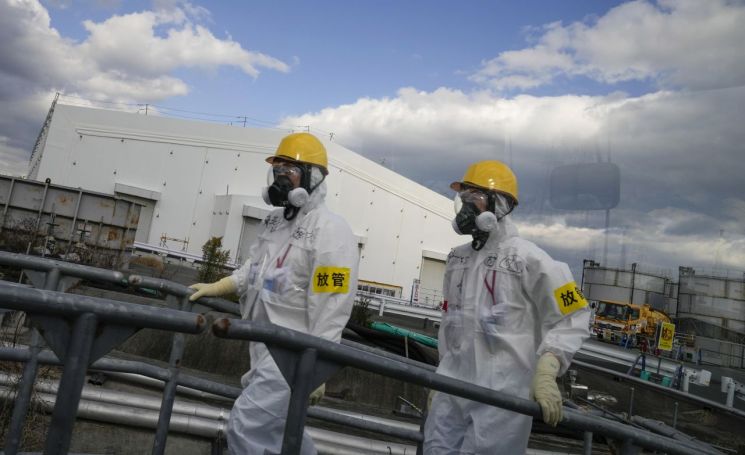 Workers involved in the dismantling operations at the Fukushima nuclear power plant after the incident [Image source=EPA Yonhap News]
[Asia Economy Reporter Lee Ji-eun] On the 29th, Nihon Keizai Shimbun reported that Japan's Ministry of Economy, Trade and Industry announced an action plan to rebuild aging nuclear power plants and extend the operational period of nuclear power plants, which is currently limited to a maximum of 60 years. As the Japanese government has begun to completely overhaul its existing nuclear power policies to resolve the energy shortage, public backlash and safety concerns are rising.
According to the report, the Ministry of Economy, Trade and Industry held a review meeting the day before and presented a plan to rebuild nuclear power plants and extend the upper limit of their operational period. It stated that the six currently operating nuclear power plants alone are insufficient to resolve the energy shortage.
Specifically, the Mihama nuclear power plant of Kansai Electric Power, which has not passed the restart screening, was mentioned as a candidate for reconstruction. Units 1 and 2 of the Mihama plant have already reached the end of their lifespan and are scheduled for decommissioning, while Unit 3 is an aging nuclear power plant that has been in operation for over 40 years.
The Ministry of Economy, Trade and Industry views rebuilding and constructing new nuclear power plants as inevitable to secure electricity through nuclear power generation. Since the Great East Japan Earthquake in 2011, Japan has legally mandated the decommissioning of nuclear power plants that have operated for more than 60 years; if this continues, the number of nuclear power plants Japan can operate by 2050 will decrease to five.
Japan currently has 33 reactors, of which 25 have applied for restart and 17 have passed the screening. Among these 17, only six nuclear power plants, including Takahama Unit 3, are currently operating normally. Next year, seven nuclear power plants, including Kashiwazaki-Kariwa Unit 6, are expected to restart.
Along with rebuilding nuclear power plants, legal revisions to extend the operational period were also discussed. Since the 2011 legal revision, the Japanese government has, in principle, limited nuclear power plant operation to 40 years but allows a one-time extension of 20 years. Asahi Shimbun reported that the Ministry of Economy, Trade and Industry, considering public backlash, is contemplating measures such as excluding the period during which operation is suspended from the plant's lifespan rather than completely abolishing the upper limit of the operational period.
The reason Japan reversed its zero-nuclear policy after the Great East Japan Earthquake is analyzed to be due to the severe energy shortage. This summer, Japan experienced a surge in energy consumption due to abnormal temperatures, leading to power shortages. In June, the Ministry of Economy, Trade and Industry issued a "power supply and demand tightness warning" for the first time ever, predicting that the power reserve rate in the Tokyo area would drop to 3.7%.
Nihon Keizai explained that the instability in power supply and demand was caused by a sharp increase in electricity usage amid a decline in nuclear power plant operation rates. Before the Fukushima Daiichi nuclear disaster, nuclear power accounted for 30% of Japan's total electricity, but last year, the share of nuclear power in total electricity supply was only 6%.
The sharp rise in energy prices triggered by the Russia-Ukraine war is also cited as a cause of the power shortage. Japan depends entirely on imports for fossil fuels such as liquefied natural gas (LNG), oil, and coal. LNG is the main energy source for power generation, with Russian LNG accounting for only 9%. However, after the Russia-Ukraine war, demand for non-Russian LNG surged, causing global LNG prices to rise sharply. As energy supply instability worsened, the Kishida Fumio Cabinet, which had been reluctant to expand nuclear power plants, announced a review of nuclear power policy in August.
However, overcoming public backlash appears to be a major challenge. Asahi Shimbun pointed out that while plans to restart nuclear power plants were included in the proposal, there was insufficient discussion on how to handle nuclear waste. The Japanese government is promoting a "nuclear fuel cycle policy" to reuse plutonium recovered from reprocessing spent nuclear fuel for nuclear power generation, but construction of reprocessing plants has been postponed 26 times due to opposition from local governments. The final disposal site for nuclear waste has also not been decided due to resistance from residents.
Nihon Keizai stated, "To expand and build new nuclear power plants, it is essential to restore public trust in nuclear power," and added, "It is also necessary to present solutions for operating reprocessing plants to recycle spent nuclear fuel and for waste disposal facilities."
© The Asia Business Daily(www.asiae.co.kr). All rights reserved.

















