Game Companies Competing on Salaries See Labor Costs Decline in Q3
Rising Labor Costs Hurt Profitability...Cost Control Through Workforce Optimization
[Asia Economy Reporter Yuri Choi] Labor costs at game companies, which surged over the past two years, have turned to a decline. The increased expenses from salary competition and aggressive hiring have led to deteriorating profitability, prompting efforts to optimize workforce efficiency. As the trend to reduce labor cost burdens spreads, it is expected that hiring opportunities will become even more limited starting next year.
NCSoft's Labor Costs Decline for Three Consecutive Quarters... Kakao Games, Pearl Abyss, and Wemade Follow Suit
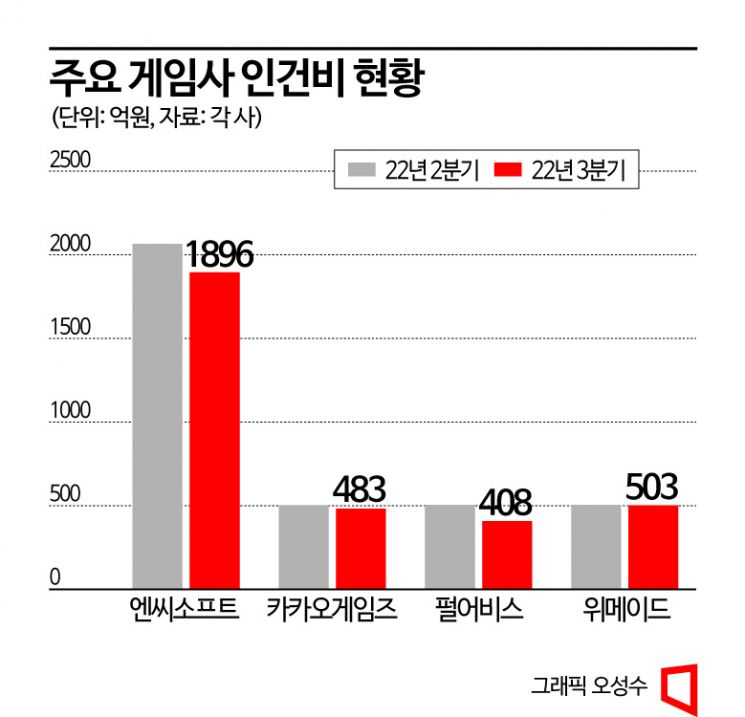
According to the game industry on the 30th, the labor costs of major domestic game companies such as NCSoft, Nexon, Netmarble, Krafton, Kakao Games, Pearl Abyss, Com2uS, and Wemade amounted to 929 billion KRW in the third quarter of this year, slightly down from 930.7 billion KRW in the previous quarter. The labor costs that had surged after COVID-19 have somewhat eased.
NCSoft, which began cost management this year, has seen labor costs decrease for three consecutive quarters. Reflecting workforce optimization, the third-quarter labor costs (189.6 billion KRW) decreased by 8.2% compared to the previous quarter.
Kakao Games, Wemade, and Pearl Abyss also returned to a downward trend in labor costs after several quarters. Kakao Games' third-quarter labor costs recorded 48.3 billion KRW, down 4.1% from the previous quarter. Labor costs, which had steadily increased since the first quarter of last year, declined for the first time in six quarters. Wemade's labor costs decreased to 50.3 billion KRW, marking a reduction after nine quarters.
Pearl Abyss experienced the largest decrease. Third-quarter labor costs were 40.8 billion KRW, down 19.2% from the second quarter. During this period, development personnel decreased by 7.2%. The company explained that the one-time cost of stock incentives paid to employees in the second quarter disappeared, and voluntary resignations of developers overlapped. Former PD Jo Yong-min, who led Black Desert Mobile, resigned and established a game company, leading some developers to leave as well.
Project Streamlining and Workforce Optimization... "Hiring Will Become Even More Restrictive Next Year"
Game companies have begun workforce optimization to control labor costs. They are reducing internal development projects and conducting hiring more conservatively. Recently, Netmarble decided to discontinue two games under development, 'BTS Dream: TinyTAN House' and 'Monster Taming Arena.' The group plans to limit workforce expansion at the corporate level. NCSoft is also controlling labor costs by focusing more on utilizing internal personnel rather than new recruitment.
An industry insider said, "Amid economic uncertainty, the pressure from increased labor costs has grown. Although there was fierce competition for hiring and salary increases to attract developers over the past two years, the current atmosphere is to make better use of existing personnel."
As this sentiment spreads, hiring opportunities are expected to become even more limited next year. Mirae Asset Securities recently forecasted in a report that the annual labor cost growth rate of major game companies will drop from 26.7% in 2020 and 20.3% in 2021 to 16.7% in 2022 and 5.9% in 2023.
Professor Wi Jeong-hyun of Chung-Ang University, president of the Korea Game Society, said, "Since NCSoft achieved good performance through cost control, other game companies will likely follow. Although they may not conduct massive layoffs like global big tech companies, new hiring is expected to decrease significantly."
© The Asia Business Daily(www.asiae.co.kr). All rights reserved.
![Clutching a Stolen Dior Bag, Saying "I Hate Being Poor but Real"... The Grotesque Con of a "Human Knockoff" [Slate]](https://cwcontent.asiae.co.kr/asiaresize/183/2026021902243444107_1771435474.jpg)











