Instead of 'Sales Period', 'Consumption Period'
Extended 20~50% Longer Than Expiration Date
Effectively Reducing Food Waste and More
[Asia Economy Reporter Jeon Jinyoung] "The expiration date has passed a bit, should I throw it away?" Anyone who is a consumer has probably experienced this dilemma. Starting January 1 next year, to reduce such confusion, the expiration date on food products purchased by consumers will be changed to a consumption period. The expiration date, which was first introduced in 1985 and used for 38 years, will disappear into history.
According to the Ministry of Food and Drug Safety on the 29th, the revised "Act on Labeling and Advertising of Foods," amended last August, will be enforced from January 1 next year. All foods that previously displayed expiration dates will be subject to change, and from now on, they must be labeled with the consumption period on packaging and other materials.
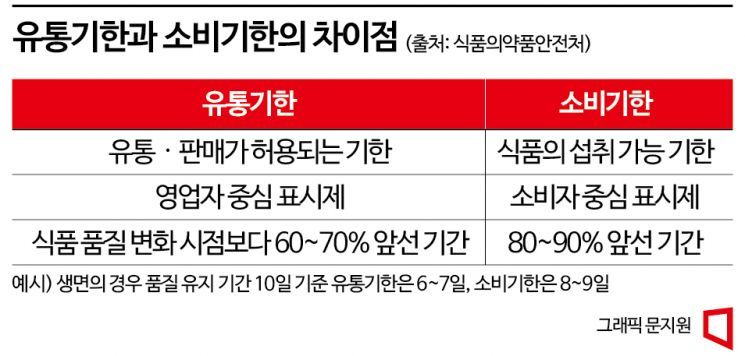
The Ministry explained the reason for the introduction, saying, "Consumers have continued to be confused about whether to consume products past the expiration date or have regarded the expiration date as the disposal point," and "to provide accurate information and reduce food waste caused by disposal, the consumption period has been introduced." The expiration date used so far refers to the period during which distribution and sales are allowed?the "period when it can be sold"?while the consumption period refers to the period during which the food is safe to eat?the "period when it can be consumed." According to the Ministry, the expiration date is set at about 60-70% of the time before the point when consumers commonly consider the food to have "spoiled," while the consumption period is set at about 80-90% of that time. Thus, the consumption period is roughly 20-50% longer than the expiration date.
In fact, experiments by the Korea Consumer Agency showed that liquid coffee containing milk, cheese, and other products can be consumed safely for much longer than the expiration date if stored at appropriate temperatures. Milk was safe for 50 days, liquid coffee for 30 days, and cheese for up to 70 days. Previously, the Consumer Agency analyzed that eggs with a 45-day expiration date could be stored for 70 days, and bread with a 3-day expiration date could be stored for 20 days if frozen. Experts also report that tofu with a 14-day expiration date can be stored for up to 90 days.
By changing to the consumption period, the burden of disposal can be reduced by the lengthened period. Currently, the annual food waste volume in Korea is 5.48 million tons, with disposal costs exceeding 1 trillion won. This is equivalent to an area of 100 soccer fields being discarded as food waste each year. The Ministry expects that introducing the consumption period will generate benefits worth 1 trillion won annually and also reduce carbon emissions.
The Ministry plans to establish and announce consumption period guidelines by food type within this week. However, for products like fresh milk, which require refrigeration and are prone to spoilage, the consumption period will be applied starting in 2031. A Ministry official stated, "We are conducting experiments considering the type and characteristics of products to determine how long they remain unspoiled, and will soon announce the consumption periods set based on these results."
Meanwhile, the Ministry has decided to have a one-year grace period from the enforcement date. This is because companies need time to reprint packaging with the consumption period. However, after the grace period ends, manufacturers who fail to display the consumption period or violate regulations will face suspension of product manufacturing and product disposal measures. Continued violations may result in business suspension, manufacturing suspension, and even business cancellation.
© The Asia Business Daily(www.asiae.co.kr). All rights reserved.

















