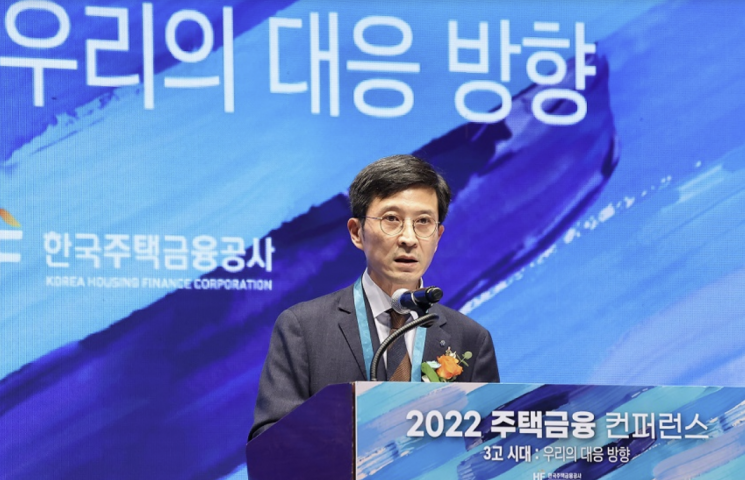
 Choi Jun-woo, President of the Korea Housing Finance Corporation, is delivering the opening address at the "2022 Housing Finance Conference" held on the 28th at the Westin Chosun Hotel in Sogong-dong, Seoul, to discuss "Our Response Direction in the Era of Triple Challenges."
[Asia Economy Reporter Eunju Lee] There is a diagnosis that the inflation rate will peak by the first half of next year and gradually stabilize downward from the second half. This is because U.S. housing prices, which lead global inflation, are showing signs of decline, and labor market conditions are also deteriorating. However, since a strong adjustment in the real estate market is likely until the first half of next year, it has been pointed out that efforts to strengthen the financial soundness of the government, companies, and households are necessary to prepare for this.
On the 28th, Korea Housing Finance Corporation held the ‘2022 Housing Finance Conference’ under the theme ‘Our Response Direction in the Era of the Three Highs’ at the Westin Chosun Hotel in Sogong-dong, Seoul. Hong Chun-wook, CEO of Prism Investment Advisory, who gave the keynote speech on ‘Real Estate Market Trends and Outlook,’ said, “It is difficult to expect an interest rate cut until the first half of 2023,” and “Inflation will peak in the first half of next year and gradually stabilize downward.”
He said, “Until the first half of 2022, inflation was driven by the sharp rise in energy and food prices, but in the second half of this year, inflation is being led by housing rent prices,” adding, “Given the shock of policy rate hikes and the fact that U.S. housing prices have recorded negative growth rates since July, housing rent prices are also expected to stabilize downward in 2023.”
The worsening labor market conditions in the U.S. were also cited as a factor increasing the possibility of inflation stabilizing downward in the second half of next year. He said, “The Federal Reserve’s monetary policy is also influenced by changes in labor market conditions. While the real wage growth rate is negative, the number of job openings continues to increase,” and “a period of interest rate freeze is expected until signs of labor market deterioration appear.” He also mentioned that leading indicators of inflation are showing signs of decline. He explained, “The Potential Inflation Pressure Index (UIG), compiled by the New York Federal Reserve Bank using various economic data, has recorded a month-on-month decline for five consecutive months since May.”
Professor Cho Dong-chul of the KDI Graduate School of International Policy, who gave a keynote speech, also mentioned, “There are signs that the rapid rise in inflation is gradually easing, and forecasts suggest that the interest rate hike cycle is entering its final stage.” However, he predicted that a strong adjustment in the housing finance market would proceed as the high inflation phase continues until just before that period.
Professor Cho said, “Until next year, when inflation is expected to visibly stabilize downward, high interest rates following additional rate hikes are likely to continue,” adding, “In a situation where high interest rate policies are inevitable, the housing finance market is expected to endure a painful time.” He also explained, “There is a possibility that a faster price adjustment in the real estate market than after the global financial crisis may occur.”
Considering this, Professor Cho suggested that not only the government and companies but also households should make efforts to strengthen their financial soundness. He said, “The downward stabilization of housing prices, which surged under a high interest rate environment, and the orderly exit of businesses that caused excessive leverage can be understood as a positive effect of high interest rate policies,” adding, “However, during this process, the government should focus on preventing localized instability from spreading into a systemic crisis and amplifying unintended ripple effects.”
Kim Hyung-seok, a team leader at the Bank of Korea, who gave a keynote speech on ‘2023 Global Macroeconomic Outlook,’ said, “Ultimately, international cooperation is necessary.” This is because it is limited to resolve the current global economic crisis situation by Korea’s efforts alone. He emphasized, “Fragmentation undermines the efficiency of the global division of labor system and causes cost increases, which may lead to entrenched high inflation and low growth,” stressing the urgent need for cooperation among countries.
© The Asia Business Daily(www.asiae.co.kr). All rights reserved.
![Clutching a Stolen Dior Bag, Saying "I Hate Being Poor but Real"... The Grotesque Con of a "Human Knockoff" [Slate]](https://cwcontent.asiae.co.kr/asiaresize/183/2026021902243444107_1771435474.jpg)
















