Next Year's Budget Draft Set at 7.2535 Trillion Won, Up 244.1 Billion Won from This Year
Support for Small Business Owners and Vulnerable Groups... Proactive Response to Climate Crises like Drought
City and City Council Emphasize 'Two Wheels
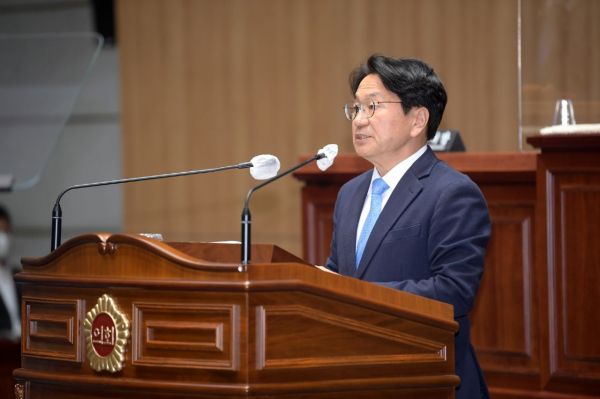
[Asia Economy Honam Reporting Headquarters Reporter Yoon Jamin] Kang Ki-jung, Mayor of Gwangju Metropolitan City, stated on the 28th during his policy speech at the Gwangju City Council, “We will accelerate the journey to become an opportunity city by serving as a support pillar and stepping stone.”
Mayor Kang emphasized, “In difficult circumstances with limited resources, we deeply considered the principles and criteria of what must be done and what must not be done. We have secured the maximum possible budget for livelihood expenses to respond to the economic crisis, organizing the budget to be a ‘support pillar for today’s crisis response’ and a ‘stepping stone for tomorrow’s opportunities.’”
The total scale of the next year’s budget proposal submitted by Gwangju City to the City Council is 7.2535 trillion won, which is a 3.5% increase compared to the 2022 original budget (7.0094 trillion won).
Looking at the main contents of the budget proposal, 789.1 billion won has been allocated as a ‘support pillar budget’ to respond to today’s crisis.
First, although the government cut or reduced it, the city allocated 76.9 billion won for the Win-Win Card budget, which was judged to provide practical help to citizens during the economic crisis, and additionally reflected 9.35 billion won from city funds to cover the government budget reduction for senior and youth job projects to ensure smooth project implementation.
The city plans to continue to proactively secure policies deemed essential for citizens, even if the government cuts or reduces them, in accordance with principles.
The budget for small and medium-sized enterprise (SME) management stabilization funds was expanded to 250 billion won, and interest support for small and medium manufacturers and small business owners was also expanded to 3%.
Additionally, 3.2 billion won was allocated next year as a new safety net budget to fully support social insurance premiums for small business owners and interest on Bitgoeul Loan and Smile Finance loans.
Furthermore, the city will do its utmost to support small business owners and self-employed individuals, who form the backbone of the local economy, to withstand the ‘three-high era’ through support such as new hiring wage subsidies for small business owners and the Yellow Umbrella Mutual Aid.
In particular, the city is taking this drought as an opportunity to prepare mid- to long-term measures to respond to the climate crisis by conducting a pilot project for the greenhouse gas reduction recognition budget system and allocating 62.2 billion won for projects such as creating climate response urban forests (3.1 billion won).
The city allocated 2.3003 trillion won as a ‘stepping stone budget’ for tomorrow’s opportunities, focusing on growth, vitality, and care.
First, 173.1 billion won was allocated to ‘growth’ to expand industries and increase jobs.
Active investments will be made in AI industry convergence with existing key industries, fostering the semiconductor industry, future mobility and other future food industries, and supporting startups and technology demonstration challenges. Budgets were reflected for AI cluster development (17 billion won), domestic AI semiconductor testing and verification environment creation (1.5 billion won), semiconductor industry promotion and support (19.2 billion won), strengthening capabilities of automobile parts companies (700 million won), and horizontal electric vehicle business ecosystem creation projects (600 million won).
636 billion won will be supported for startup testbed demonstration support (3 billion won) and the construction of a startup growth support center (9.5 billion won) to make Gwangju a city with a high startup success rate.
2.815 trillion won was allocated to ensure citizens can enjoy a ‘vital’ life.
The city set a challenging goal to open the ‘era of 30 million urban users’ by building infrastructure and stories that can bring new fun and vitality to Gwangju, starting with the nation’s top-level complex shopping mall.
To realize this, budgets were prepared for fostering representative local festivals such as the Chungjang Festival and Buskers World Cup (2 billion won), and for activating nighttime downtown tourism on the Road of Light (3.5 billion won).
Additionally, 37.3 billion won was allocated for urban regeneration New Deal projects to revitalize the downtown area, and 10.9 billion won was supported for the integrated culture, sports, and tourism voucher project to enable citizens to evenly enjoy culture and sports.
Small but significant budgets were also reflected, such as 200 million won for Gwangju-type youth gap year support for the future of youth, and 30 million won for the Yeongsan River and Hwangryong River Y-belt exciting project, which will symbolize new prosperity and abundance.
Finally, 1.8456 trillion won was allocated for robust ‘care’ across life cycles.
The city’s strategy is to develop ‘Gwangju-style integrated care’ as a welfare brand representing the 8th term of the local government, creating a Gwangju without care worries.
From April next year, any Gwangju citizen in need of care?including infants, children and adolescents, the elderly, disabled persons, and single-person households?will be able to receive customized services with just one application. A budget of 7.8 billion won was allocated for this.
Starting with systematic preparation for farmer’s allowance payments (150 million won), the city will steadily implement the three major public value allowances, allocate 105.2 billion won for senior job and social activity support, and 27.1 billion won for region-led youth job projects. Through building a detailed social safety net across life cycles, the city plans to realize a warm care city where no one is left out.
Mayor Kang said, “Gwangju City and the City Council are the two wheels driving the ‘happiness of Gwangju citizens,’” and added, “Let us join hands and move forward together as ‘partners in reform’ to overcome the great economic crisis and create a vibrant and dynamic opportunity city, Gwangju.”
© The Asia Business Daily(www.asiae.co.kr). All rights reserved.