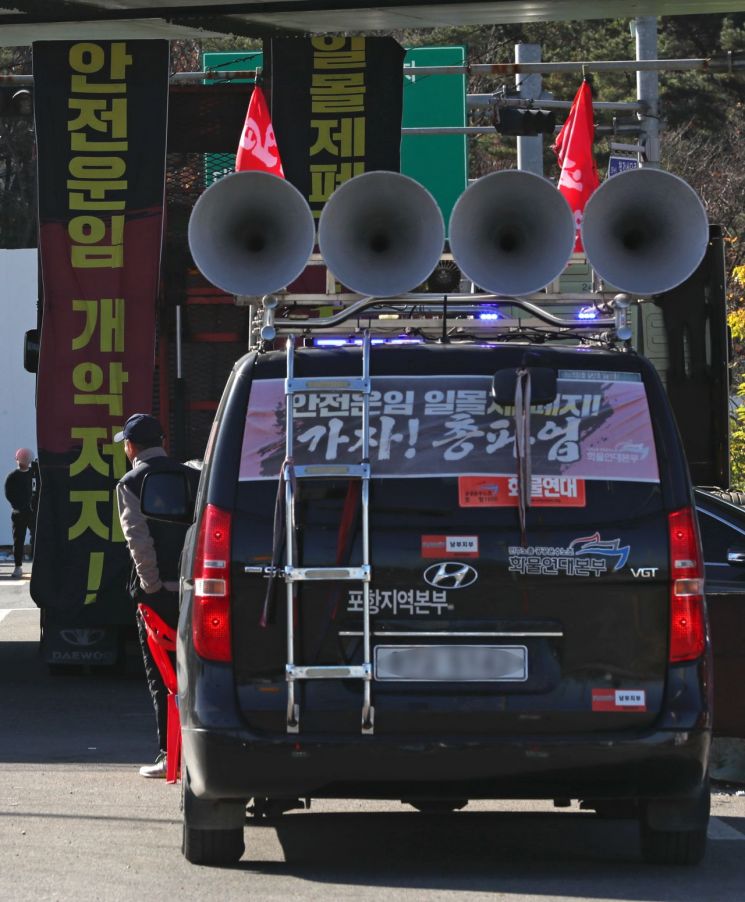
[Asia Economy Reporter Kim Min-young] Five days after the Cargo Solidarity Union continued its general strike, the Ministry of Land, Infrastructure and Transport (MOLIT) and the Cargo Solidarity Union will sit at the negotiation table for the first time. The prospects for negotiations are not bright as both sides have not narrowed their positions regarding the abolition of the Safe Freight Rate System and the expansion of applicable items. Attention is focused on the negotiation results as the government may issue a work commencement order if negotiations fail.
On the 28th, MOLIT and the Cargo Solidarity Union will negotiate issues related to the strike, such as the extension of the Safe Freight Rate System and the expansion of applicable items, at the Government Complex Sejong in the afternoon. This is the first official dialogue since the general strike on the 24th, and the first negotiation in 14 days since the 15th.
Negotiations are expected to be difficult. It is highly likely that both sides will only reaffirm their differences without any progress. The Cargo Solidarity Union holds a strong position demanding "the permanent establishment of the Safe Freight Rate System and expansion of items," while MOLIT insists on "extending the Safe Freight Rate System for three years but not expanding the items." A representative of the Cargo Solidarity Union said, "MOLIT proposed to prepare a consensus and negotiate, so we agreed," adding, "Our position to legalize the permanent Safe Freight Rate System and item expansion remains unchanged."
The government has stated that if negotiations end without any results, it will consider issuing a work commencement order. On the 26th, MOLIT Minister Won Hee-ryong said, "We have completed practical preparations to issue the work commencement order immediately." If the order is issued, it will be the first case since its introduction in 2004. MOLIT is known to have completed practical preparations for issuing the order and is currently compiling the scale of damage to the industry.
The reason the government is taking a tough stance by considering the work commencement order card, unlike during the strike in June, is due to the recent economic situation. With rising interest rates and an economic recession increasing the management burden on industries, concerns are growing that the strike could cause serious economic damage.
MOLIT reported that as the Cargo Solidarity Union’s collective refusal to transport continues, the damage situation is becoming increasingly severe, and accordingly, as of 9 a.m. on the day, the crisis alert level was raised from "caution" to the highest level, "serious," according to the ‘Land Freight Transport Crisis Response Manual.’
The upgrade of the crisis alert level considers the nationwide spread of the transport refusal, ongoing transport disruptions at major logistics facilities such as ports, and difficulties in handling import and export cargo. With the issuance of the "serious" level, the government’s response system is also strengthened to a central disaster and safety countermeasures headquarters at the government-wide level. Accordingly, a comprehensive government emergency plan will be implemented in cooperation with related agencies including the Ministry of the Interior and Safety, National Police Agency, Ministry of National Defense, Ministry of Oceans and Fisheries, and Ministry of Trade, Industry and Energy.
© The Asia Business Daily(www.asiae.co.kr). All rights reserved.
![Clutching a Stolen Dior Bag, Saying "I Hate Being Poor but Real"... The Grotesque Con of a "Human Knockoff" [Slate]](https://cwcontent.asiae.co.kr/asiaresize/183/2026021902243444107_1771435474.jpg)
















