Yonsei University-Seoul National University Joint Research Team

[Asia Economy Reporter Kim Bong-su] Domestic researchers have developed a new vaccine to treat Alzheimer's disease.
Professor Kim Young-su of Yonsei University College of Pharmacy and Professor Kim Byung-soo of Seoul National University College of Engineering recently announced on the 28th that they have developed a new therapeutic vaccine for Alzheimer's disease. This vaccine not only produces antibodies to remove amyloid beta aggregates but also suppresses neuroinflammation in the brain by inducing amyloid beta-specific regulatory T cells, thereby eliminating two major causes of Alzheimer's disease, as demonstrated in animal experiments.
Alzheimer's disease is one of the top five causes of death, and the number of patients is expected to continue increasing due to accelerated aging. However, current Alzheimer's medications only temporarily manage symptoms without addressing the root causes of the disease. Therefore, developing treatments for Alzheimer's disease, which has a high unmet medical need, is very important. Although the exact causes of Alzheimer's disease have not been definitively identified, hypotheses include amyloid beta protein aggregates, tau protein hyperphosphorylation, and neuroinflammation as representative causes.
In 2021, Aducanumab, an antibody therapy targeting amyloid beta protein aggregates developed by the U.S. company Biogen, was approved by the U.S. FDA as the first new drug for Alzheimer's disease. However, there has been much controversy regarding its therapeutic efficacy and side effects. Additionally, antibody therapies have the disadvantage of costing tens of millions of won annually. In contrast, therapeutic vaccines have the advantage of much lower treatment costs. Several years ago, clinical trials of a therapeutic vaccine that generated antibodies against amyloid beta protein aggregates were conducted, but development was halted due to brain inflammation side effects.
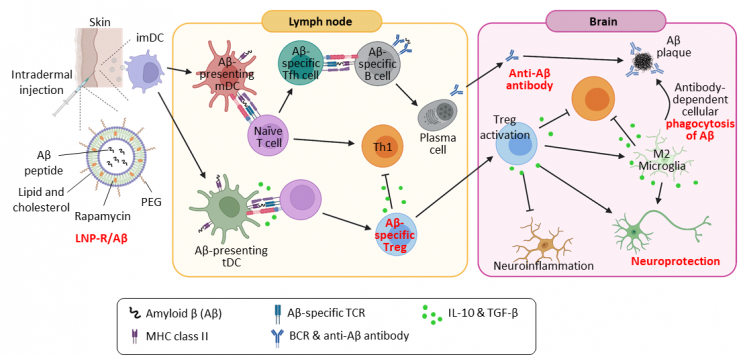
The research team injected a vaccine loaded with amyloid beta peptide and the immunotolerant drug rapamycin encapsulated in lipid nanoparticles into the skin of Alzheimer's disease animal models. This vaccine simultaneously produced antibodies against amyloid beta and induced amyloid beta-specific regulatory T cells. As a result, amyloid beta aggregates were removed from the brain, neuroinflammation was alleviated, and cognitive learning functions improved. Compared to existing antibody therapies and vaccines that focus solely on removing amyloid beta aggregates, this vaccine is expected to have advantages in improving cognitive function and preventing brain inflammation side effects.
This therapeutic vaccine, which precisely regulates the patient's immune system, is expected to be effective in terms of safety, therapeutic efficacy, and treatment cost compared to existing antibody therapies.
The research results were published on the 17th in the nanotechnology journal Advanced Materials (IF 32). The English title of the paper is 'A therapeutic nanovaccine that generates anti-amyloid antibodies and amyloid-specific regulatory T cells for Alzheimer’s disease'.
© The Asia Business Daily(www.asiae.co.kr). All rights reserved.
![Clutching a Stolen Dior Bag, Saying "I Hate Being Poor but Real"... The Grotesque Con of a "Human Knockoff" [Slate]](https://cwcontent.asiae.co.kr/asiaresize/183/2026021902243444107_1771435474.jpg)

















