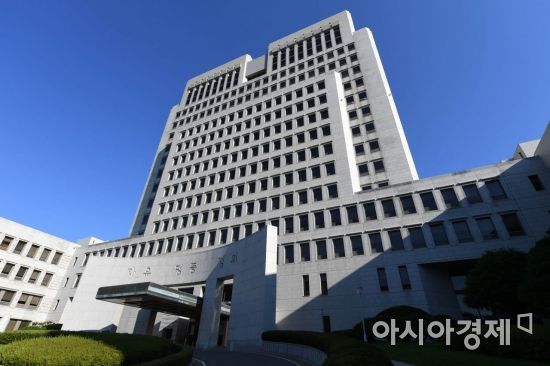
[Asia Economy Reporter Choi Seok-jin, Legal Affairs Specialist] The Supreme Court has ruled that incentives received annually from a company must be included in the salary income, which serves as the basis for calculating lost income (the income loss that the victim of an illegal act will not be able to earn in the future).
This ruling aligns with the Supreme Court's previous stance that "proof regarding future expected income does not require concrete and certain evidence but is sufficient as proof of income with considerable probability."
The Supreme Court's Second Division (Presiding Justice Cheon Dae-yeop) announced on the 28th that it overturned the lower court's partial ruling in favor of Kim (33), an engineer working at a well-known domestic conglomerate, in his appeal lawsuit against Hyundai Marine & Fire Insurance Co., Ltd., and remanded the case to the Seoul Central District Court.
The court stated, "The lower court's judgment contained errors in the legal principles regarding the calculation of lost income and failed to conduct necessary hearings, which affected the judgment," as the reason for the reversal and remand.
Kim was injured on December 29, 2018, at the Penguin Slope, a beginner slope at Phoenix Pyeongchang Ski Resort in Pyeongchang-gun, Gangwon Province, when he collided with A, who was ahead of him while skiing, resulting in injuries including a rupture of the right knee posterior cruciate ligament and a rupture of the ligament in the right little finger, requiring more than six weeks of treatment.
At the time of the accident, A was giving a snowboarding lesson to his junior and, while turning to change direction, failed to notice Kim coming from behind, causing the collision.
Fortunately, A had entered into an insurance contract with Hyundai Marine & Fire Insurance in August 2008, which included a daily life liability coverage that compensates up to 100 million KRW for bodily injury or property damage caused to others due to accidental incidents during daily life.
Kim filed a lawsuit against the insurer of A, claiming damages of 100 million KRW.
The trial focused on determining the degree of fault in the collision and how to calculate the lost income, which forms the basis for the damage compensation amount.
Regarding the accident circumstances, Kim claimed that A suddenly performed a J-turn while descending the slope, causing him to move slightly uphill and leading to the accident. In contrast, A argued that he was performing a heel turn while descending when he collided with Kim coming from behind.
The first trial court ruled that ▲ the testimonies of both parties conflicted and there was no other evidence to verify, ▲ Kim, descending from behind, might have misunderstood A's direction change as a J-turn, ▲ the slope was for beginners and very gentle, ▲ A, who was giving a snowboarding lesson to an acquaintance, was likely not turning at a high speed, and ▲ since Kim was descending from behind, he could have somewhat predicted A's direction and speed, and ▲ Kim's failure to watch ahead was more significant than A's breach of duty of care, limiting A's fault to 30%.
Regarding the calculation of lost income, Kim argued that the amount should be based on the sum of his income until his retirement date of August 31, 2049, including the performance incentive of about 22 million KRW received in January 2018, the Lunar New Year travel allowance of about 2.2 million KRW (February), the target incentive of about 2.3 million KRW (July), and the Chuseok travel allowance of about 2.3 million KRW (September) received that year.
On the other hand, the insurance company argued that the performance incentive, target incentive, and Lunar New Year and Chuseok travel allowances claimed by Kim should be excluded from the salary income used as the basis for calculating lost income, as these are additional benefits that are not continuously or regularly paid.
The first trial court judged that the Lunar New Year and Chuseok travel allowances could be considered continuously and regularly paid benefits since the company regularly paid them to all employees during employment. However, the performance and target incentives were deemed not to be continuously and regularly paid benefits because their occurrence was uncertain and the payment rates varied annually.
Ultimately, the first trial court calculated Kim's lost income by considering a 14.5% loss of labor capacity due to the accident and an average monthly salary of about 3.8 million KRW, and ordered the insurer to pay Kim about 46.2 million KRW, including already incurred medical expenses of about 1.6 million KRW and 5 million KRW in consolation money. Litigation costs were to be borne equally by the insurer and Kim.
Kim appealed, but the second trial court also found no problem with the first trial court's judgment and dismissed Kim's appeal, ordering Kim to bear all appeal costs.
However, the Supreme Court's judgment differed.
The court found no issue with limiting A's fault to 30% as part of Kim's appeal regarding liability limitation.
On the other hand, the court ruled that the lower courts erred in excluding the performance and target incentives from the salary income used as the basis for calculating Kim's lost income.
The court first introduced two previous Supreme Court rulings related to the calculation of lost income.
The Supreme Court had previously stated, "In cases where bodily injury occurs due to another's illegal act, the calculation of lost income is principally based on the victim's actual income at the time of the illegal act, and the average wage or ordinary wage under the Labor Standards Act cannot be considered as a standard for calculating damages equivalent to lost income."
Additionally, the Supreme Court's position is that "the degree of proof regarding future expected income should be relaxed compared to proof of past facts, so it is sufficient to prove income with considerable probability within a reasonable and objective scope, rather than concrete and certain proof of income that the victim could realistically earn."
The court noted, "According to the company's salary regulations where Kim was employed, the target incentive is paid twice a year on June 30 and December 31, with payments made on July 8 for the first half and December 24 for the second half. The payment targets are all employees employed as of the payment date, and the calculation standard is 120% of the base salary as the 'bonus calculation base,' multiplied by the payment rate, with other detailed standards according to separate criteria."
It also pointed out, "The performance incentive is paid once a year on January 31 of the following year based on the payment date of December 31, and the payment targets are all employees employed as of the payment date. The calculation standards are divided between salaried and non-salaried employees, with other detailed standards according to separate criteria."
The court stated, "The plaintiff joined the company in 2008 and received target and performance incentives annually from the first half of 2012 until the first half of 2021, after the accident," adding, "Considering these facts and the contents of the employee salary regulations at the plaintiff's workplace, it is reasonable to conclude that, regardless of whether these incentives have the nature of average or ordinary wages under the Labor Standards Act, there is considerable probability that the plaintiff would have continued to receive these incentives within a certain range after the accident."
It concluded, "Nevertheless, the lower court judged that the target and performance incentives did not constitute salary income forming the basis for calculating the plaintiff's lost income for the reasons stated, which constitutes an error in the legal principles regarding lost income calculation and a failure to conduct necessary hearings, affecting the judgment."
© The Asia Business Daily(www.asiae.co.kr). All rights reserved.
![Clutching a Stolen Dior Bag, Saying "I Hate Being Poor but Real"... The Grotesque Con of a "Human Knockoff" [Slate]](https://cwcontent.asiae.co.kr/asiaresize/183/2026021902243444107_1771435474.jpg)
















