Need to Increase Local Production to Respond to Inflation Reduction Act
SK On to Sign Business Agreement This Month... Under-the-Radar Cooperation Talks with LG Energy Solution
Two Factories + α Needed for Local Supply of 800,000 Batteries
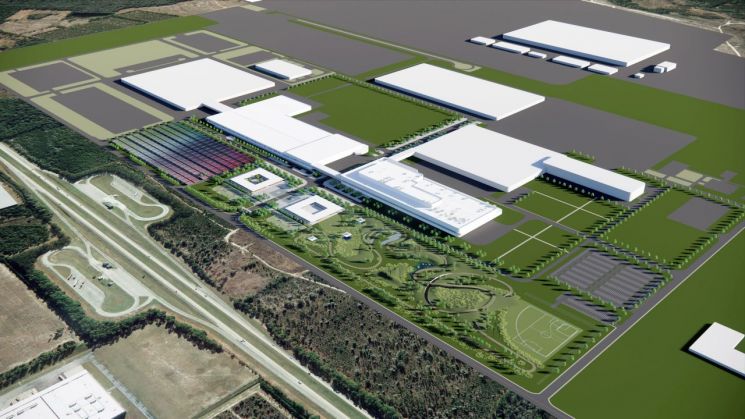 A bird's-eye view of Hyundai Motor Group's Meta Plant America in Georgia, USA, which is being promoted with the goal of operation in 2025. It is located near Savannah on the southeastern coast of Georgia. Full-scale construction will begin next year, and after completion, it is expected to operate with an annual production capacity of 300,000 units.
 [Asia Economy Reporter Choi Daeyeol] Hyundai Motor Company has decided to partner with domestic battery companies to secure electric vehicle battery supply in the United States. Similar to the domestic market, SK and LG are expected to be the main suppliers, with the possibility of collaborating with a third battery company, according to industry insiders. Due to the Inflation Reduction Act (IRA) in the U.S., which requires a significant increase in local production, securing local battery supply is considered crucial to meet the initially targeted volume.
According to the industry on the 28th, Hyundai Motor plans to sign a memorandum of understanding this month to cooperate with SK On on battery business in the U.S. The operation type, method, site, and scale of the factory have not yet been decided and will be determined through detailed discussions later. Although it is expected to take some time, battery cooperation plans with LG Energy Solution are also being steadily discussed behind the scenes. Similarly, a joint venture or factory between the two companies is a likely option to produce batteries for electric vehicles manufactured locally by Hyundai Motor.
Hyundai Motor Group has so far sourced electric vehicle batteries from SK, LG, and China's CATL. In the past, LG supplied a larger share for hybrid vehicles, but with the transition to dedicated electric vehicle platforms such as Ioniq 5 and EV6, SK's share has significantly increased. Recently, due to cost issues, CATL batteries have been used in some models.
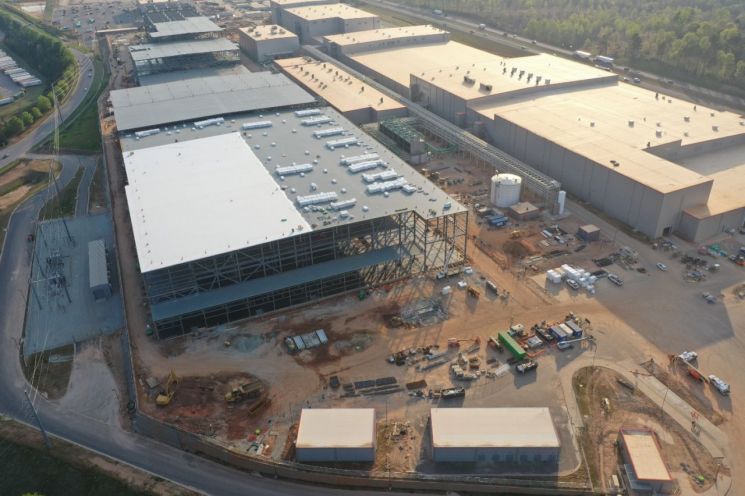 Exterior view of SK Battery plants 1 and 2 in Georgia, USA. There is remaining land available for building additional plants.
 Initially, joint ventures between Hyundai Motor Group and domestic battery companies were expected to proceed with some flexibility. This was because SK and LG have been pursuing joint venture plans with local automakers over the past 2-3 years, making it difficult to secure funds, organization, and manpower. The timeline has been accelerated due to the Inflation Reduction Act. Hyundai Motor needs to advance the timing of local electric vehicle production, and localization of batteries is essential due to transportation and logistics costs. Battery raw materials must also comply with the standards set by the U.S. Inflation Reduction Act.
Hyundai Motor's mid-to-long-term sales target for electric vehicles is 830,000 units in the U.S. alone by 2030. The dedicated electric vehicle plant scheduled to start operation in 2025 has an annual capacity of 300,000 units. Even considering additional expansions, new electric vehicle production lines must be established not only at the existing Alabama (Hyundai) and Georgia (Kia) plants but also at the Mexico plant (Kia).
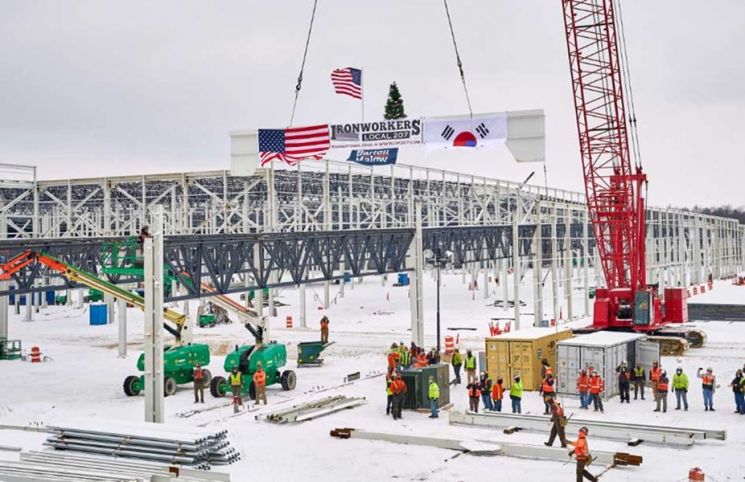
Battery supply is considered critical because if the current pace of electric vehicle adoption continues, a supply shortage is expected within 2 to 3 years. To locally source batteries for the 830,000 electric vehicles targeted by Hyundai Motor and Kia, a mass production system with an annual capacity of over 60 GWh is required. Considering that a large-scale battery cell plant typically has an annual capacity of about 20 GWh, it is estimated that Hyundai Motor will need at least three joint venture plants to secure a stable battery supply.
As sites for joint venture plants, the southeastern U.S., including Georgia where a new electric vehicle plant is being established, is the top choice. The southeastern region of South Carolina, adjacent to Georgia, is also mentioned as a candidate. In the mid-to-long term, Hyundai Motor Group is reportedly considering establishing a plant in the U.S. Midwest, such as Indiana, with an eye on sales to other automakers that have local plants. A Hyundai Motor Group official stated, "Nothing has been decided yet."
© The Asia Business Daily(www.asiae.co.kr). All rights reserved.
![Clutching a Stolen Dior Bag, Saying "I Hate Being Poor but Real"... The Grotesque Con of a "Human Knockoff" [Slate]](https://cwcontent.asiae.co.kr/asiaresize/183/2026021902243444107_1771435474.jpg)


















