Professor Kim Jong-seung's Team at Jeonbuk National University Hospital
Research Utilizing HIRA Health Care Big Data
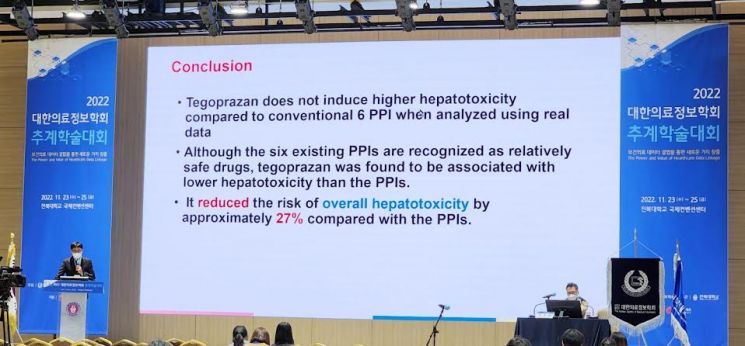 Professor Kim Jong-seung from the Department of Otorhinolaryngology at Jeonbuk National University is presenting research findings at the Autumn Academic Conference of the Korean Society of Medical Informatics. (Photo by HK Innoen)
[Asia Economy Reporter Chunhee Lee] Research results comparing the liver toxicity risks of HK Innoen's potassium-competitive acid blocker (P-CAB) class gastroesophageal reflux disease (GERD) new drug 'K-CAB' and proton pump inhibitor (PPI) class products have been released.
HK Innoen announced on the 28th that it presented the results of a study titled "Comparison of Liver Toxicity Risks between P-CAB and PPI: A Follow-up Cohort Study," which compared the liver toxicity risks of the P-CAB class K-CAB and other PPI class products, at the 2022 Fall Academic Conference of the Korean Society of Medical Informatics held over three days from the 23rd to the 25th at Jeonbuk National University Convention Center. The presentation was led by Professor Jongseung Kim of the Department of Otorhinolaryngology at Jeonbuk National University Hospital, who spearheaded the study.
Professor Kim’s research team utilized big healthcare data from the Health Insurance Review and Assessment Service (HIRA) to compare the risks of liver function damage caused by drugs used to treat gastroesophageal reflux disease. The results showed that K-CAB tablets had a 27% lower risk of liver toxicity compared to other PPI class drugs.
The research team extracted patient data from the HIRA database for those who were continuously prescribed K-CAB of the P-CAB class or six types of PPI drugs for more than two months between January 2019 and December 2020, analyzing the prevalence of liver disease and various risk factors for liver toxicity. Out of a total of 6,487,583 cases, to increase the reliability of the results, variables that could affect outcomes such as antibiotic use history and age were matched under identical conditions, resulting in a final analysis of 1,737,176 cases.
By reaffirming the safety of K-CAB compared to existing PPI class products through big data accumulated in actual prescription environments, it is expected that various big data studies verifying the safety and efficacy of new drugs will continue to be conducted.
Professor Jongseung Kim, who conducted this study, commented, "While existing P-CAB class drugs had liver toxicity issues, this study showed that K-CAB has relatively lower liver toxicity. This research was conducted using real-world data (RWD) from the entire population to investigate drug side effects, and meaningful conclusions were drawn through relatively rapid data access and analysis despite it being a new drug."
© The Asia Business Daily(www.asiae.co.kr). All rights reserved.

















