No Negotiation Results... Traffic and Logistics Crisis Inevitable
Freight Solidarity and Government Tense Ahead of Talks
Union: "Unprecedented Lack of Communication in Any Previous Government"
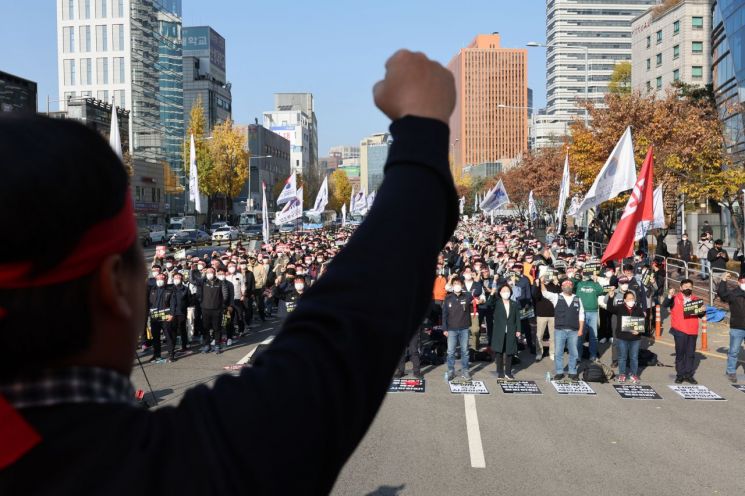 Members of the Seoul Regional Headquarters of the National Railway Union held a general strike resolution rally near Seoul Station on the 18th, demanding the reinforcement of safety personnel and the resignation of the Minister of Land, Infrastructure and Transport.
 [Image source=Yonhap News]
The railway and subway unions, which had engaged in lawful struggle, are escalating their level of protest by announcing a general strike. The Cargo Solidarity is making it even more difficult to find a solution, engaging in a war of nerves with the government even before negotiations begin.
The Seoul Metro Union, which operates subway lines 1 to 8 and part of line 9 (Sinnonhyeon to Jungang Veterans Hospital), has announced that it will launch a general strike starting with the day shift on the 30th. Since the 24th, the Seoul Metro Union has been conducting lawful struggle by stopping trains for more than 30 seconds, breaking away from the previous practice of ignoring safety rules, in protest against the management's workforce reduction plan. Although negotiations were held with management afterward, there was no significant progress, leaving the union no choice but to proceed with a general strike, according to the union. The Seoul Metro Union will negotiate again on that day, but if there is no outcome, it will lead to a general strike.
If Seoul Metro proceeds with the general strike, a traffic chaos during the morning commute is inevitable. Only the essential personnel designated by the union will work, while all other members will participate in the strike. After the general strike, the weekday operation rate of Seoul Subway Line 1 is expected to be only 53.5%. On weekends, the operation rate of Seoul Subway Lines 1 to 9 will drop to 50%. Due to the lawful struggle continuing until the 29th, the operation of Lines 1 and 3 during commuting hours is delayed by about 15 minutes.
The National Railway Union, which includes the KORAIL union, has also started lawful struggle, refusing to participate in overtime work and causing disruptions in train operations. The proportion of KORAIL-operated trains is about 80% on Line 1, 25% on Line 3, and 30% on Line 4. If the Railway Union launches a full strike, disruptions are expected in the operation of KTX and Mugunghwa trains. Although the lawful strike by the Railway Union has allowed metropolitan subway and KTX to operate normally, some regular trains such as Mugunghwa and Saemaeul were delayed by an average of over 30 minutes, with the longest delay reaching 98 minutes.
These labor and management parties have failed to narrow differences over issues such as the revision of ordinary wages and management innovation plans. The Seoul Metro Union demands that management withdraw the restructuring plan to reduce about 1,500 personnel by 2026 and expand safety personnel. The National Railway Union claims, "We demanded the withdrawal of railway privatization policies, operation of KTX to Suseo, integration of high-speed rail, and establishment of a fair promotion system, but the government is considering reducing more than 1,000 personnel." Lee Jeong-sik, Minister of Employment and Labor, criticized the unions, saying, "If the railway and subway unions proceed with the announced strike, it will only increase damage caused by disruptions in transportation and logistics."
Government hints at work commencement order... Cargo Solidarity protests
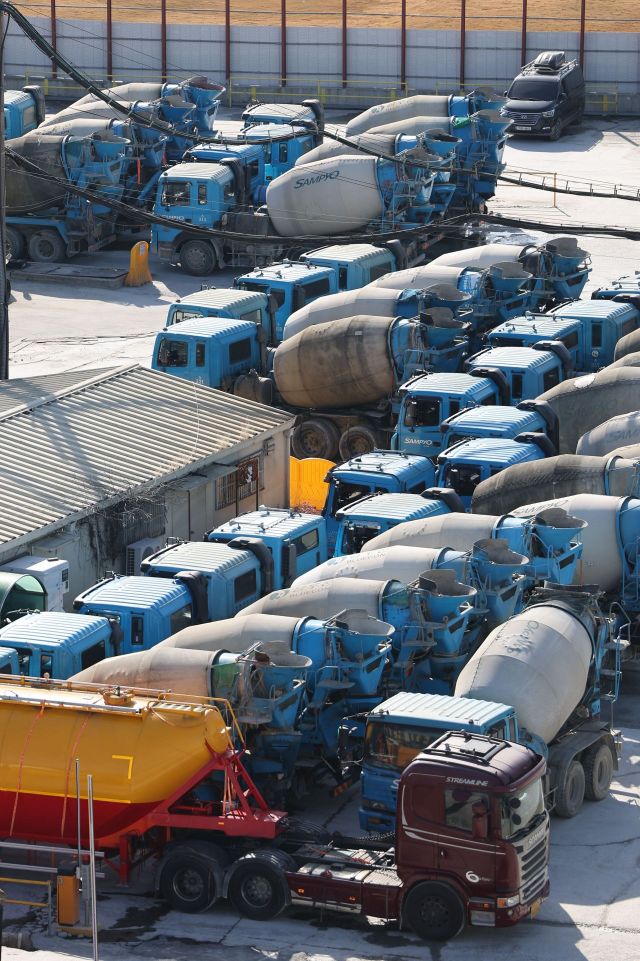 On the fourth day of the Cargo Solidarity general strike on the 27th, a ready-mix concrete truck is parked at a ready-mix concrete plant in Seoul. [Image source=Yonhap News]
The Cargo Solidarity is in an even more difficult situation to find a solution. On that day, the Ministry of Land, Infrastructure and Transport (MOLIT) and the Cargo Solidarity engaged in a war of nerves even before negotiations began. On the 26th, MOLIT announced that Deputy Minister Eo Myeong-so and Cargo Solidarity Chairman Lee Bong-ju would have a tea meeting before negotiations. In response, the Cargo Solidarity protested, saying that MOLIT unilaterally announced a schedule that was not previously agreed upon, calling it "an act of disrespect that does not recognize Cargo Solidarity as a dialogue partner."
The Cargo Solidarity also did not hide its discomfort regarding the government's work commencement order. On the 26th, Minister of Land, Infrastructure and Transport Won Hee-ryong stated, "We have completed practical preparations to issue the work commencement order immediately if necessary." If the work commencement order is issued, it will be the first case since its introduction in 2004. The Cargo Solidarity criticized, "Minister Won has been threatening daily by mentioning the work commencement order from the first day of the general strike, blatantly belittling the status of negotiations by calling them mere talks rather than negotiations."
The labor community blamed the government and ruling party for not engaging in dialogue. The Korean Confederation of Trade Unions Public Transport Workers' Union stated, "The response of the President and the government and ruling party after the unions' joint strike is disappointing," adding, "It is a lack of communication and arrogance rarely seen in previous governments. If you truly want to resolve this through dialogue, respond to the talks."
© The Asia Business Daily(www.asiae.co.kr). All rights reserved.


















