[Asia Economy Reporter Lee Gwan-joo] A study has shown that patients with intractable epilepsy accompanied by mitochondrial dysfunction can safely undergo epilepsy surgery.
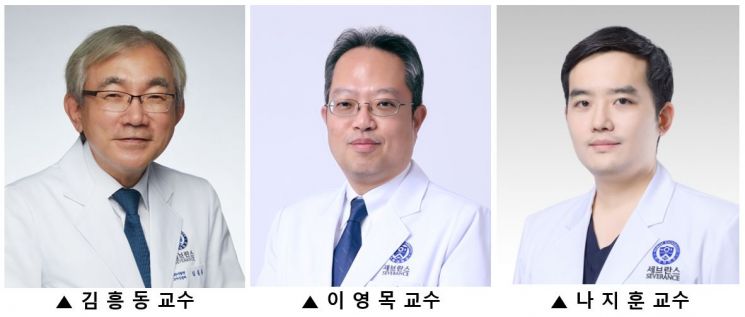
Professor Kim Heung-dong of the Department of Pediatric Neurology at Severance Hospital, along with Professors Lee Young-mok and Na Ji-hoon of the Department of Pediatrics and Adolescents at Gangnam Severance Hospital, announced on the 28th that they successfully and safely applied corpus callosotomy, a representative palliative epilepsy surgery, to patients with intractable epilepsy accompanied by mitochondrial dysfunction.
The research team compared the effectiveness and safety of corpus callosotomy in patients with intractable epilepsy accompanied by mitochondrial dysfunction by comparing surgical outcomes between patients with and without mitochondrial dysfunction. Corpus callosotomy is a representative palliative epilepsy surgery that involves severing the corpus callosum, the connection between the two cerebral hemispheres, to reduce the frequency and intensity of seizures when the epileptic focus is not clearly identifiable.
The research team first analyzed 20 pediatric patients with intractable epilepsy who underwent corpus callosotomy at Severance Hospital between 2007 and 2015. Among them, 10 patients had mitochondrial dysfunction, and the other 10 did not.
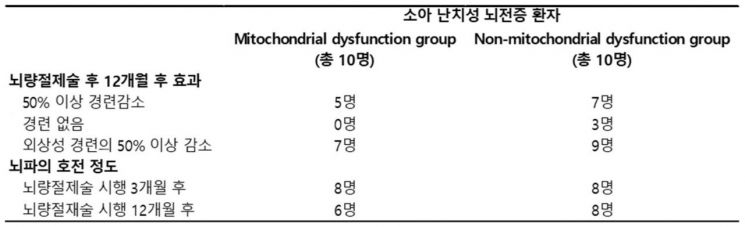
To evaluate treatment effectiveness, seizure reduction and EEG improvement were examined. The proportion of patients showing more than a 50% reduction in seizures 12 months after surgery was 50% in the mitochondrial dysfunction group and 70% in the control group, with no statistically significant difference, indicating excellent surgical outcomes in both groups. Additionally, the rates of EEG improvement 12 months post-surgery were 60% and 80%, respectively, demonstrating the excellent EEG improvement effect of corpus callosotomy in both groups.
No serious side effects occurred after corpus callosotomy. Patients safely recovered through intensive care for two weeks post-surgery. This result demonstrates the safety of corpus callosotomy performed on patients with mitochondrial dysfunction.
Professor Na stated, "It was generally considered contraindicated for pediatric patients with intractable epilepsy accompanied by mitochondrial dysfunction to undergo treatments with high energy demands such as surgery, as they were thought to be difficult and risky. Through this study, we have shown that patients with mitochondrial dysfunction can safely undergo corpus callosotomy and improve intractable epilepsy."
This research was published in the international journal Therapeutic Advances in Neurological Disorders.
© The Asia Business Daily(www.asiae.co.kr). All rights reserved.


















