Emergency Macroeconomic and Financial Meeting
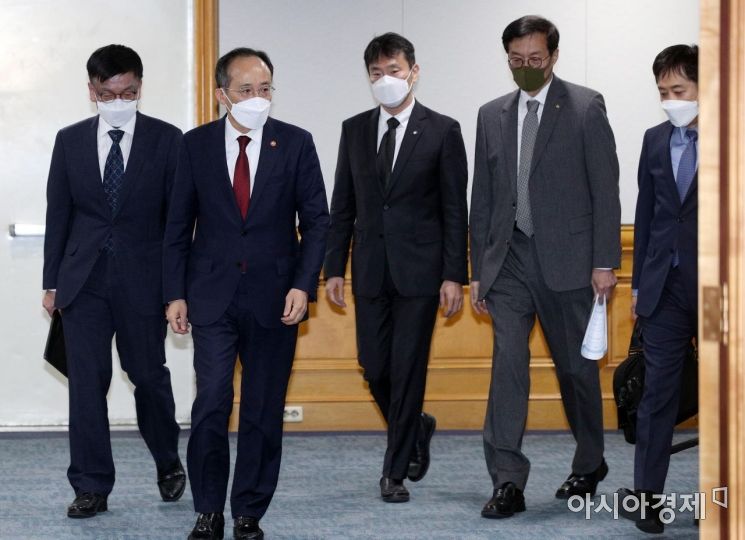 Deputy Prime Minister and Minister of Economy and Finance Choo Kyung-ho, along with heads of financial authorities, are attending the Emergency Macroeconomic and Financial Meeting held on the 28th at the Bankers' Hall in Jung-gu, Seoul. From the left, Chief Secretary for Economic Affairs Choi Sang-mok, Deputy Prime Minister Choo, Financial Supervisory Service Governor Lee Bok-hyun, Bank of Korea Governor Lee Chang-yong, and Financial Services Commission Chairman Kim Ju-hyun. Photo by Kim Hyun-min kimhyun81@
[Asia Economy Reporter Moon Jiwon] As corporate paper (CP) interest rates have recently surged sharply and short-term liquidity in the market and companies has deteriorated, the government and the Bank of Korea have announced additional measures. They will conduct an additional capital call for the 5 trillion won-scale Bond Market Stabilization Fund (BMSF) and drastically reduce the amount of government-issued treasury bonds to ease the burden on the bond market. In addition to the 6 trillion won repurchase agreement (RP) purchases announced last month, the Bank of Korea plans to provide liquidity support of up to 2.5 trillion won.
Deputy Prime Minister and Minister of Economy and Finance Choo Kyung-ho and Bank of Korea Governor Lee Chang-yong held an emergency macroeconomic and financial meeting on the morning of the 28th at the Bankers’ Hall in Jung-gu, Seoul, to discuss financial market stabilization policies. The meeting was attended by Deputy Prime Minister Choo, Governor Lee, Financial Services Commission Chairman Kim Joo-hyun, Financial Supervisory Service Governor Lee Bok-hyun, and Presidential Secretary for Economic Affairs Choi Sang-mok. This marks the second time in just a month that the heads of finance and economy have convened since the meeting on the 3rd.
At the meeting, the government reviewed the follow-up measures and implementation status of the '50 trillion won + α' market stabilization plan announced on the 23rd of last month and discussed future policy directions. The Ministry of Economy and Finance judged that although some uncertainties have improved, such as the decline in corporate bond interest rates since the last measures, the short-term funding market remains unstable. In particular, due to continued interest rate hikes, market funds are excessively concentrated in the banking sector, causing significant differences in funding conditions across industries. With expected interest rate hikes in major countries including the U.S. within the year, sluggish real estate markets, and year-end settlements remaining, there is a possibility that financial market instability could further expand.
Accordingly, the government and the Bank of Korea announced additional measures on the day to reduce financial risk factors at year-end and early next year and to expedite stabilization of the short-term financial market. First, they plan to expand the purchasing capacity of policy support programs such as the Bond Market Stabilization Fund and corporate bond and CP purchase programs to support liquidity improvement for the market and companies.
The government decided to reduce the originally planned treasury bond issuance amount of 9.5 trillion won next month to less than half, issuing only 3.8 trillion won to ease the burden on the bond market. Along with this, public institutions such as Korea Electric Power Corporation and Korea Gas Corporation will work with banks to reduce bond issuance volumes, stagger issuance timing, and convert to bank loans.
The BMSF will conduct a second capital call of 5 trillion won following the first capital call of 3 trillion won. To reduce the burden on contributing financial companies, the capital call will be implemented in installments from next month through January of next year. Additionally, further support measures will be considered for non-investment grade corporate bonds related to real estate project financing (PF) and construction, as well as A2-rated CP.
The Bank of Korea plans to provide liquidity support of up to 2.5 trillion won, within 50% of the capital contributions, to financial companies participating in the BMSF’s second capital call through RP purchases. This liquidity support is separate from the 6 trillion won RP purchases announced on the 27th of last month and will be conducted through 91-day RP purchases with 83 contributing financial companies. The Bank of Korea also plans to expand RP purchases further next month.
Earlier, Governor Lee stated at a press conference following the Monetary Policy Committee meeting on the 24th, "The concentration in the short-term funding market and asset-backed commercial paper (ABCP) related to real estate is still somewhat excessive," adding, "If necessary, additional policies can be implemented, and in that case, the Bank of Korea will play its role."
The government will expedite the execution of corporate bond and CP purchase programs by Korea Development Bank, Industrial Bank of Korea, and Korea Credit Guarantee Fund, as well as securities company CP purchases and securities and construction company guaranteed PF-ABCP programs. The securities company guaranteed PF-ABCP purchase program began purchases on the 24th, and the construction company PF-ABCP purchase program will start purchases this week.
For the Industrial Bank of Korea’s securities company-issued CP purchase program, the review period will be shortened from the existing 10 days to 5 days to accelerate purchases, and burdens will be reduced by extending maturities when purchasing CP rollover items through policy support programs. Additionally, the government will implement regulatory easing measures such as excluding 11 types of loans funded by government funds from loan-to-deposit ratio calculations to secure banks’ loan-to-deposit ratio capacity and suspending the application of retirement pension borrowing limits until the end of March next year.
The Ministry of Economy and Finance plans to expand the PF guarantee scale by 5 trillion won and newly establish a 5 trillion won-scale guarantee for unsold PF loans to ensure stable progress of real estate PF projects preparing for pre-sale, given the recent instability in the real estate market. These will be implemented early from January next year. Additional real estate regulatory easing measures, such as reforming the registered rental business system and improving reconstruction safety inspections, will also be pursued within this year.
© The Asia Business Daily(www.asiae.co.kr). All rights reserved.

















