Vote Share 94.9% ... At 80 This Year, Will Serve as President for 7 More Years
Seized Power by Ousting Uncle in 1979 Coup ... Oppressed Opponents and Corruption Also Present
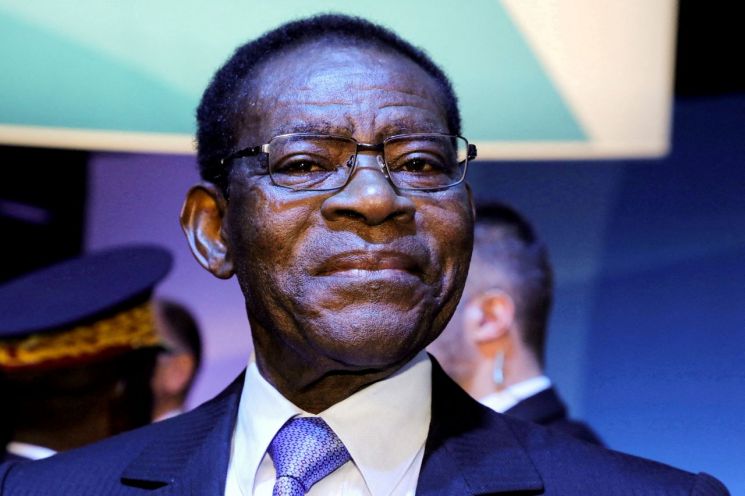 The world's longest-serving leader, Teodoro Obiang Nguema Mbasogo, President of Equatorial Guinea, who has successfully achieved six terms in office. Photo by Reuters Yonhap News
[Asia Economy Reporter Kim Hyunjung] President Teodoro Obiang Nguema Mbasogo of Equatorial Guinea, who has ruled the country for 43 years since coming to power through a coup in 1979, has succeeded in securing a sixth term.
According to foreign media including AFP on the 26th (local time), President Obiang was re-elected with 94.9% of the vote and will serve as president for another seven years. On this day, the Equatorial Guinea Electoral Commission announced that the voter turnout for the election held on the 20th was 98%. Obiang, who is 80 years old this year, is the longest-serving head of state in the world excluding monarchs. During the six presidential elections held, he has never officially been re-elected with less than 93% of the vote. In the last presidential election in 2016, he received 93.7% of the vote.
Having ruled for over 40 years, President Obiang is Equatorial Guinea's 'second' president. He led a coup to overthrow his uncle, Francisco Nguema, the first president, and had him executed by firing squad. Since then, he has maintained long-term rule by suppressing opposition forces and thwarting a series of coup attempts.
In this election, President Obiang faced two opposition candidates. From the outset, the opposition and the international community did not expect the election to be conducted fairly. Andres Esono Ondo, the candidate from the opposition Convergence for Social Democracy (CPDS), claimed in a phone interview with foreign media that the election was a "complete fraud," stating that there was evidence of electoral fraud such as proxy voting and voter intimidation. The United States and the European Union (EU) also criticized the Obiang regime for corruption, long-term dictatorship, and human rights abuses, demanding a fair election, but Obiang's side rejected this, calling it election interference. Alongside the presidential election, a general election was also held in Equatorial Guinea, in which the ruling party, the Democratic Party of Equatorial Guinea (PDGE), swept all the seats. The vote percentages for the two opposition presidential candidates were not announced. Regarding the election results, Teodoro Obiang Nguema Mangu, Vice President and son of President Obiang, wrote on his Twitter, "History repeats itself. We will continue to prove that we are a great party."
Equatorial Guinea was under Spanish colonial rule for nearly 200 years before gaining independence in 1968. With the discovery of offshore oil in the mid-1990s, Equatorial Guinea became the third richest country in Sub-Saharan Africa by per capita income in 2021, but wealth is concentrated in the hands of a few, including President Obiang's family. According to the World Bank, during the height of the oil boom in 2006, more than three-quarters of Equatorial Guinea's population lived in extreme poverty on less than $1.90 (about 2,500 won) per day, and no new figures have been released since then. Equatorial Guinea, a member of the Organization of the Petroleum Exporting Countries (OPEC), once boasted abundant crude oil production but has seen a sharp decline. The country is also notorious for corruption, ranking 172nd out of 180 countries in Transparency International's 2021 Corruption Perceptions Index.
© The Asia Business Daily(www.asiae.co.kr). All rights reserved.

















