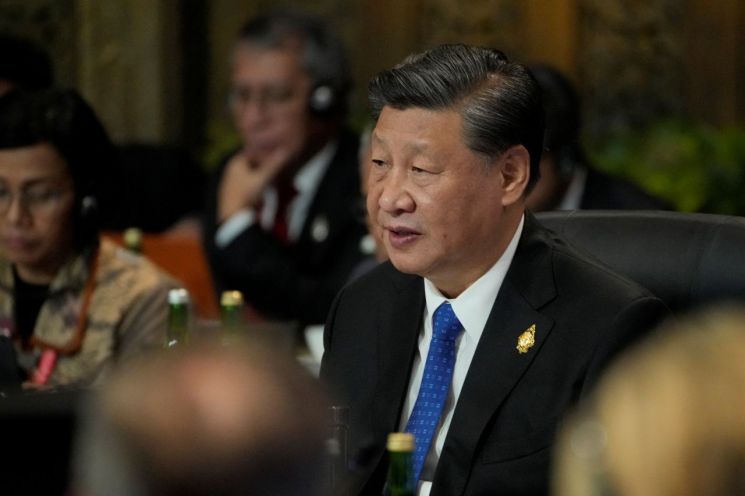
 Chinese President Xi Jinping is speaking at the G20 Summit held on the 15th (local time) in Nusa Dua, Bali, Indonesia.
 [Image source=Yonhap News]
The Bank of Korea explained that China’s 'Zero-COVID' lockdown policy is unlikely to end early as the market expects, and it is expected to be gradually lifted starting from the second quarter of next year.
On the 27th, the Bank of Korea announced this through its Overseas Economic Focus report titled 'Assessment of the Possibility of Early Termination of China’s Zero-COVID Policy.'
The Chinese authorities are implementing a stringent Zero-COVID lockdown policy to prevent the spread of COVID-19. Since the closing of the 20th National Congress of the Communist Party on the 22nd of last month, expectations for an early end to the Zero-COVID policy have been growing, especially in financial markets.
On the 1st, rumors spread on Twitter that the Chinese government would form a 'Reopening Committee' in March next year, and these expectations grew further after the Chinese government allowed large-scale sports events on the 11th and announced relaxed quarantine measures.
Accordingly, stock markets in China and Hong Kong surged sharply earlier this month, and the won-dollar exchange rate plummeted. Since China is South Korea’s largest export market, the easing of lockdown policies significantly impacts the Korean economy.
However, the Bank of Korea explained that considering all conditions, the possibility of China ending the Zero-COVID policy in the near term is low.
The reasons for this assessment include the recent sharp increase in new COVID-19 cases in China and the still limited medical capacity.
Since mid-last month, China’s infection reproduction number has consistently exceeded 1, indicating a high likelihood that the spread will continue for some time. In particular, there is a burden regarding full-scale easing of quarantine measures due to the large-scale movement during the Lunar New Year holiday early next year.
Also, the stagnation in the third-dose vaccination rate among the elderly aged 60 and above acts as an obstacle to the early termination of the lockdown policy. Because there is a significant gap in medical services between urban and rural areas in China, if the spread intensifies in rural areas, the damage could be greater compared to urban areas.
An earlier-than-expected end to the Zero-COVID policy could be interpreted as a policy failure by President Xi Jinping, which may become a political burden. Therefore, despite sluggish economic indicators such as declining exports, the policy is expected to continue for the time being.
The Bank of Korea stated, "The Zero-COVID policy is unlikely to end early as some market participants expect, and it is expected to be gradually lifted from the second quarter of next year." It added, "However, since the Politburo Standing Committee mentioned 'minimizing economic impact,' a policy shift toward precision epidemic control is expected to continue."
It also added, "It is necessary to remain vigilant about the possibility of switching to large-scale lockdowns like the Shanghai lockdown in April if the spread of the infectious disease goes beyond control," noting that "recently, some local governments such as Beijing have reinstated quarantine measures equivalent to lockdowns, indicating rising tension."
© The Asia Business Daily(www.asiae.co.kr). All rights reserved.
![Clutching a Stolen Dior Bag, Saying "I Hate Being Poor but Real"... The Grotesque Con of a "Human Knockoff" [Slate]](https://cwcontent.asiae.co.kr/asiaresize/183/2026021902243444107_1771435474.jpg)
















