2022 Fall Conference of the Korean Society of Digital Therapeutics
Jaejin Kim "The First DTx Will Be Released Soon... Insomnia DTx"
[Asia Economy Reporter Lee Chun-hee] As the country's first digital therapeutic (DTx) is expected to be released soon, discussions on the next steps of reimbursement and commercialization are gradually advancing. Academia and industry experts suggest that to effectively enter the market, it is essential to enhance the acceptance of patients and care providers based on 'patient-centeredness.'
At the '2022 Autumn Academic Conference of the Korean Society of Digital Therapeutics' held on the 25th at Korea University Hana Square in Seongbuk-gu, Seoul, Kim Jae-jin, president of the Digital Therapeutics Society and professor of psychiatry at Gangnam Severance Hospital, stated, "The first DTx is expected to be released soon with an insomnia DTx," emphasizing, "For DTx to be widely used, its effectiveness must be certain and verifiable, and no matter how effective it is, if it is not commercialized, it cannot be disseminated, so commercialization is crucial." Currently, Aimmed, which is developing the insomnia DTx 'Somz,' has applied for product approval from the Ministry of Food and Drug Safety, and Welt, developing 'PillowRx,' has completed confirmatory clinical trials and is accelerating the approval process, making it highly likely that the first domestic DTx approval will be granted within this year.
However, even after receiving approval from the Ministry of Food and Drug Safety, there are still many hurdles to overcome for actual commercialization. In Korea, where a strong public insurance system called National Health Insurance is established, entering reimbursement is synonymous with market entry. The government is likely to adopt a method of applying the innovative medical technology evaluation track to prioritize market entry and then proving effectiveness compared to standard treatment using real-world data (RWD), but passing through this process is expected to take considerable time.
Recognition of DTx Value Must Start from Patient-Centeredness
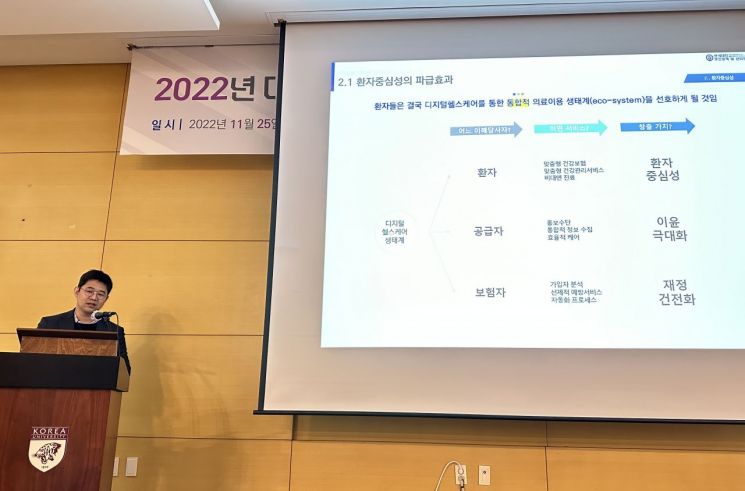 On the 25th, at Korea University Hana Square in Seongbuk-gu, Seoul, Shin Jae-yong, professor of the Department of Preventive Medicine at Yonsei University (CEO of Evertry), is presenting at the "2022 Autumn Academic Conference of the Korean Digital Therapeutics Society." / Photo by Lee Chun-hee
Professor Shin Jae-yong of the Department of Preventive Medicine at Yonsei University and CEO of Evertry said that to properly evaluate the value of DTx, it is necessary to move away from traditional medical service evaluation methods. He explained, "If face-to-face psychological counseling costs 100,000 KRW per week and yields an effectiveness of 100, and DTx costs 10,000 KRW per week with an effectiveness of 30, the existing treatment is superior in terms of effectiveness," but added, "However, DTx can provide specialized treatment 24 hours a day, and its cost-effectiveness is better."
Professor Shin emphasized that "the most important keyword, though it may sound clich?, is 'patient-centeredness.'" Accordingly, he stressed that the effects of DTx should be recognized beyond simple medical cost savings to include secondary benefits such as improved labor productivity, similar to Germany's Digital Health Applications (DiGA). Regarding insomnia DTx, he estimated that "if used for patients in their 50s, the expenditure would be 13 billion KRW, while direct medical cost savings would only be 680 million KRW," explaining that "this structure would never pass the Health Insurance Policy Deliberation Committee." On the other hand, "labor productivity improvement amounts to 32.9 billion KRW," and he added, "It is necessary to consider the ripple effects of DTx more realistically, including labor productivity recovery through improvement of insomnia symptoms, rather than just simple medical effects and cost savings, to achieve a smooth landing."
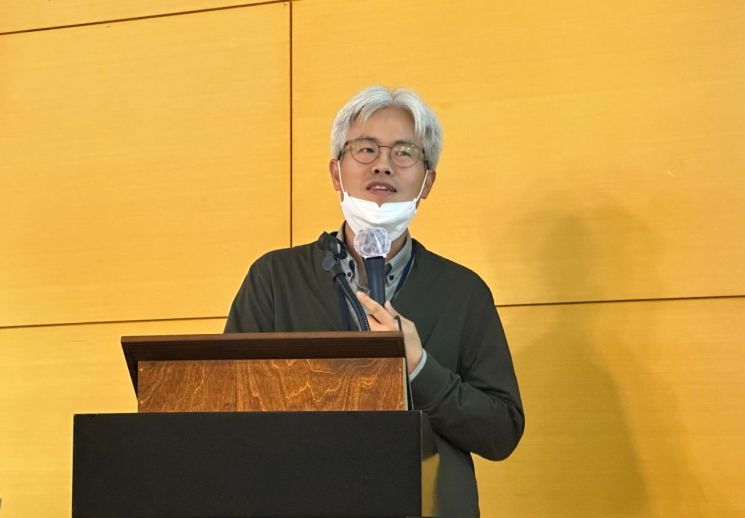 On the 25th, at Korea University Hana Square in Seongbuk-gu, Seoul, Lee Sang-yeol, Director of Kyung Hee Digital Health Center (Professor of Endocrinology and Metabolism at Kyung Hee University Hospital), is presenting at the '2022 Korean Digital Therapeutics Society Autumn Academic Conference.' / Photo by Lee Chun-hee
Lee Sang-yeol, director of the Kyung Hee Digital Health Center and professor of endocrinology and metabolism at Kyung Hee University Hospital, shared similar concerns. He said, "Although it is often said that DTx has no side effects, requires less development time and cost, allows real-time monitoring, and has high medication adherence, as a physician, I am cautious about fully agreeing."
Director Lee mentioned that various achievements have been made through digital health solutions, from patient and caregiver educational content on YouTube to blood sugar control in diabetic patients using digital twins, but "in reality, it is not often said to be as effective as expected," and "from a physician's perspective, one might wonder, 'Should I just prescribe one more medication?'" He emphasized that "clinical results are necessary" to overcome this situation. To be used in conjunction with actual medical services, effectiveness must be proven by securing RWD from many users.
No Usability Means 'No Go'... UI/UX Must Consider Target Users
During the presentation, there was also a discussion on what aspects should be considered when developing DTx for different users to verify more effective RWD of DTx.
Professor Hong Hwa-jung of the Department of Industrial Design at the Korea Advanced Institute of Science and Technology (KAIST), who is developing DTx for children and adolescents with autism spectrum disorder, said that since caregivers often use DTx together with children and adolescents, this should be taken into account. Professor Hong stated, "What is important in DTx is not only usability but also user experience (UX)," and emphasized the need to continuously explore what value it can provide. In several apps under development, efforts are being made to secure digital literacy of families and introduce mutual evaluation tools between parents and children, enabling not only the target users but also their families to participate together.
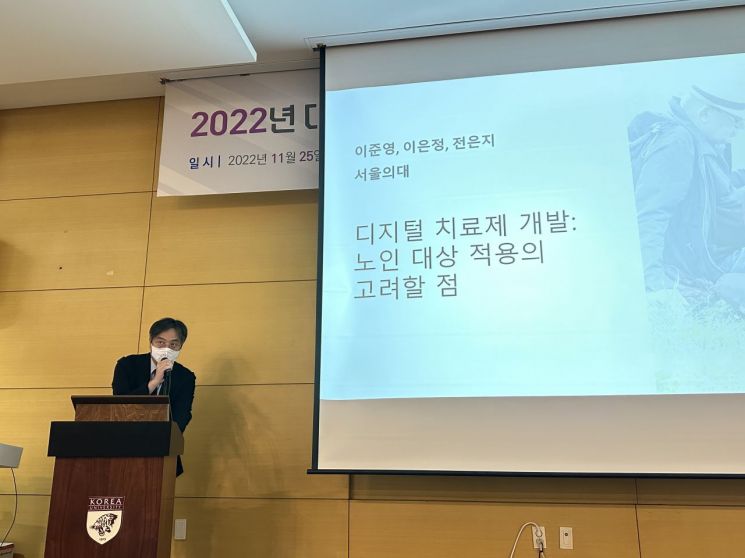 On the 25th, at Korea University Hana Square in Seongbuk-gu, Seoul, Lee Jun-young, professor of psychiatry at Boramae Medical Center, Seoul National University College of Medicine (co-CEO of Imocog), is presenting at the "2022 Autumn Academic Conference of the Korean Digital Therapeutics Society." / Photo by Lee Chun-hee
Lee Jun-young, CEO of Imocog and developer of 'Cogthera,' a DTx for mild cognitive impairment (MCI) mainly occurring in the elderly, said, "Initially, only about 20% of users could use the app," and lamented, "With memory decline due to MCI, learning becomes difficult, so there was much concern about how to make it usable." He emphasized that to solve this, apps must be made as accessible and simple to operate as possible. For example, all complex gestures such as double tap and swipe are excluded and unified to tap (single tap), automatic correction is applied even if input is incorrect, and related information is displayed at a glance with minimal input. He added that through such optimization, they succeeded in increasing the proportion of usable users from about 20% to approximately 85%.
© The Asia Business Daily(www.asiae.co.kr). All rights reserved.

![Clutching a Stolen Dior Bag, Saying "I Hate Being Poor but Real"... The Grotesque Con of a "Human Knockoff" [Slate]](https://cwcontent.asiae.co.kr/asiaresize/183/2026021902243444107_1771435474.jpg)

















