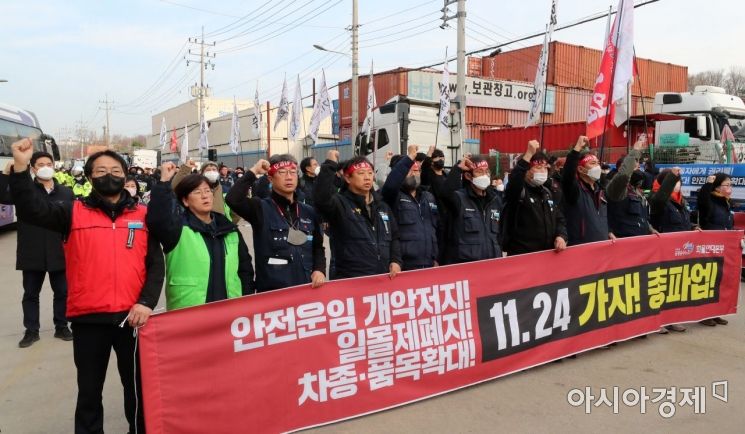
 On the 24th, when the Cargo Solidarity Union began an indefinite general strike, members of the Cargo Solidarity Union held a send-off ceremony near the Uiwang Inland Container Terminal in Gyeonggi-do. Photo by Dongju Yoon doso7@
This year, frequent strikes have filled the construction industry with 'strike fatigue.' The conflict mainly occurs between labor groups and the government, and since issues like wages and safety are difficult for either side to compromise on, sharp breakthroughs are not easily forthcoming. In particular, the recent Cargo Solidarity Union strike is escalating into a standoff. Since this situation benefits no one in the long term, there are calls to reduce tension and pressure by establishing a permanent tripartite consultative body and to initiate dialogue first.
According to the construction industry on the 25th, labor-related issues such as work stoppages and strikes have occurred unusually often this year. In March, the rebar and concrete industries carried out a nationwide 'shutdown' at construction sites, and at the end of April, companies in the Honam and Jeju regions stopped work at all construction sites. In June, subcontractors for rebar and concrete in the Busan, Ulsan, and Gyeongnam regions conducted shutdowns demanding increased construction costs. The Korean Confederation of Trade Unions (KCTU) Construction Union mobilized 40,000 members on the 22nd in front of the National Assembly to demand the enactment of a special construction safety law and began a sit-in protest. Logistics disruptions are also recurring. The Cargo Solidarity Union Headquarters of the KCTU, currently on strike demanding the abolition of the sunset clause on the Safe Freight Rate System and the expansion of applicable vehicles and items, also conducted an eight-day strike in June.
This year’s intense relay strikes are evaluated as a result of intertwined domestic and international issues such as COVID-19, global inflation, and the Serious Accident Punishment Act. The COVID-19 pandemic cut off the supply of foreign labor, causing labor shortages, and the sharp rise in raw material prices has made business management difficult. Moreover, the Serious Accident Punishment Act, implemented this year, has increased safety management costs, placing a greater burden on employers.
The problem is that these issues are all structural problems that are not easily resolved in the short term. A representative from the Korea Research Institute for Human Settlements said, "The ongoing strikes and related problems this year concern wages and working conditions, so temporary solutions are difficult, and a long-term approach is inevitable." As the Cargo Solidarity Union has entered a re-strike within just five months, it is difficult to manage union risks with stopgap measures. Woo Sang-beom, former adjunct professor of business administration at Hanyang University, said, "The tripartite parties should form a permanent consultative body to seek solutions. Otherwise, the hardline standoff between labor and management will continue, and society will have to bear high social costs such as work stoppages and extended construction periods due to union rallies."
© The Asia Business Daily(www.asiae.co.kr). All rights reserved.

















