China's 2035 Electric Vehicle Sales Target of 50% Likely to Be Advanced by 3-5 Years
Automakers Compete for China's EV Market... Chip and Battery Prices Are Key
[Asia Economy Senior Reporter Cho Young-shin] It is forecasted that sales of new energy vehicles, including electric vehicles, in China will account for more than 35% of new car sales next year. Considering that China's annual new car sales volume is 26 million units, it is expected that more than 9 million new energy vehicles will be sold.
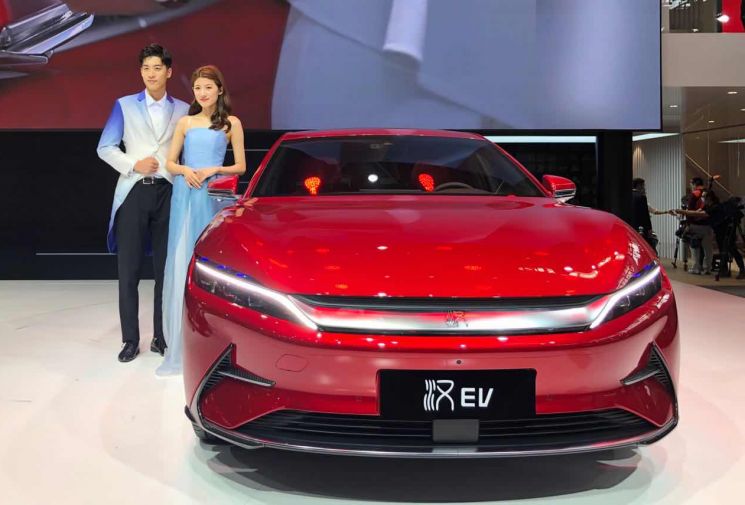
The South China Morning Post (SCMP) reported on the 25th, citing a report from international credit rating agency Fitch, that the share of new energy vehicles such as electric cars in China's new car sales will exceed 35% in 2023.
Fitch forecasted that the Chinese new energy vehicle market will continue to grow rapidly next year following this year, intensifying competition among automakers.
As of the end of October, the cumulative sales of new energy vehicles in China reached 5.28 million units, about double compared to the same period last year. The share of new energy vehicle sales also reached 24%. The dominant forecast is that by the end of the year, sales of new energy vehicles in China will approach 7 million units, reaching a 27% share. China set a goal through the 'New Energy Vehicle Technology Roadmap 2.0' in 2020 to expand the share of new energy vehicle sales to 25% by 2025, 40% by 2030, and 50% by 2035. If the current trend continues, the 50% target is expected to be achieved more than five years ahead of schedule.
Fitch added that the Chinese government's decision to end subsidy support policies for new energy vehicles at the end of this year is because demand has been met. It also stated that even if subsidy support policies for new energy vehicles are discontinued, China's new energy vehicle market will continue to grow steadily by more than 30% annually. China has implemented a tax exemption policy for new energy vehicles since 2017 to strengthen the competitiveness of the new energy vehicle industry, but this will be discontinued at the end of next month.
SCMP predicted that competition among existing automakers, new entrants, foreign brands, and Chinese domestic brands will become even more intense in the Chinese new energy vehicle market.
SCMP also expected that Chinese domestic brands such as BYD will seek differentiation by entering the premium new energy vehicle market in China and will also knock on the door of export markets such as Europe.
However, SCMP added that challenges will arise from the supply of automotive semiconductor chips and the increase in battery prices, which will lead to higher costs for new energy vehicles.
© The Asia Business Daily(www.asiae.co.kr). All rights reserved.
![Clutching a Stolen Dior Bag, Saying "I Hate Being Poor but Real"... The Grotesque Con of a "Human Knockoff" [Slate]](https://cwcontent.asiae.co.kr/asiaresize/183/2026021902243444107_1771435474.jpg)
















