Already prohibited under the Road Traffic Act
Full-scale enforcement following the Itaewon tragedy
Commuters suffer a 'living hell' amid the rush hour chaos
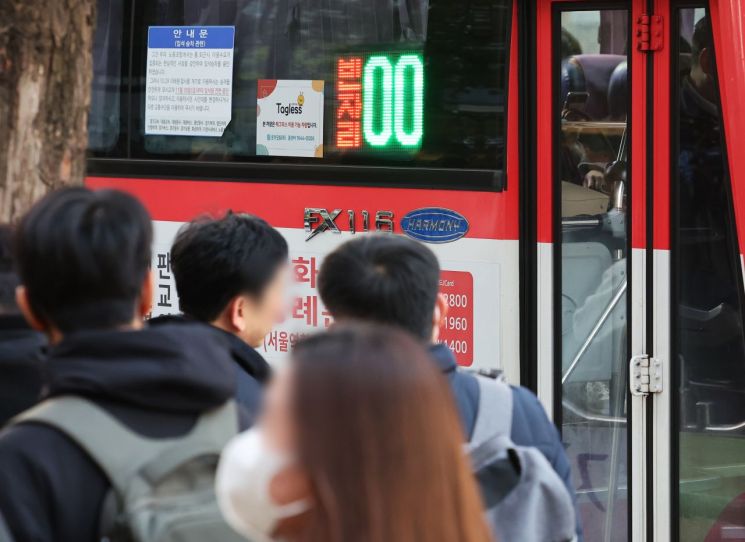
[Asia Economy Reporter Yoo Byung-don] Han Hyun-ji (25), an office worker commuting from Uiwang to Pangyo, faces a daily ordeal every morning. The 3330 express bus she usually takes to work is always full, forcing her to let 3 to 4 buses pass by each morning. Han has resorted to taking a city bus seven stops backward to transfer to an express bus, a situation that has persisted for four days. She lamented, “With standing passengers banned, my already tiring commute has become even more inconvenient.”
Son Ji-in (30), who uses the 7770 express bus from Suwon to Sadang, recently experienced a frustrating incident. After boarding near Jowon-dong, Jangan-gu, Suwon-si, Gyeonggi-do, she found no seats available and hesitated. The driver told her, “Standing passengers are not allowed,” and instructed her to get off and wait for the next bus. Although Son, pressed for time, insisted on standing, the driver said, “We miscounted,” and firmly refused standing passengers, returning her fare in cash, leaving her no choice but to disembark.
It has been a week since standing passengers were effectively banned on express buses in the Gyeonggi area, and complaints from citizens are pouring in. The lack of alternatives has left commuters without transportation options during rush hours.
Following the Itaewon tragedy on October 29, KD Transportation Group, which operates express buses in Gyeonggi Province, implemented a ban on standing passengers starting from the 18th. Although standing passengers on express buses were already prohibited under the Road Traffic Act, enforcement had been lax until the tragedy prompted strict compliance.
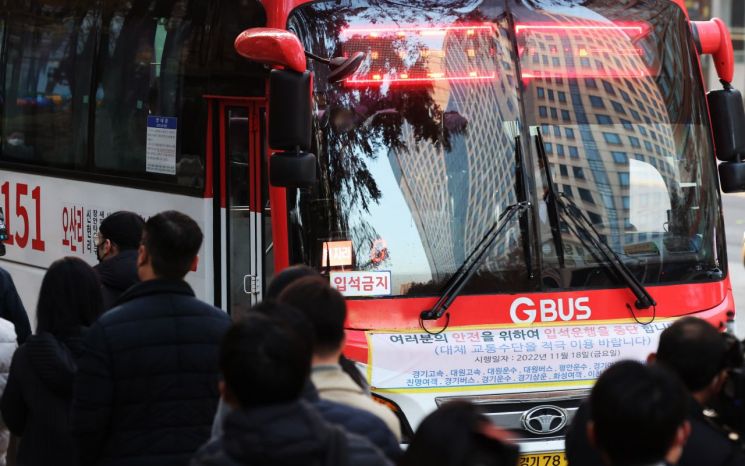
Previously, standing passengers were tacitly allowed during rush hours, but due to labor union legal strikes and enhanced safety measures following the Itaewon disaster, standing has now been completely restricted. As a result, standing is banned on a total of 146 routes, especially on 112 routes serving the Seoul metropolitan area, involving 1,123 buses. This accounts for 51% of all public bus routes in Gyeonggi Province.
However, the outright refusal to allow standing passengers without adequate alternatives has sparked complaints that commuters have lost their means of transportation during rush hours. Additionally, fierce competition to board buses has made the roads in front of crowded bus stops more dangerous.
The government and Gyeonggi Province plan to gradually increase bus supply to reduce confusion, but resolving the issue immediately is challenging due to shortages of both buses and drivers. Given that demand concentrates during rush hours while buses run with empty seats during off-peak hours, causing deficits, additional budget allocation is difficult. Earlier, Gyeonggi Province failed to present effective measures despite warnings from the bus industry about the suspension of standing passengers, only announcing plans to deploy 68 additional buses by early next year after the ban was enforced.
© The Asia Business Daily(www.asiae.co.kr). All rights reserved.
![Clutching a Stolen Dior Bag, Saying "I Hate Being Poor but Real"... The Grotesque Con of a "Human Knockoff" [Slate]](https://cwcontent.asiae.co.kr/asiaresize/183/2026021902243444107_1771435474.jpg)

















