Suspension of Cargo Solidarity Transport Refusal
Halt Amendment of Labor Union Act
Demands for Corporate Tax and Inheritance Tax Burden Relief
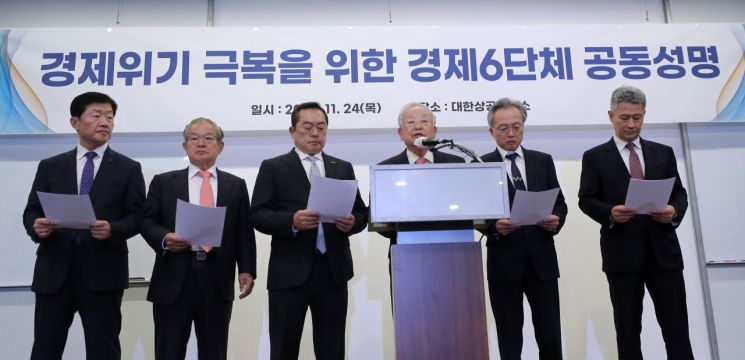 Son Kyung-sik, Chairman of the Korea Employers Federation, holds a press conference on the 24th at the Korea Chamber of Commerce and Industry in Jung-gu, Seoul, announcing the position of six economic organizations to overcome the economic crisis. Attending the press conference were Son Kyung-sik, Chairman of the Korea Employers Federation; Koo Ja-yeol, Chairman of the Korea International Trade Association; Choi Jin-sik, Chairman of the Korea Association of Small and Medium Business; Woo Tae-hee, Executive Vice Chairman of the Korea Chamber of Commerce and Industry; and Kwon Tae-shin, Executive Vice Chairman of the Federation of Korean Industries. Photo by Yoon Dong-joo doso7@
[Asia Economy Reporter Choi Seoyoon] Amid growing management uncertainties due to the "3 highs" phenomenon (high inflation, high exchange rates, and high interest rates), six major economic organizations have expressed strong concerns over the government's stance on strengthening labor and tax regulations. There are fears that ongoing issues such as the Cargo Solidarity's transport refusal, amendments to the Labor Union Act, and increased burdens from corporate and inheritance taxes will cause significant disruptions to corporate management.
The six economic organizations?the Korea Chamber of Commerce and Industry, Korea Employers Federation, Federation of Korean Industries, Korea International Trade Association, Korea Federation of Small and Medium Business, and Korea Federation of Medium-sized Enterprises?held an emergency press conference on the 24th at the Korea Chamber of Commerce and Industry building in Jung-gu, Seoul. They issued a "Statement for Overcoming the Economic Crisis," stating, "The Korean economy is facing severe difficulties amid the complex crisis of the 3 highs (high inflation, high exchange rates, and high interest rates). Cooperation among all economic actors, including the government, the National Assembly, companies, and workers, is more crucial than ever."
The statement's main points are ▲immediate cessation of the Cargo Solidarity's transport refusal ▲halt to amendments of the Labor Union Act ▲alleviation of burdens from corporate and inheritance taxes. They urged, "First, the unilateral transport refusal by the Cargo Solidarity, which deteriorates export competitiveness, must be immediately withdrawn, and the Safe Freight Rate system should be abolished." In June, the Cargo Solidarity's collective transport refusal paralyzed key national industries such as automotive, steel, petrochemicals, and cement for over a week, and small and medium enterprises suffered from being unable to transport export goods, leading to the cancellation of future export contracts.
The business community views this collective transport refusal as causing significant damage to the trade sector, which serves as a pillar of the Korean economy, ultimately pushing the economy to the brink. They particularly argue, "The Safe Freight Rate system, which is the reason behind the Cargo Solidarity's collective transport refusal, is a unique regulation in Korea that ignores market principles and is unprecedented globally," adding, "It artificially causes a surge in logistics costs, weakening the export competitiveness of our companies competing fiercely on the global stage."
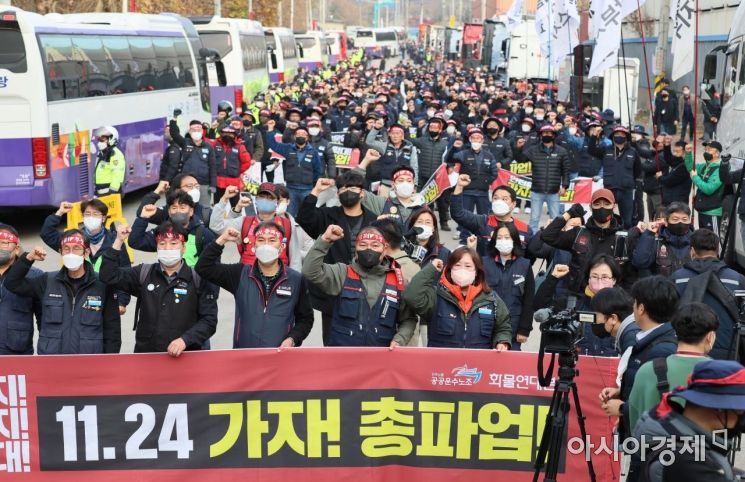 On the 24th, when the Cargo Solidarity Union began an indefinite general strike, members of the union held a send-off ceremony near the Uiwang Inland Container Terminal in Gyeonggi Province. Photo by Dongju Yoon doso7@
They also demanded a halt to amendments of the Labor Union Act. The business community stated, "Amendments to the Labor Union Act, which encourage illegal strikes and labor-management conflicts in industrial sites and increase uncertainty in the business environment, must be stopped." The proposed amendments, which expand the concepts of employers and labor disputes, are seen as shaking the foundation of Korea's legal system and severely damaging corporate competitiveness.
In fact, in recent years, labor-related legislation has been strengthened, significantly increasing the burden on companies. The minimum wage has risen sharply, and the reduction of working hours has greatly reduced management efficiency. With the enforcement of the Serious Accident Punishment Act starting this year, corporate burdens have increased, and if amendments to the Labor Union Act proceed, companies will face an unbearable level of strain.
They emphasized that the change of the 52-hour workweek system to a monthly basis should be implemented promptly. The business community stated, "The outdated and uniform 52-hour workweek system must be improved as soon as possible." The current government has launched the Future Labor Market Research Group, composed mainly of experts, to promote flexibility in working hours, and plans to announce the final proposal related to this next month.
According to the draft released by the research group, the calculation unit for overtime work will be expanded from weekly to monthly or longer, and the scope of jobs eligible for the selective work system will be expanded from R&D to all job types. The small and medium business sector also argued that the additional 8-hour weekly overtime system, which was applied as a special case only to workplaces with fewer than 30 employees, is set to expire at the end of this year, and to alleviate manpower shortages in small businesses, the sunset clause should be abolished and the system made permanent.
They further argued, "The high burdens of corporate and inheritance taxes must be eased to revitalize companies." Korea's highest corporate tax rate, including local taxes, is 27.5%, ranking tenth among 38 OECD countries, and the highest inheritance tax rate is 50%, the second highest after Japan. However, when considering the premium valuation on major shareholders' stocks, the effective rate reaches 60%, making it practically the highest in the world. The high corporate and inheritance tax burdens dampen companies' investment incentives and hinder the emergence of prestigious long-established companies, ultimately causing harm to all citizens.
Unlike Korea, major countries have been steadily lowering corporate tax rates to improve their domestic business environments and attract foreign investment. Their inheritance tax systems actively reflect corporate realities in terms of deduction targets, deduction amounts, and post-management requirements, showing a clear difference from Korea's punitive system.
Finally, the heads of the six economic organizations stated, "The business community will take the lead in overcoming the crisis," and appealed, "We ask the National Assembly, government, labor sector, and the public to lend their support."
Attending the press conference were Korea Employers Federation Chairman Son Kyung-sik, Korea International Trade Association Chairman Koo Ja-yeol, Korea Federation of Medium-sized Enterprises Chairman Choi Jin-sik, Korea Chamber of Commerce and Industry Executive Vice President Woo Tae-hee, Federation of Korean Industries Executive Vice President Kwon Tae-shin, and Korea Federation of Small and Medium Business Executive Director Lee Jae-won.
© The Asia Business Daily(www.asiae.co.kr). All rights reserved.


















