Army Raised Requirements Last Year but Failed to Reflect in Defense Budget
Repair Costs Up to 7 Times Original Price Due to US Parts Sales Refusal
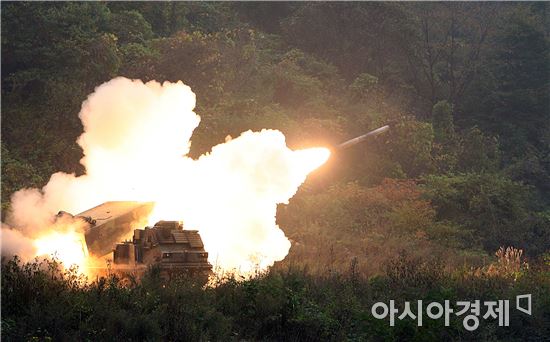 Scene of large-caliber multiple launch rocket system (MLRS) firing training held by the US military.
[Asia Economy Yang Nak-gyu, Military Specialist Reporter] Our military's multiple launch rocket systems (MLRS) to counter North Korea's long-range artillery are set to be phased out starting next year, but plans for additional production are delayed. Some MLRS units cannot even be operated due to the unavailability of parts.
According to the military on the 24th, our forces introduced 45 MLRS units from the U.S. in 1998 and deployed 18 units (2 firing batteries) to the 1st Corps 2000th Battalion and 27 units (3 firing batteries) to the 5th Corps 5000th Battalion. The 130mm-class 'Guryong,' our military's first multiple launch rocket, also supplemented the firepower.
Later, in 2013, Hanwha Defense independently developed the domestically produced MLRS Cheonmu. It can fire three types of rockets: the 130mm old-model unguided 'Guryong' rockets, 230mm unguided rockets, and 239mm guided rockets. Especially when using cluster munitions, 300 submunitions are dispersed in the air, capable of devastating an area about three times the size of a soccer field. This is why it is called the Korean-made 'Steel Rain.'
The problem lies with the U.S.-imported MLRS introduced since 1998. The lifespan of MLRS is 25 years, so they must be phased out starting next year. In particular, the U.S. State Department notified in November 2020 that it would no longer sell MLRS repair parts. As a result, maintenance costs for U.S.-made MLRS have increased up to seven times. The electric motor costs only 15 million won originally, but repairs cost over 100 million won. The hoist assembly costs 25 million won originally, but repairs cost four times that, about 100 million won. The repair period for parts has also lengthened. It takes three years to repair the power supply unit.
To replace the U.S.-made MLRS, the third phase of domestic MLRS production should be deployed starting next year, but the Army's requirement submission (December 2021) was delayed, and the feasibility study is expected to be completed only this year. Due to the Army's delayed procurement process, the third phase production budget (663 billion won for 65 units) was not included in next year's defense budget.
A military official said, "We are making efforts to reflect the budget for replacing the aging MLRS in next year's defense budget."
© The Asia Business Daily(www.asiae.co.kr). All rights reserved.
















