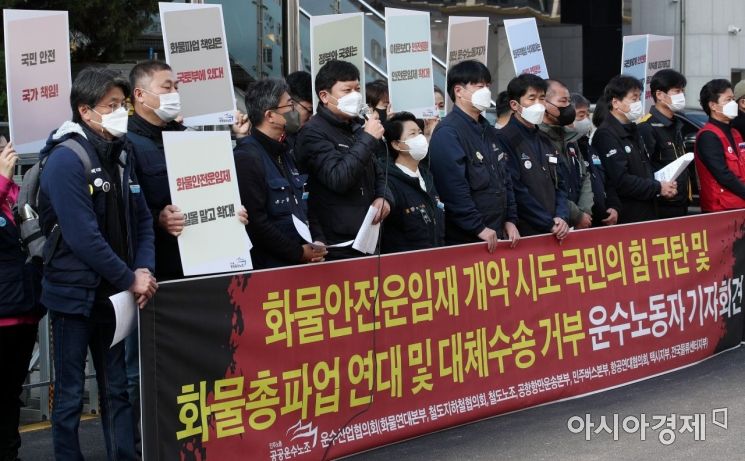
 Officials from the Cargo Solidarity Headquarters and the Public Transport Union Transport Industry Council held a press conference on the 23rd in front of the People Power Party headquarters in Yeouido, Yeongdeungpo-gu, Seoul, condemning the ruling party and government for attempting to worsen the Cargo Safety Freight Rate System, expressing solidarity with the cargo general strike, and refusing alternative transportation by transport workers. Photo by Kim Hyun-min kimhyun81@
General Strike by Cargo Solidarity Union Begins at Midnight on the 24th
Government and Union Released Agreement, but Interpretations Differ
Demands for Abolition of Safety Freight Rate System and Expansion of Applicable Vehicle Items
[Asia Economy Reporter Kim Min-young] The Cargo Solidarity Union has declared another general strike after five months due to conflicts surrounding the safety freight rate system. In June, the Cargo Solidarity Union also went on strike for the same reason and reached an agreement with the government, but differing interpretations have raised the possibility of a logistics crisis recurring. The Korea Public Service and Transport Workers' Union Cargo Solidarity Headquarters and the government have significant differences in their positions regarding demands including the safety freight rate system, leading to expectations that this strike will last longer than the one in June.
On the 24th at 10 a.m., the Cargo Solidarity Union will hold a general strike send-off ceremony at 16 regional headquarters nationwide. Afterwards, they have announced plans to block entrances including the inland container depot (ICD) in Uiwang, Gyeonggi Province, a logistics hub in the metropolitan area, as well as Busan New Port, Gwangyang Port in Jeonnam, and Hyundai Steel in Chungnam. The Cargo Solidarity Union estimates that more than 22,000 members will participate in the strike.
Minister of Land, Infrastructure and Transport Won Hee-ryong will hold an emergency on-site situation meeting related to the Cargo Solidarity Union’s collective transport refusal at the Uiwang ICD in Gyeonggi at 9:30 a.m. on the same day. Minister Won plans to review emergency transport measures and inspect the site.
Earlier, the Cargo Solidarity Union proposed and held the first round of negotiations with the Ministry of Land, Infrastructure and Transport on the 15th, but it is reported that only differences in positions were confirmed with no progress in discussions. A Cargo Solidarity Union official said, "The more discussions proceed, the more it is reconfirmed that it is difficult to reach consensus with the Ministry of Land, Infrastructure and Transport," adding, "The schedule for the second round of negotiations has not yet been confirmed."
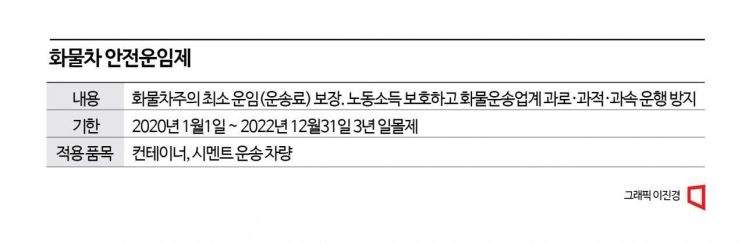
The strike centers on three main issues. First is the permanent establishment of the safety freight rate system. The safety freight rate system guarantees a minimum transportation fee so that truck drivers do not have to engage in overwork, speeding, or overloading, and imposes fines on shippers who violate this. The government decided to extend the safety freight rate system, which is set to expire at the end of this year, for three more years, but the Cargo Solidarity Union demands its complete abolition rather than a temporary extension. After the June strike, the government and the Cargo Solidarity Union reached an agreement, but interpretations differed on this point. The Cargo Solidarity Union viewed it as a decision to end temporary operation and pursue permanent implementation, while the Ministry of Land, Infrastructure and Transport saw it as a discussion about extending the deadline.
The second issue is the expansion of applicable vehicle types and cargo items. They are requesting expansion from the existing container and cement to five additional items including steel products, automobiles, hazardous materials, feed grains, and parcel delivery trunk lines. Lastly, they demand the abolition of the safety freight rate system revision that deletes the shipper responsibility clause.
The Ministry of Land, Infrastructure and Transport maintains the position that the introduction effect of the safety freight rate system is minimal and that expanding applicable vehicles is impossible due to difficulties in standardization and specification. The Cargo Solidarity Union counters that they will not end the strike unless the three demands are accepted. A Cargo Solidarity Union official said, "They are trying to induce the end of the strike by emphasizing economic logic, but for us, this is a matter of survival," adding, "This time, if the law does not pass in the National Assembly, we do not plan to end the strike."
© The Asia Business Daily(www.asiae.co.kr). All rights reserved.
!["The Woman Who Threw Herself into the Water Clutching a Stolen Dior Bag"...A Grotesque Success Story That Shakes the Korean Psyche [Slate]](https://cwcontent.asiae.co.kr/asiaresize/183/2026021902243444107_1771435474.jpg)

















