"Expectations that 'Environmental Damage and Safety Accident Risks Will Disappear with Soil and Rock Extraction from the Summit'"
[Asia Economy Reporter Kim Jong-hwa] "If we do not limit it below the 60% ridge line and instead start cutting down from the summit, both environmental issues and safety accidents can be resolved."
The aggregate industry is increasingly voicing demands to ease the environmental impact assessment regulations that are mandatory for extracting earth, sand, gravel, and rocks.
According to the aggregate industry on the 24th, the extraction of earth and rocks, which are the basic raw materials for aggregates, is currently allowed only below the 70% ridge line under the Mountainous Area Management Act. However, for low mountains below 300 meters in elevation, extraction above the 70% ridge line is permitted.
The problem arises because, before most development activities including earth and rock extraction, an environmental impact assessment must be conducted. The Ministry of Environment's "Strategic Environmental Impact Assessment Work Manual" stipulates that work cannot be done above the 60% ridge line. This regulation, established by the Ministry of Environment to secure wildlife corridors and prevent ecological axis disruption, blocks extraction above the 60% ridge line even on mountains below 300 meters in elevation where the higher law, the Mountainous Area Management Act, permits it.
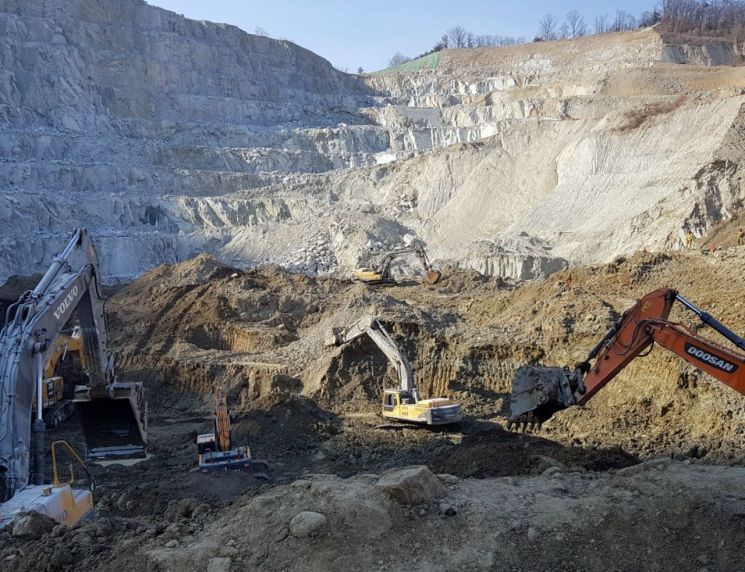
When extracting earth and rocks below the 60% ridge line, work starts mid-mountain and proceeds in a terraced manner on the slopes, which always carries the risk of collapse and other safety accidents. On the other hand, if extraction starts from above the 70% ridge line, i.e., from the mountain summit downward in layers, the risk of safety accidents decreases. Also, below the 60% ridge line, only part of the mountain can be worked on, but starting from the summit allows removal of the entire mountain, resulting in at least 5 to 10 times more extraction volume.
A representative from the aggregate industry said, "If the Ministry of Environment only revises the 'work manual' regulations, it would be possible to extract at least 5 to 6 times more than the current annual forest aggregate supply plan of 107 million cubic meters," adding, "Environmental damage caused by the development clause below the 60% ridge line and the risk of safety accidents from terraced slope work would disappear."
According to the annual aggregate supply plan by the Korea Aggregate Association, this year plans call for extracting a total of 263 million cubic meters, more than twice the volume of Namsan Mountain in Seoul. Of this, forest aggregate extracted from mountains accounts for 41%, or 107 million cubic meters. The remainder is supplied by 120 million cubic meters (46%) of selective crushed aggregates using construction site waste and 36 million cubic meters (13%) of river and marine aggregates.
A Korea Aggregate Association official explained, "There are restrictions related to earth and rock extraction in as many as 22 laws. We ask that even an exception clause be added to create conditions allowing work above the 60% ridge line," and added, "We plan to gather industry opinions soon and propose an 'exception clause' to be added to the environmental impact assessment work manual."
Experts also advised flexible application of the law. Cheon Gu Han, Honorary Chair Professor of the Department of Architectural Engineering at Cheongju University, said, "Unless the demands are unreasonable, such as completely leveling mountains, I think the industry’s opinions can be accepted to some extent," and advised, "As long as it does not deviate from the Ministry of Environment’s grand purpose of protecting the environment, the related manual can be operated flexibly."
In this regard, the Ministry of Environment and the Korea Forest Service recently held an inter-agency policy meeting and reportedly agreed to add an exception clause to the relevant provisions of the work manual. A Korea Forest Service Mountain Policy Division official stated, "Since the Mountainous Area Management Act explicitly allows earth and rock extraction above the 70% ridge line as an exception, we decided to establish an exception clause in the environmental impact assessment work manual as well." A Ministry of Environment Land and Environment Policy Division official said, "Considering that the relevant provisions could be mandatory at extraction sites, we will review revising the manual," adding, "We will accept proposals from the aggregate industry and establish specific exception clauses, so that from as early as next year, environmental impact assessments can be conducted according to the new manual."
© The Asia Business Daily(www.asiae.co.kr). All rights reserved.
![Clutching a Stolen Dior Bag, Saying "I Hate Being Poor but Real"... The Grotesque Con of a "Human Knockoff" [Slate]](https://cwcontent.asiae.co.kr/asiaresize/183/2026021902243444107_1771435474.jpg)
















