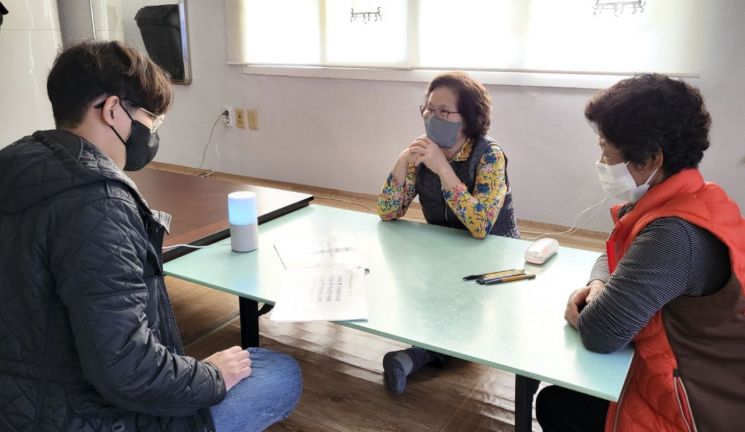
 Elderly residents in Buyeo-gun are using 'Dunetoktok' to train for dementia prevention. Photo by Maumkkok
[Asia Economy Reporter Oh Su-yeon] The AI speaker "NUGU," developed jointly by SK Telecom and Happy Connect, features a memory training program called "Brain Tok Tok," which has been evaluated to have an effect in reducing the dementia incidence rate among the elderly.
On the 23rd, SK Telecom announced that the first-year implementation results of the dementia prevention Social Impact Bond (SIB) project targeting elderly residents in Buyeo-gun showed that the dementia incidence rate (the rate of diagnosis progressing from mild cognitive impairment to dementia) among the elderly using cognitive therapy and AI-based "Brain Tok Tok" was around 2%.
This project, conducted over three years, targets a total of 300 high-risk elderly individuals aged 60 to 80 with mild cognitive impairment living in Buyeo-gun. It provides offline cognitive training programs to improve attention and memory, as well as dementia prevention content ("Brain Tok Tok") via the AI speaker (NUGU Candle SE), aiming to prevent the onset of dementia. "Brain Tok Tok" was developed through collaboration among SKT, Happy Connect, and Professor Lee Jun-young’s research team at Seoul National University. It is an advanced program that transforms the metacognitive classroom brain exercise program into voice-based AI content.
The project evaluation agency, Inje University Industry-Academic Cooperation Foundation (Paik Hospital), reported that during the first year (June 28, 2021 ? June 27, 2022), only 1 out of 50 elderly individuals with mild cognitive impairment progressed to dementia (dementia incidence rate of 2.0%).
The Inje University Industry-Academic Cooperation Foundation explained, "Typically, the annual dementia incidence rate is about 15%, and the goal of this elderly dementia prevention project is to reduce the annual dementia incidence rate to 7.5?10% over three years. A 2% dementia incidence rate is a significantly low figure. Although this is only the first year of the project, the current program outcomes are effective."
In particular, since this project is conducted as a Social Impact Bond (SIB), it is expected to emerge as a solution to alleviate the financial burden on local governments nationwide, where aging is progressing rapidly.
The Social Impact Bond is a method where initial project costs for public services in welfare, health, education, employment, housing, culture, and environment are covered by private investment, and the government or local governments allocate budgets according to agreed standards only after achieving the goals. This approach has the advantage of streamlining welfare projects by disbursing budgets retrospectively only when successful results are achieved.
The beneficiary of the performance reward for the Buyeo-gun SIB project is Buyeo-gun, the operating organization is Pan Impact Korea, the executing organizations are Maumkok and Happy Connect, the Industry-Academic Cooperation Foundation of CHA University, and private investors include the Happy Sharing Foundation, Korea Social Value Solidarity Fund, and MY Social Company.
Previously, Professor Lee Jun-young’s research team at Seoul National University published research results in the prestigious international journal in medical informatics and healthcare, JMIR (Journal of Medical Internet Research), confirming that elderly users who continuously used SKT’s "Brain Tok Tok" showed a 15% improvement in long-term memory, 16% in working memory, and 10% in verbal fluency, demonstrating significant effects in delaying dementia onset.
Park Jeong-hyun, Mayor of Buyeo-gun, said, "Buyeo-gun, an ultra-aged city where the proportion of people aged 65 and over reaches 36.7%, faces a very high risk of dementia among the elderly. We believe that privately led SIB is the optimal solution to address the social issue of dementia care burden. Since the first-year results are hopeful, we will strive to successfully complete the project so that elderly residents in the area can enjoy a happy old age."
Yoon Jeong-hye, CEO of Maumkok, the main executing organization, said, "The first-year project results showed a low dementia incidence rate and improvements in verbal fluency and cognitive function. However, since trends in incidence rates for the second and third years may vary depending on sample selection, continuous research is necessary."
Lee Jun-ho, SK Telecom’s ESG Promotion Officer, stated, "The research results showing that the AI technology-based dementia prevention service 'Brain Tok Tok' can delay dementia in the elderly have even greater significance for our country heading toward a super-aged society. We plan to take the lead in enabling more institutions and local governments to reduce the burden of dementia through SIB projects."
© The Asia Business Daily(www.asiae.co.kr). All rights reserved.
![Clutching a Stolen Dior Bag, Saying "I Hate Being Poor but Real"... The Grotesque Con of a "Human Knockoff" [Slate]](https://cwcontent.asiae.co.kr/asiaresize/183/2026021902243444107_1771435474.jpg)
















