After Graduating from the Department of Cyber Defense, Officers Must Serve Mandatory Duty... Half of This Year's Graduates Did Not Commission
Calls for Improved Treatment to Strengthen Professional Workforce
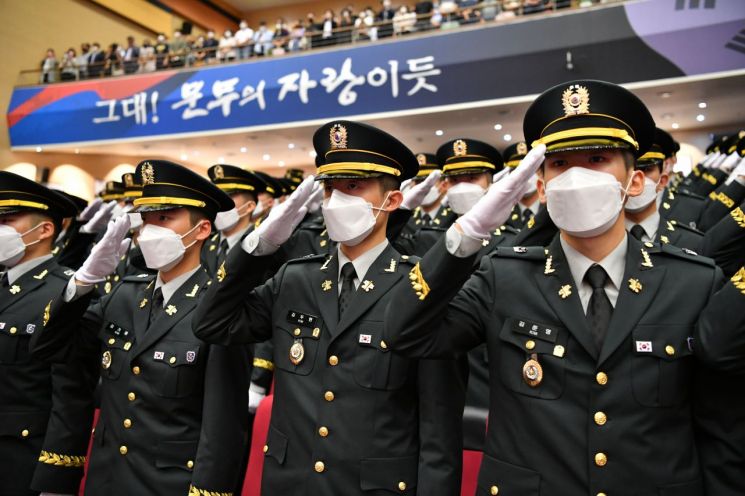
[Asia Economy Yang Nak-gyu, Military Specialist Reporter] The commissioning rate of cyber warfare specialist officers has been declining every year. There are concerns that the lack of recruitment of specialized personnel to respond to cyber warfare may weaken the cyber military capabilities of our armed forces.
According to the Ministry of National Defense on the 26th, the military is implementing a system where graduates of Korea University's Cyber Defense Department serve as officers for seven years in cyber defense-related institutions. Students admitted to Korea University's Cyber Defense Department receive a scholarship benefit of 10 million KRW for one year. After graduation, they are commissioned as officers.
The first batch of officers commissioned in 2016 was highly popular, with a commissioning rate of about 93% of the admission quota. However, the third batch (2018) had a 90% rate, and the fifth batch (2020) dropped to 69%. This year, the rate is only about 43%, not even reaching half. There are about 1,500 cyber specialist positions within the military, which should be assigned to units such as the Defense Security Support Command, Intelligence Command, and the 777th Unit, but there is a severe shortage of specialized personnel.
On the other hand, North Korea's cyber personnel are deployed mainly within the Technical Bureau of the Reconnaissance General Bureau of the General Staff. It is known to have nearly 6,800 personnel, consisting of seven attack organizations (about 1,700 personnel) and 18 support organizations (about 5,120 personnel). This is comparable to advanced countries leading cyber warfare. In the case of the United States, out of 1.6 million troops, about 61,000 (3.9%) are cyber personnel. China also has about 180,000 cyber personnel (7.8%) out of 2.3 million troops.
On July 13, President Yoon Suk-yeol attended the 11th ‘Information Security Day’ ceremony held at the Pangyo 2nd Techno Valley Enterprise Support Hub in Seongnam, Gyeonggi Province, and stated, "We will strengthen cyber warfare capabilities by introducing the ‘Cyber Talpiot’ and ‘Cyber Reserve Forces System,’ which link military service with employment and entrepreneurship after discharge." ‘Talpiot’ refers to Israel’s elite science and technology officer development program that allows outstanding talents to conduct research in science and technology fields during their military service. Additionally, to address the shortage of cyber talents, he emphasized, "We will expand support for cyber departments in universities and graduate schools and cultivate 100,000 talents through elite information security product development personnel and white hacker training systems."
However, voices inside and outside the military emphasize that improving treatment is necessary to attract specialized personnel. The military states that while the highest annual salary at domestic cybersecurity companies such as Steelyon and Theory exceeds 100 million KRW, the annual salary of a level 5 military civilian employee at step 10 is only 60 million KRW, making it inevitable to suffer from manpower shortages.
A military official said, “We are making efforts to resolve career interruption issues by allowing excellent cyber personnel to continue working in related fields during their military service,” and added, “We plan to recruit personnel through various incentives.”
© The Asia Business Daily(www.asiae.co.kr). All rights reserved.
![Clutching a Stolen Dior Bag, Saying "I Hate Being Poor but Real"... The Grotesque Con of a "Human Knockoff" [Slate]](https://cwcontent.asiae.co.kr/asiaresize/183/2026021902243444107_1771435474.jpg)
















