[Asia Economy Reporter Minji Lee] Expectations for the lifting of the Hanhanryeong are rising.
At 9:04 a.m. on the 23rd, Studio Dragon is pointing to 70,500 won, up 5% from the previous trading day. Samhwa Networks (4.64%), Contentree Joongang (4.33%), AStory (3.74%), and Wysiwyg Studios (2.4%) are also showing upward trends. As the possibility of lifting the Hanhanryeong increases, investor sentiment has expanded mainly around drama and content production companies.
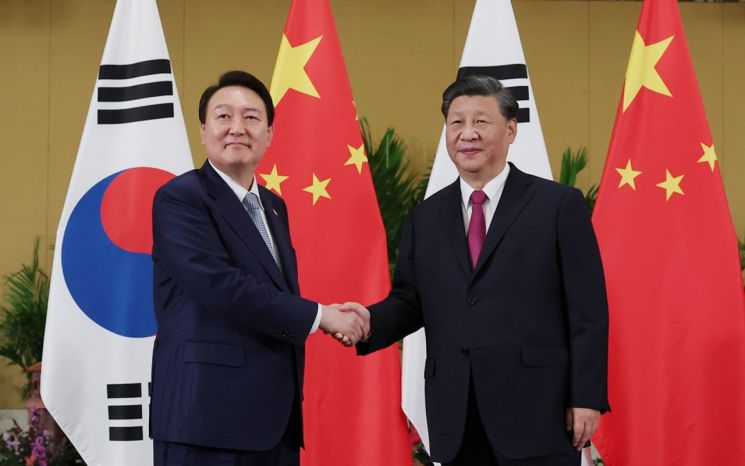
Yesterday, the Presidential Office announced that, following the Korea-China summit held on the 15th, China will resume OTT services for Korean films after six years. During the Korea-China summit, President Yoon Seok-yeol emphasized the importance of cultural and human exchanges between Korea and China, and it appears that President Xi Jinping responded by allowing domestic films to be screened on Chinese OTT platforms. Currently, Tencent, a Chinese OTT platform, is streaming the 2018 film "Gangbyeon Hotel."
In January this year, the Chinese rights for domestic dramas such as "Saimdang: Light's Diary," in March "Something in the Rain," and in April "Now, We Are Breaking Up" were sold, but compared to the 2016 level, it is still a small scale. KB Securities researcher Yonghyun Choi said, "President Xi Jinping acknowledged that the suspension of cultural and human exchanges negatively affected both countries," adding, "Considering that this was mentioned as an achievement of the Korea-China summit in official government statements, the possibility of lifting the Hanhanryeong seems high."
If exports of Chinese content expand, it is expected to benefit drama production companies. Compared to other industries, the issuance period for licenses is relatively short, and sales of works produced during the Hanhanryeong period can quickly contribute to performance. Before the Hanhanryeong, exports to China accounted for nearly 30% of total exports based on completed domestic broadcasting programs, but after the Hanhanryeong, this has decreased to about 5%. The export amount to China dropped from 80 million dollars (110 billion won) in 2016 to 18 million dollars (25 billion won) in 2020.
If the Chinese market opens, the profitability of content companies is expected to improve significantly. Recently, concerns about profitability have emerged due to poor performance of OTT and captive channels, but if sales to China become possible, content producers can improve sales and profitability without additional cost burdens through diversification of sales channels. Researcher Choi said, "New dramas with IP ownership could achieve a recoup rate of 30-40% through sales in China," adding, "There are many sellable older works, and content production companies that produced dramas featuring Hallyu stars are expected to benefit, with Contentree Joongang and Studio Dragon anticipated to be the main beneficiaries."
© The Asia Business Daily(www.asiae.co.kr). All rights reserved.
![Clutching a Stolen Dior Bag, Saying "I Hate Being Poor but Real"... The Grotesque Con of a "Human Knockoff" [Slate]](https://cwcontent.asiae.co.kr/asiaresize/183/2026021902243444107_1771435474.jpg)
















