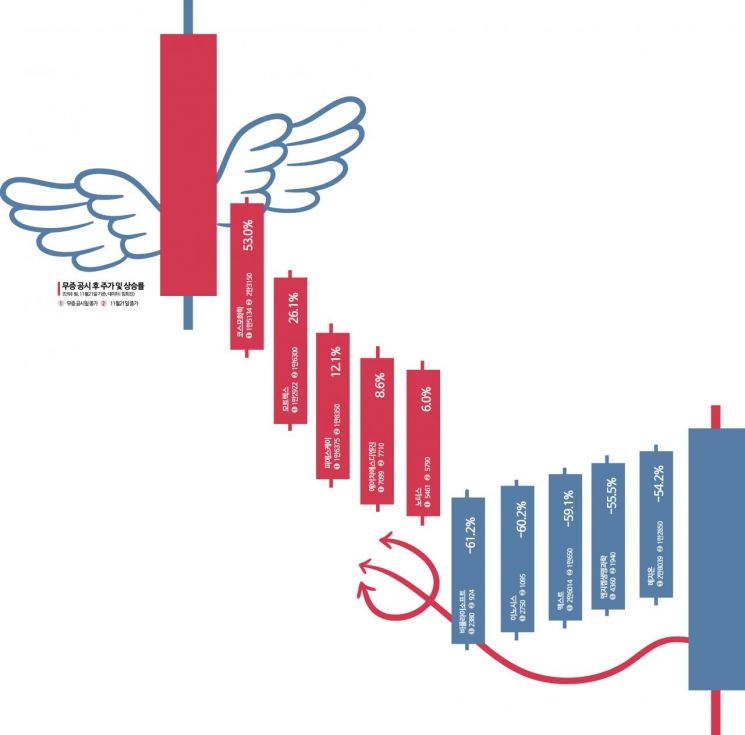
[Asia Economy Reporter Jang Hyowon] This year, "free capital increases" spread like a trend in the stock market. Under the pretext of enhancing shareholder value, many companies rushed to conduct free capital increases. However, the stock price fluctuations varied from company to company. Some stocks rose more than sixfold after the free capital increase announcement, while others never surpassed their pre-increase prices and continued to decline.
On the 23rd, Asia Economy analyzed that a total of 65 companies conducted free capital increases from the beginning of this year until October. Six companies were listed on KOSPI, and 59 on KOSDAQ. The increase ratios varied widely, ranging from 0.03 shares per one share to as much as eight shares.
A free capital increase is a formal capital increase that transfers stock issuance premiums and retained earnings included in the total capital on the accounting books to the capital account. Unlike paid-in capital increases, it does not inject money into the company to expand capital, so there is no actual change in corporate value or financial soundness.
However, the number of shares increases, which can enhance liquidity. Also, the price per share decreases, creating an optical illusion that the stock price is cheaper. Because of this, stock prices tend to show strength after the free capital increase announcement. In fact, the closing price on the announcement day rose by an average of 5% compared to the opening price.
Among the companies with free capital increases, 58 recorded stock prices higher than the closing price on the announcement day at least once. The highest stock price among all free capital increase companies rose 35.6% compared to the closing price on the announcement day. The stock with the highest increase was Notus, which conducted a 1-for-8 free capital increase, rising 578.5%. On the other hand, Eutilex's stock price continued to decline after the free capital increase, with the highest point after the announcement being 9.8% lower. Including Eutilex, seven listed companies saw their stock prices continue to fall after the free capital increase announcement.
Based on the ex-rights date, the stock prices of companies with free capital increases showed an average increase of 11.8% one day after the ex-rights date compared to the first announcement day. This was higher than the 9.4% increase on the ex-rights day and the 1.48% increase one day before the ex-rights date. The ex-rights date is the day when the right to receive new shares from the capital increase disappears, and the stock price is adjusted by the number of newly issued shares.
However, after the free capital increase ended, most stock prices eventually returned to their original levels. As of the 21st, the stock prices of companies with free capital increases fell by an average of 25.2% compared to the closing price on the announcement day. Bflysoft fell the most at -61.2%, while Cosmo Chemical recorded a 53% increase. Notus, which had recorded the highest price, also returned to its original position.
© The Asia Business Daily(www.asiae.co.kr). All rights reserved.
![Clutching a Stolen Dior Bag, Saying "I Hate Being Poor but Real"... The Grotesque Con of a "Human Knockoff" [Slate]](https://cwcontent.asiae.co.kr/asiaresize/183/2026021902243444107_1771435474.jpg)
















