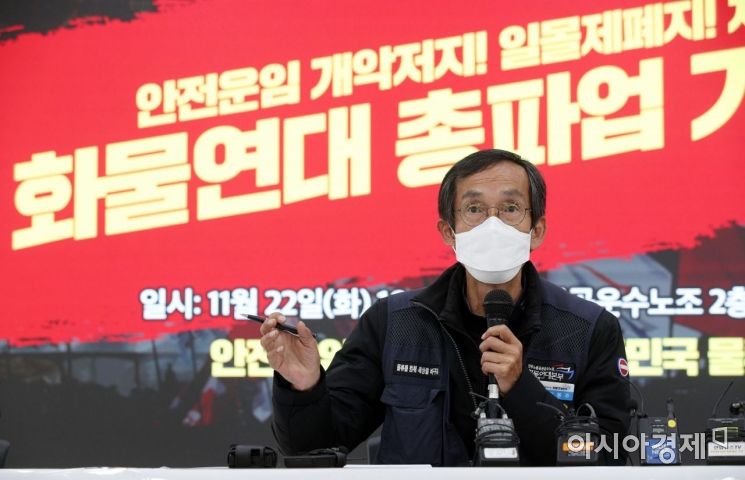
 Lee Bong-ju, Chairman of the Cargo Solidarity Headquarters, is holding a "Press Conference on the General Strike of the Cargo Solidarity: Preventing the Deterioration of Safe Freight Rates! Abolishing the Sunset Clause! Expanding Vehicle Types and Items!" at the Cargo Solidarity Headquarters of the Public Transport Solidarity in Gangseo-gu, Seoul on the 22nd. Photo by Kim Hyun-min kimhyun81@
[Asia Economy Reporter Kim Min-young] The Ministry of Land, Infrastructure and Transport (MOLIT) has clearly stated that while the extension of the sunset clause for the Cargo Truck Safety Freight Rate System is possible, its abolition is not, urging the Cargo Solidarity Headquarters to withdraw its plan for a collective transport refusal. MOLIT plans to form an emergency transport countermeasure headquarters to minimize logistics damage in relation to the Cargo Solidarity Headquarters' scheduled collective transport refusal on the 24th.
On the 22nd, MOLIT stated, "After discussions with stakeholders, we plan to pursue a three-year extension of the current sunset clause applied to containers and cement safety freight rates, but expanding the applicable items is difficult," adding, "We intend to maintain this consistent stance during the National Assembly discussions."
This clearly indicates that the demands by the Cargo Solidarity for abolishing the sunset clause of the safety freight rate system and expanding the applicable items are not acceptable.
Regarding the extension of the sunset clause, MOLIT believes that since the original purpose of the system?to improve traffic safety?is unclear, it is necessary to verify the system's effectiveness further through the extension.
Concerning the applicable items, MOLIT holds the position that expanding the scope is inappropriate when the system's effects are not evident. The other items such as automobiles and hazardous materials, which the Cargo Solidarity Headquarters demands to include, have relatively better income for truck owners compared to containers and cement, thus the need for application is low.
MOLIT also added that expanding the items could lead to increased logistics costs not only for exports and imports but also for major domestic industries, raising concerns about increased prices and the burden on consumers and the public.
In this regard, Minister of Land, Infrastructure and Transport Won Hee-ryong expressed concern, saying, "If the items are expanded, logistics costs will increase not only for exports and imports but also for major domestic industries, which could lead to price rises. That burden could fall on consumers and the public."
Furthermore, MOLIT explained that while containers and cement, to which the safety freight rate system applies, can be standardized and regulated, other items have very diverse characteristics in terms of products and transport types, making it practically impossible to standardize freight rate calculations.
Earlier, the Cargo Solidarity of the Korean Confederation of Trade Unions' National Public Transport Workers' Union announced that starting at midnight on the 24th, 25,000 union members will begin a general strike demanding the prevention of the deterioration of the safety freight rate system, abolition of the sunset clause, and expansion of vehicle types and items. The strike will involve blocking major logistics hubs such as steel, cement, shipbuilding equipment, and automobile parts businesses and refusing transport.
The Cargo Solidarity claims that the reason for the indefinite strike is the government's failure to fulfill agreements. Previously, in June, the government and Cargo Solidarity agreed to end an eight-day strike on the condition of continuing the safety freight rate system and pursuing legal amendments. However, the Cargo Solidarity believes that MOLIT has directly denied the purpose of introducing the safety freight rate system and breached the agreement.
In preparation for this collective transport refusal, the government has formed and is operating an emergency transport countermeasure headquarters jointly with related ministries including the National Police Agency, Ministry of Oceans and Fisheries, Ministry of Trade, Industry and Energy, and Ministry of National Defense. They also stated they will thoroughly prepare to minimize national economic damage by implementing emergency transport measures in cooperation with related agencies.
First, police forces will be pre-deployed and patrol activities strengthened at important logistics hubs such as ports, ICDs, highway toll booths, and rest areas to prevent illegal activities. They also plan to increase cargo transport capacity through military-commissioned containers and paid transport by private cargo trucks.
Additionally, to provide benefits (incentives) to transport participants, during the period of collective transport refusal, highway tolls will be waived for commercial towing-type special vehicles over 10 tons and private paid transport permit vehicles.
Meanwhile, in cooperation with the police, MOLIT will ensure that cargo truck drivers who carry out transport normally can operate with peace of mind, and illegal acts such as obstructing transport will be dealt with strictly according to law and principles.
© The Asia Business Daily(www.asiae.co.kr). All rights reserved.

















