Exchange Rate Surpasses 1360 Won Ahead of June 24 Monetary Policy Meeting
Dropped to Early 1300s Then Rose Again
Volatility Expected to Remain High... Possible Sharp Rise
Maintains Mid-1300s, 'High in Early Year, Low Later' Expected Next Year
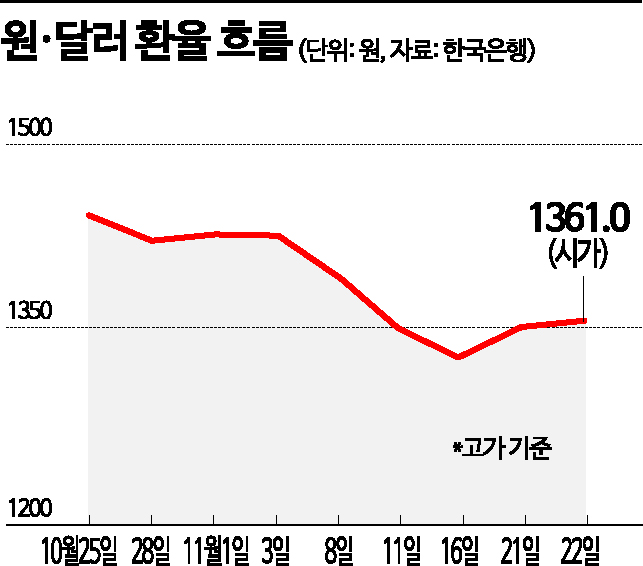
The won-dollar exchange rate, which seemed to have somewhat stabilized, has recently shown increased volatility, creating an uneasy atmosphere. Earlier this month, when it dropped sharply by more than 100 won, some analyses suggested that the exchange rate could fall to the 1,200 won range. However, as opinions diverged regarding the U.S. Federal Reserve's (Fed) tightening policy, the rate fluctuated again, rising to the 1,360 won level. Experts see a low possibility of breaking the previous high above the mid-1,400 won range but expect volatility to increase around the mid-1,300 won range for the time being.
According to Seoul Foreign Exchange Brokerage on the 22nd, the won-dollar exchange rate opened at 1,361 won, up 6.3 won from the previous trading day. This is the first time since the 10th that the rate has exceeded 1,360 won at the opening. After falling to 1,308.5 won on the 14th, the exchange rate has risen by more than 50 won in about a week, continuing its upward trend. Compared to the record high of 1,444.2 won on the 25th of last month, the current level is lower, but the rate has been swinging by tens of won within just a few days this month, showing a 'rollercoaster market,' which maintains a sense of unease.
Gong Dong-rak, a researcher at Daishin Securities, said, "It is no longer possible to predict U.S. monetary policy with the regularity seen in the past," adding, "The exchange rate is often described as a rugby ball, and this year it is even more so."
The won is heavily influenced by external political and economic situations such as those in the U.S. and China. Recently, uncertainties have greatly expanded due to economic slowdown, interest rate hikes, and geopolitical instability, inevitably increasing volatility. The weakening of the yuan due to a rise in COVID-19 cases in China and inflation concerns caused by the U.S. railroad strike are factors pushing the won-dollar exchange rate higher. However, expectations of interest rate cuts next year and the Korean foreign exchange authorities' measures to stabilize the exchange rate could act as downward pressures.
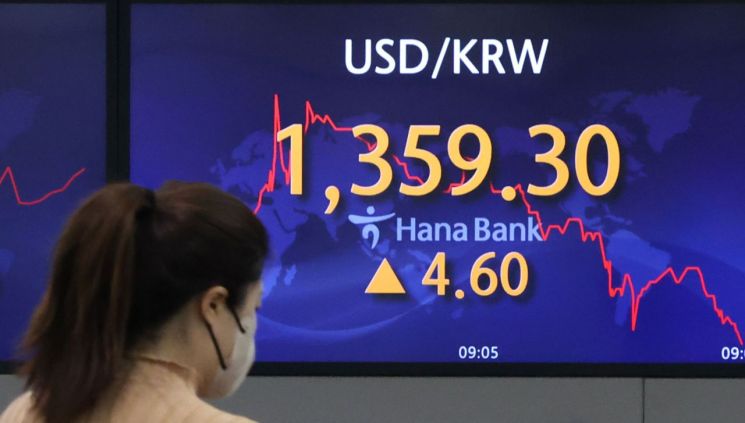 Dealers are working in the dealing room at the Hana Bank headquarters in Jung-gu, Seoul. On this day, the KRW/USD exchange rate rose by 6.3 won from the previous day to 1361.0 won, and the KOSDAQ opened down 2.33 points (0.32%) at 716.24.
 [Image source=Yonhap News]
The won-dollar exchange rate plays a crucial role not only in South Korea's imports and exports and current account balance but also in the direction of monetary policy, drawing significant market attention to its future trend. Earlier, on the 11th, Lee Chang-yong, Governor of the Bank of Korea, told reporters that the sharp drop in the exchange rate due to expectations of easing U.S. tightening was a "good sign" and that "a change has been detected." Following this, the market speculated that the Bank of Korea would begin to slow the pace of interest rate hikes starting from the Monetary Policy Committee meeting on the 24th, citing exchange rate decline and financial stability as reasons.
Experts predict that the U.S. interest rate hikes will continue for some time, making it unlikely for the exchange rate to fall below 1,300 won. They also see it difficult for the rate to surge again well above 1,400 won. Hwang Se-woon, a senior researcher at the Korea Capital Market Institute, said, "Since the U.S. benchmark interest rate peak is expected around the first quarter of next year, the exchange rate will likely peak before then," adding, "On average, the rate will stay in the 1,300 won range until next year and may drop to the 1,200 won range around the year after next." He explained that a clear 'high at the start, low at the end' trend will be evident as the second half of next year approaches.
Researcher Gong said, "Basically, the strong dollar environment is still valid, so the recent sharp decline in the exchange rate is seen as a reaction to the short-term excessive rise," adding, "I expect the exchange rate to move around the 1,300 won level until the first quarter of next year."
© The Asia Business Daily(www.asiae.co.kr). All rights reserved.


















