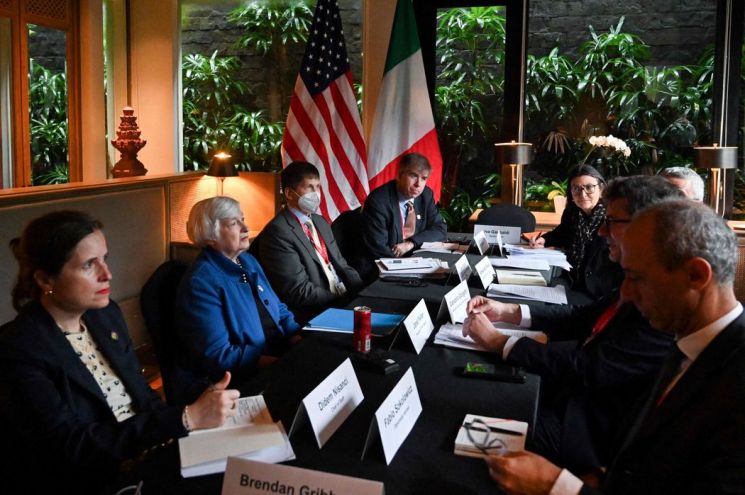
 U.S. Treasury Secretary Janet Yellen urged the continuation of sanctions against Russia by the relevant countries at the G20 summit held last week in Bali, Indonesia. (Photo by AFP)
[Asia Economy Reporter Jo Yujin] As Russia's trade volume, which had sharply declined due to Western sanctions following the Ukraine crisis, shows signs of rebound, the United States has launched diplomatic pressure on its allies to maintain the sanctions. The European Union (EU) has also begun reviewing legal procedures to confiscate Russian government and private company assets frozen overseas and use them for Ukraine's reconstruction.
On the 20th (local time), The Wall Street Journal (WSJ) reported that key officials from the Biden administration, including the Treasury Department, Commerce Department, and State Department, are traveling worldwide to conduct diplomatic efforts to pressure Russia sanctions. According to a senior U.S. administration official, their mission includes sharing network information related to companies and individuals involved in sanction evasion and military supply transport to Russia, as well as imposing punitive measures on countries and companies that are lukewarm about participating in the sanctions.
A senior official criticized that sanctions against Russia in the financial and trade sectors are losing effectiveness due to some countries' lukewarm attitudes and passive enforcement, warning that such relaxation of sanctions would only delay the end of the war in Ukraine.
Earlier, U.S. Treasury Secretary Janet Yellen, during her visit to Bali, Indonesia, to attend the G20 summit, held talks with leaders of developing countries and pledged to maintain sanctions against Russia. She emphasized that even if peace negotiations between Russia and Ukraine are successful, economic sanctions against Russia will be maintained for the time being, encouraging allied countries to sustain their sanctions on Russia.
To pressure Russia sanctions, U.S. Treasury Deputy Secretary Wally Adeyemo visited Brussels, London, and Paris earlier this month, and Elizabeth Rosenberg, Deputy Assistant Secretary for Terrorist Financing, visited Japan to discuss related issues, WSJ reported. Deputy Assistant Secretary Rosenberg also visited the Arab region last month, issuing a strong warning to major banks that "there are official reports of active Russian money laundering in the Arab world."
According to trade data compiled by WSJ, the volume of trade with Russia, which had dropped by up to 50% or more in many U.S. allied countries, is recently showing signs of bottoming out and rebounding. In the cases of South Korea and Japan, about one-third of the trade volume lost since the outbreak in February has been recovered. While analyses suggest that the Russian economy, holding massive energy export revenues, is holding up well despite Western sanctions, there are also concerns that countries like Switzerland and some companies are acting as loopholes in the sanctions against Russia, thereby diminishing their effectiveness.
George Volosin, an investigator in charge of Russia sanctions at the Association of Certified Anti-Money Laundering Specialists (ACAMLS), pointed out, "Most companies and banks avoid transactions that could violate Russia sanctions, but some see this as an opportunity and cooperate with the Russian government."
There is also analysis that banks in non-EU member countries such as Austria, the Czech Republic, and Switzerland are passive in enforcing sanctions against Russia. Swiss financial authorities froze $8 billion worth of Russian assets in April but lifted the freeze on $3 billion of that amount.
Meanwhile, the EU is also joining efforts to strengthen sanctions against Russia. Political media outlet Politico, citing a document obtained exclusively, reported that the EU Commission is preparing legal mechanisms to confiscate Russian government and private assets frozen by Western sanctions to fund Ukraine's reconstruction.
The EU Commission has started tracking assets of the Russian government and oligarchs (Russia's oligarchic tycoons) as a preliminary step to asset confiscation. The confiscated amount is expected to include about $300 billion, roughly half of the Russian central bank's foreign exchange reserves ($640 billion), as well as some assets of oligarchs and individuals listed in the EU sanctions list.
Earlier, some EU governments including Ukraine, Poland, Slovakia, and Lithuania proposed in May to seize Russian assets frozen overseas and use them for war damage recovery, and have been investigating the legal feasibility since last month.
Some voices express skepticism about the legal realization of asset confiscation. WSJ reported that while there are valid methods under international law to confiscate frozen assets, the path is unverified.
© The Asia Business Daily(www.asiae.co.kr). All rights reserved.

















