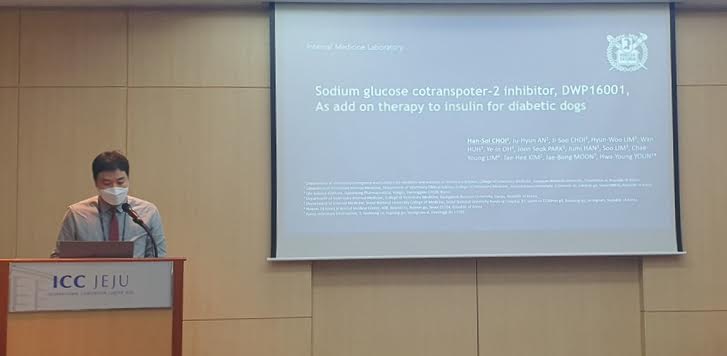
 Choi Hansol, a full-time veterinarian at the Department of Veterinary Internal Medicine, Seoul National University, is presenting research on the diabetes treatment effects of 'DWP16001' in companion animals. (Photo by Daewoong Pharmaceutical)
[Asia Economy Reporter Lee Chun-hee] Daewoong Pharmaceutical has confirmed the possibility of further developing 'DWP16001,' currently under development as a new drug for diabetes, as a treatment for diabetes in companion dogs.
Daewoong Pharmaceutical announced on the 22nd that it recently disclosed additional clinical trial results by researchers on the diabetes treatment effects of DWP16001 in companion animals at the Korean Veterinary Medical Association. The announced data is the result of a study that further verified the long-term safety of extended one-year administration in type 1 diabetic (insulin-dependent diabetes) companion dogs who participated in the eight-week researcher-led clinical trial announced in May last year.
DWP16001 (active ingredient: Inavogliflozin) is a new drug developed by Daewoong Pharmaceutical for the treatment of type 2 diabetes in humans. Diabetes is generally considered an "adult disease" caused by environmental factors such as obesity and aging in adults over 40 years old. However, this refers to type 2 diabetes, whereas type 1 diabetes, also known as "juvenile diabetes," is a refractory disease caused by immune cells attacking and destroying pancreatic beta (β) cells due to exposure to environmental factors such as viruses and chemicals in a genetically predisposed state, resulting in insufficient insulin production in the body. Once type 1 diabetes develops, insulin must be administered for life.
Daewoong Pharmaceutical stated, "Humans have more type 2 diabetes patients with complex causes than congenital type 1 diabetes patients, so we are developing it as a treatment for type 2 diabetes. Conversely, most diabetic companion dogs have type 1 diabetes rather than type 2, so we are pursuing additional development targeting type 1 diabetic dogs." Basically, all diabetes requires blood sugar control, and since DWP16001 is a sodium-glucose co-transporter (SGLT)-2 inhibitor that controls blood sugar to treat diabetes, it can be used for both type 1 and type 2 diabetes.
This announcement was made by Choi Han-sol, a full-time veterinarian at the Department of Veterinary Internal Medicine, Seoul National University. Insulin and DWP16001 were co-administered once daily or once every three days for one year, and tests including blood ketone and lactate dehydrogenase (LDH) tests, complete blood cell (CBC) tests, serum chemistry tests, electrolyte tests, and urinalysis were conducted in each group. Blood ketone and LDH tests are known as evaluation tests for diabetic ketoacidosis and are major indicators for assessing side effects along with hypoglycemia.
The test results confirmed no significant changes in blood ketone and LDH levels during the one-year drug administration, indicating no hypoglycemia or diabetic ketoacidosis, which are the most important side effects in treating and managing diabetic companion dogs. Additionally, no significant changes were observed in white blood cells, red blood cells, platelets, or major organs (liver, kidneys, etc.), securing long-term safety for one-year administration of insulin and DWP16001 in diabetic companion dogs. The principal investigator of this study, Professor Yoon Hwa-young of Seoul National University College of Veterinary Medicine, said, "Long-term application of insulin and DWP16001 in diabetic companion dogs over one year confirmed safety and blood sugar control effects."

Daewoong Pharmaceutical plans to accelerate development toward the actual launch of animal drugs, having confirmed efficacy and safety through two researcher-led clinical trials. As of 2020, households raising companion animals in Korea accounted for 15% of all households, totaling 3,129,000 households. Diabetes in companion animals is known to occur in about one in 300 dogs and one in 200 cats. However, there are no oral animal drugs for diabetes treatment, and most are treated with insulin injections. If DWP16001 is launched as a diabetes treatment for companion dogs, it is expected to provide a new treatment option as the first oral diabetes treatment for companion animals.
Seung-ho Jeon, CEO of Daewoong Pharmaceutical, said, "We confirmed both the efficacy and safety of DWP16001 in diabetic companion dogs through researcher-led clinical trials," adding, "We expect to offer a new choice in the companion animal market, where there are no oral treatments, by developing it as a drug for companion animals."
Meanwhile, Daewoong Pharmaceutical's Inavogliflozin has recently applied for marketing authorization with the Ministry of Food and Drug Safety in April for single formulation, dual combination with metformin, and triple combination with metformin and gemigliptin for human use. If approved, it will be the first domestic pharmaceutical company to secure a new drug with the SGLT-2 inhibitor mechanism.
Daewoong Pharmaceutical plans to obtain marketing authorization for Inavogliflozin within this year and launch it domestically by the first half of next year. The product name has been tentatively set as 'Enblo.'
© The Asia Business Daily(www.asiae.co.kr). All rights reserved.