Last July's Munmu Daewang-class SM-2 Launch Failure Attributed to Poor Maintenance Investigation
Calls for "Comprehensive Review" Amid Consecutive Failures of Army, Navy, and Air Force Interceptor Missiles
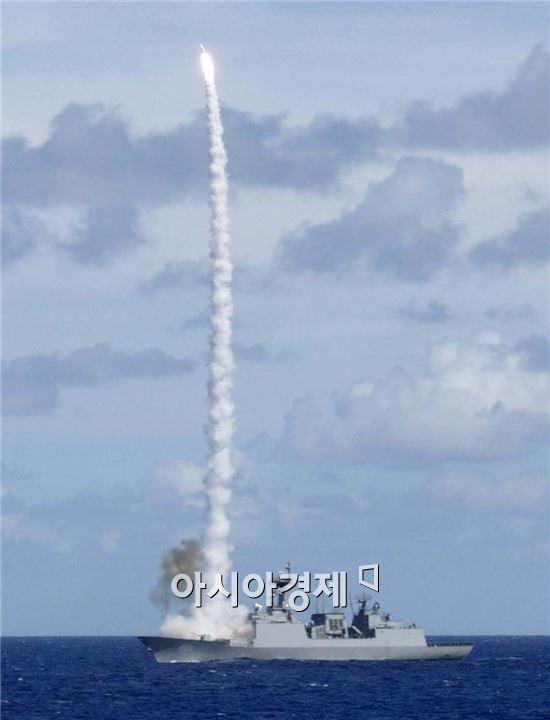 Scene of launching an SM-2 missile from the ROKS Yi Sun-sin ship
[Asia Economy Yang Nak-gyu, Military Specialist Reporter] The controversy over the South Korean military's poor missile response, which surfaced due to misfire accidents, has also appeared in the Navy. It was later confirmed that North Korea's ballistic missile interception test failed due to poor maintenance of key components. The poor management of missile systems by our military has once again come under scrutiny.
According to the military on the 22nd, the Navy's Munmu the Great-class destroyer participated in the US-led multinational joint maritime exercise 'Rim of the Pacific Exercise (RIMPAC)' last July. At that time, the Munmu the Great fired one SM-2 missile to intercept a North Korean ballistic missile but failed to intercept it.
The Navy internally concluded that there was a problem with the missile seeker. Immediately after firing the SM-2, the missile failed to locate the target and self-destructed in mid-air. The missile seeker is a device that guides missiles launched from naval vessels to their targets and is considered a key component in operating interceptor missiles. The Navy introduced missile seekers from the US in 2004, but since 2018, due to the retirement of maintenance personnel and closure of facilities, maintenance has no longer been possible.
However, a bigger problem is that the military's countermeasures were insufficient despite the US company's suspension of maintenance. As maintenance ceased, 215 out of 502 seeker parts (42%) for the Gwanggaeto the Great-class DDH-I and 102 out of 208 parts (49%) for the Chungmugong Yi Sun-sin-class DDH-II were discontinued. According to military officials, parts were patched up by cannibalizing components between ships.
Because of this, the Navy's SM-2 hit rate (70%) is lower than that of the US Navy (75%). Currently, the South Korean Navy possesses about 400 SM-2 missiles, but unless the fundamental problem with the missile seeker is resolved, the hit rate cannot be guaranteed.
Inside and outside the military, there are calls to reorganize the missile system to respond to North Korea's missile provocations. Earlier, during the military's response to North Korea's short-range ballistic missile (SRBM) launch south of the Northern Limit Line (NLL), an error was found in the fighter jet's target designation, causing two guided bombs to not be dropped in time. Subsequently, the F-15K was to fire two SLAM-ER missiles, but a problem occurred during missile loading, resulting in only one missile being fired. Prior to this, last month, there was a misfire accident involving the Hyunmoo-2C ballistic missile, and during the Air Force's guided missile shooting competition, one Patriot interceptor missile failed to launch due to equipment malfunction.
Shin Jong-woo, Secretary General of the Korea Defense and Security Forum, said, "The recent consecutive failures in launching attack and interception weapon systems appear to be mainly due to poor military management," adding, "Not only a comprehensive inspection of missile weapon systems but also improvements in quality control, operational maintenance, and institutional issues need to be addressed."
© The Asia Business Daily(www.asiae.co.kr). All rights reserved.
![Clutching a Stolen Dior Bag, Saying "I Hate Being Poor but Real"... The Grotesque Con of a "Human Knockoff" [Slate]](https://cwcontent.asiae.co.kr/asiaresize/183/2026021902243444107_1771435474.jpg)















