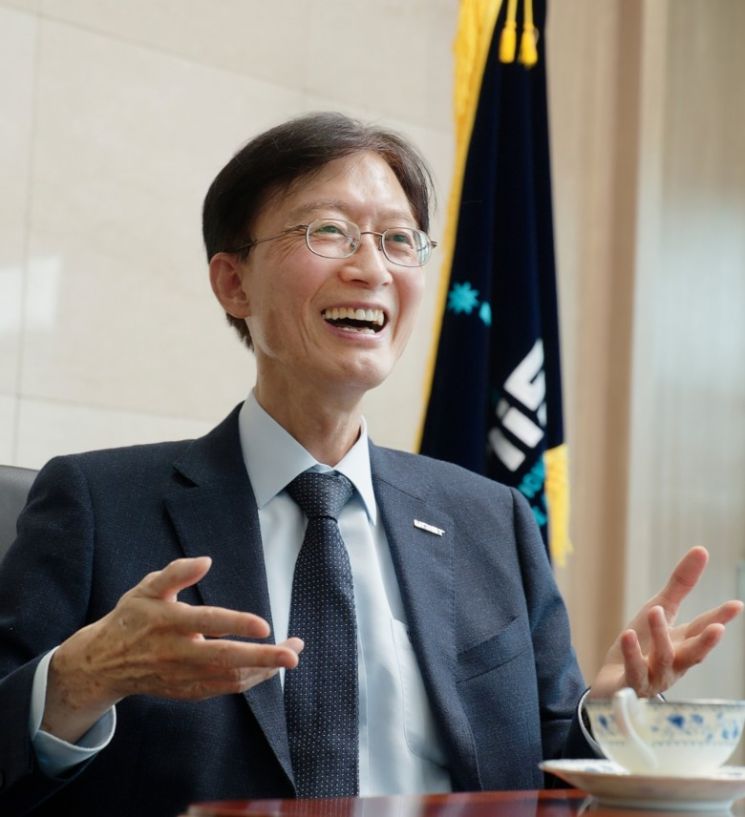
[Asia Economy Yeongnam Reporting Headquarters Reporter Kim Yong-woo] “Ulsan should have a national university,” said citizens and local politicians, who worked tirelessly and after a long period of preparation, broke ground in 2007. Two years later, in 2009, Ulsan National Institute of Science and Technology (UNIST) opened its doors, and with the enactment of the Institute of Science and Technology Act in 2015, the current UNIST was established.
At the time of the foundation of the corporation, the appointment of the first president, and the groundbreaking ceremony held on a barren land stretching across mountains and fields, it was thought to be just one of the national universities that the metropolitan local government with a 10-year history (Ulsan Metropolitan City) naturally wanted as a local ‘talent pool.’ However, most expectations were ‘pleasantly’ proven wrong.
Since its opening in 2009, this 13-year-old university has leaped forward at an accelerating pace beyond expectations, with its goals steadily falling into place in reality.
UNIST recently entered the world’s top 100 universities. It ranked 174th globally in the THE University Rankings and 197th in the QS University Rankings. Domestically, it settled around 5th to 6th place. In the ranking of emerging universities worldwide established within 50 years, it is 11th globally and 1st domestically. These are remarkable achievements for a university only 13 years since opening and 7 years since its transition to an institute of science and technology.
“Our goal is to enter the world’s TOP 100 research-oriented universities within 5 years.”
President Lee Yong-hoon’s first words were as expected. The results already achieved while running predicted the speed at which they would continue.
On the 23rd, marking his 3rd anniversary in office, President Lee opened by saying, “To achieve such a leap, we will focus on instilling a ‘Global First Mover DNA’ throughout research and education.”
President Lee emphasized, “The four major fields of artificial intelligence, semiconductors, carbon neutrality, and biomedical are strategic industries that will change Ulsan’s future.” He also explained, “Through research and development, technology commercialization, and startups in these four fields, the traditional manufacturing city of Ulsan is transforming into an advanced smart industrial city.”
Lee Yong-hoon was appointed as the 4th president of UNIST in November 2019, with a four-year term ending in November 2023.
He said, “Most of the projects planned at the time of my inauguration seem to have been achieved. This is thanks to the interest of Ulsan City, the support of citizens, and the dedicated help of UNIST members.”
“The foundation has been solidified across research, education, organizational culture, and campus environment, and now we have risen to become the top research-oriented university in Korea. We have set a new goal to leap into a world-class research university and are already preparing for it,” he summarized his three years in office.
Regarding UNIST’s domestic status, President Lee said, “Our greatest strength is the outstanding research capability of our faculty. As of 2022, we have a total of 10 HCRs (Highly Cited Researchers, scientists in the top 1% by citation), ranking first among Korean universities. We have also maintained first place domestically for six consecutive years in the Leiden Ranking, which evaluates the qualitative excellence of papers.”
He introduced the four strategic fields that will lead future science and technology.
“They are artificial intelligence, semiconductors, carbon neutrality, and biomedical fields. We have consecutively established four specialized graduate schools: the Graduate School of Artificial Intelligence in 2020, the Graduate School of Semiconductor Materials and Components in 2021, the Graduate School of Carbon Neutrality this year, and the Graduate School of Medical Science next year. We have also established specialized research centers such as the AI Innovation Park in 2020 and the Smart Healthcare Research Center last year, achieving remarkable results. These will be the core foundation for transforming the traditional manufacturing city of Ulsan into an eco-friendly advanced industrial city,” he emphasized.
When asked if aiming to be among the world’s top 100 universities by 2027 was too ambitious, he gave a lengthy and detailed explanation, eager to share his thoughts.
“Looking at countries currently leading global technological hegemony, they all have many world-class research universities that create super-gap technologies. According to the 2023 THE World University Rankings, 50% of the top 100 universities are research universities from the US, UK, and Germany. China has more than doubled its number from 3 in 2020 to 7 in 2023. In contrast, South Korea has only three. Considering that South Korea’s public R&D budget was 27.4 trillion won in 2021, ranking 5th globally in scale, this is a disappointing result. For South Korea to leap into the world’s top five science and technology powers, more world-class research universities must emerge. UNIST is also taking on this mission and aims to enter the world’s top 100 within five years.”
He added specific strategies. “Our goals will be ‘outstanding research achievements comparable to the Nobel Prize’ and ‘producing global innovative companies like Google.’ Entering the world’s top 100 research universities means becoming a global ‘First Mover,’ and the ‘First Mover DNA’ must be established throughout education and research.”
He continued, “Early next year, an international advisory committee composed of Nobel laureates and presidents of the world’s top universities will be launched, and we will build a global network by expanding direct exchanges with the world’s top 100 universities. To strengthen global research competitiveness, we will also expand international joint research and overseas research dispatch programs, advance research support systems, and attract top faculty and students.”
Currently, UNIST has a total of 145 startups founded by professors and students (65 by professors, 80 by students). The total corporate value is estimated to exceed 1 trillion won. The first faculty startup was listed on KOSDAQ in 2020, and two to three other companies are preparing for listing.
Regarding this evaluation, President Lee explained that they focus on supporting technology commercialization for undergraduates and graduate students through startup support based on laboratory research achievements.
He said, “We support sharing laboratory startup achievements and spreading startup culture through the Laboratory Startup Innovation Group, the Laboratory Specialized Startup Leading University project, the joint startup competition among four institutes of science and technology, and the Southeast region laboratory startup team performance presentation.”
UNIST is focusing on playing a ‘magnet-like role’ for regional development.
“We believe we must attract talent, companies, and technology, and based on this, contribute to Ulsan’s future and national development through innovative research and startups.”
He smiled, saying that Lee Junho, chairman of Deoksan Group and a first-generation venture entrepreneur in Ulsan, responded to these efforts by donating 30 billion won as a development fund.
“His development fund will be used to build the ‘Challenge Convergence Hall,’ a cradle for nurturing global startup talent. I think it is the most ideal model of co-growth among universities, companies, and the region. The Challenge Convergence Hall will begin construction in January 2023 and be completed by the end of 2026. As a scientist and technologist, I am very excited to envision what comes after.”
President Lee said, “If only half of the talented students entering UNIST each year could stay in Ulsan, the future of Ulsan would change dramatically.” Therefore, he is focusing on creating an attractive campus where excellent talents want to stay.
He proudly said, “Since last year, we have renovated dormitories and student cafeterias, opened a clinic and pharmacy, and created the UNIST Youth Bus program, which conducts weekend tours of Ulsan and nearby areas. This fall, we newly renovated the first floor of the library into a complex cultural space and opened a stylish book caf?, operating various humanities programs such as lectures and reading clubs.”
Next year, he hopes to open one or two popular restaurants on campus, smiling somewhat unexpectedly. “I hope the campus becomes a popular outing spot where citizens can enjoy time holding their children’s hands,” he concluded.
© The Asia Business Daily(www.asiae.co.kr). All rights reserved.
![Clutching a Stolen Dior Bag, Saying "I Hate Being Poor but Real"... The Grotesque Con of a "Human Knockoff" [Slate]](https://cwcontent.asiae.co.kr/asiaresize/183/2026021902243444107_1771435474.jpg)











