O Gi-hyeong of the Democratic Party and Yoon Chang-hyun of the People Power Party Hold Debate at the National Assembly
Fair Trade Commission Announces Plans to Establish Platform Monopoly Review Guidelines Within the Year
"Issues of Fairness with Other Operators... Concerns Over Reverse Discrimination Against Overseas Platforms"
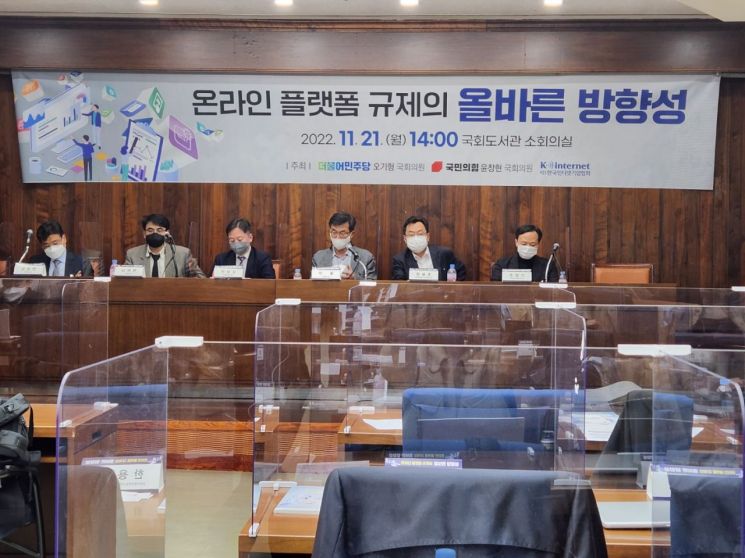 The Korea Internet Corporations Association held a discussion forum on the 21st at the National Assembly Library's small conference room, jointly with Oh Ki-hyung of the Democratic Party of Korea and Yoon Chang-hyun of the People Power Party, on the topic of "The Right Direction for Online Platform Regulation."
 [Photo by Choi Yuri]
[Asia Economy Reporter Yuri Choi] As monopoly regulations on platforms such as Naver and Kakao are anticipated, calls for careful consideration have emerged. The 'Kakao outage' incident, which sparked the discussion, is unrelated to monopoly issues, and introducing regulations could only produce side effects that hinder business innovation and consumer welfare.
On the 21st, the Korea Internet Corporations Association (hereinafter KICA), together with Assemblyman Oh Ki-hyung of the Democratic Party and Assemblyman Yoon Chang-hyun of the People Power Party, held a forum titled "The Right Direction for Online Platform Regulation" at the National Assembly Library's small conference room.
Recently, regulatory discussions on platforms have gained momentum, centered around the political and government sectors. Following last month's Kakao outage caused by a fire at SK C&C's Pangyo data center, platform monopoly regulation has become a major issue. The Fair Trade Commission plans to establish guidelines for reviewing online platform monopolies within the year. The guidelines focus on prohibiting preferential treatment of one's own services, demands for most-favored-nation treatment, and restrictions on multi-homing (interference with the use of competing platforms) based on the platform's market dominance.
The industry pointed out that the Kakao outage resolution and platform monopoly regulation are not closely related. Considering the fire accident as a platform monopoly issue is an approach detached from the core problem. Park Sung-ho, chairman of KICA, said, "There is a need for careful review of the Fair Trade Commission's attempt," adding, "In the current government, which pursues minimal regulation, pushing forward platform review guidelines may undermine the essence of self-regulation."
Academia also supported the cautious approach to monopoly regulation. Treating acts such as platforms favoring their own products or content ('self-preference') or requiring competitors to offer the same or lower prices ('most-favored-nation treatment') as illegal could cause significant side effects.
Professor Park Se-hwan of Seoul National University of Science and Technology Law School stated, "Platforms acting as intermediaries have become providers of products and services, leading to conflicts of interest," and argued, "When regulating this, it is necessary to analyze whether the same standards can be applied to other vertically integrated businesses and whether there are efficiency gains from platform vertical integration." He explained that regulating platforms that both sell and mediate could raise fairness issues with distributors selling both distribution and private brand (PB) products or film production and distribution companies.
Professor Lee Ho-young of Hanyang University Law School emphasized that various aspects should be considered regarding platforms' self-preference acts. He stated that when regulating self-preference, it is necessary not only to prove the purpose of maintaining or strengthening monopoly status but also to sufficiently consider managerial necessity and competition-promoting effects.
Professor Oh Seung-han of Ajou University Law School also said, "Online platforms have very diverse business models and revenue structures, and the factors affecting competition vary," adding, "Their self-preference acts cannot be deemed illegal per se, and proof of competitive restriction effects or potential in related markets is required."
The legal community also expressed concerns. They forecast that the Fair Trade Commission's announced review guidelines could excessively restrict businesses' free economic activities. They also pointed out that monopolies arising from consumer choice should be distinguished from monopolies obtained through unfair means.
Attorney Jeon Sang-ho of the law firm Hwawoo said, "If a monopoly forms because consumers flock to excellent services, artificially regulating the monopoly itself could hinder innovation and reduce consumer welfare," emphasizing, "Government intervention under competition law should only occur when a business acquires monopoly power through unfair means."
Issues of reverse discrimination against overseas platforms were also raised. Attorney Jeon added, "In Europe, there are no giant platforms subject to regulation, and only foreign platforms are regulated, so related regulations have progressed rapidly, but the situation differs from ours," and stressed, "Consideration should be given to avoid reverse discrimination against overseas platforms."
© The Asia Business Daily(www.asiae.co.kr). All rights reserved.

![A Woman with 50 Million Won Debt Clutches a Stolen Dior Bag and Jumps... A Monster Is Born [Slate]](https://cwcontent.asiae.co.kr/asiaresize/183/2026021902243444107_1771435474.jpg)















