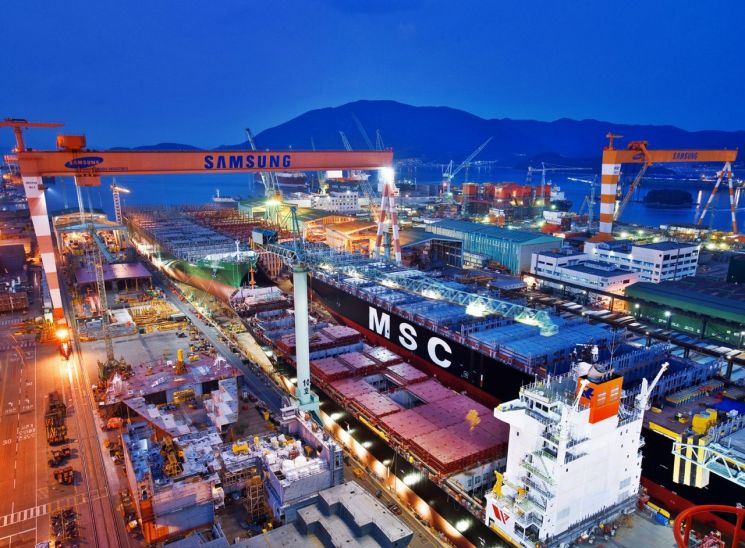
[Asia Economy Reporter Kwon Jae-hee] This year, as the Korean shipbuilding industry has secured a substantial amount of orders, expectations for stock price increases in the shipbuilding sector are also rising. This is due to the improved performance outlook of the shipbuilding industry and the fact that the prices of large liquefied natural gas (LNG) carriers, which the Korean shipbuilding industry has monopolized, are approaching record highs. Although concerns about the base effect next year are growing due to the surge in orders this year, the securities industry still maintains a 'weight increase' opinion.
According to the Korea Exchange as of 9:30 AM, Daewoo Shipbuilding & Marine Engineering is trading at 19,750 KRW, down 1.74% from the previous trading day in the KOSPI market. At the same time, Samsung Heavy Industries (-3.94%), Hyundai Heavy Industries (-1.28%), Korea Shipbuilding & Offshore Engineering (-0.90%), and Hyundai Mipo Dockyard (-0.33%) are also showing weakness.
The shipbuilding sector has previously shown a steep upward trend as part of the 'Taejo-Ibangwon (Solar Power, Shipbuilding, Secondary Batteries, Defense, Nuclear Power)' theme. This is due to the prolonged Russia-Ukraine war causing an energy supply shortage in Europe, which sharply increased demand for LNG carriers. In fact, the Korean shipbuilding industry swept 43% of the global ship orders from January to August this year on a cumulative basis. It is expected that the total order amount for the five major shipbuilders (Daewoo Shipbuilding & Marine Engineering, Hyundai Heavy Industries, Samsung Heavy Industries, Hyundai Mipo Dockyard, Korea Shipbuilding & Offshore Engineering) will reach 42 billion USD by the end of this year.
Despite high expectations for strong performance, stock prices are weak due to concerns about the base effect next year. Daewoo Shipbuilding & Marine Engineering peaked at 29,000 KRW on April 18 and has since declined, while Samsung Heavy Industries also peaked at 6,450 KRW on April 22 and has been on a downward trend. Hyundai Heavy Industries peaked at 161,500 KRW on April 20 and has fallen about 30% since then. It is expected that orders for LNG carriers and container ships will decrease by 35% and 60%, respectively, next year. However, the securities industry believes that despite the peak-out in LNG and container ship orders, tankers and LPG carriers will lead orders, driving overall improvement in the shipbuilding industry.
Choi Kwang-sik, a researcher at Daol Investment & Securities, analyzed, "Despite the decrease in LNG and container ship orders, the total orders for next year are expected to grow by 32% in value due to tankers and LPG carriers."
Additionally, positive factors include the increase in construction of high-priced orders starting next year, reflecting last year's rise in steel plate prices and other cost increases, as well as the rise in new ship prices.
It is also noteworthy that foreigners have continued to buy shares in the shipbuilding sector. This month, foreigners have bought Daewoo Shipbuilding & Marine Engineering shares for 10 consecutive trading days. Hyundai Heavy Industries has been bought for 8 trading days, and Korea Shipbuilding & Offshore Engineering for 10 trading days.
Researcher Choi said, "We maintain a 'weight increase' opinion on the shipbuilding sector in 2023 as well. While LNG led the market this year, the focus in 2023 will be on tankers and offshore (FLNG). We raise the target prices for Hyundai Heavy Industries and Samsung Heavy Industries, which have strengths in tankers and FLNG, and recommend a 'STRONG BUY' investment opinion."
© The Asia Business Daily(www.asiae.co.kr). All rights reserved.
![Clutching a Stolen Dior Bag, Saying "I Hate Being Poor but Real"... The Grotesque Con of a "Human Knockoff" [Slate]](https://cwcontent.asiae.co.kr/asiaresize/183/2026021902243444107_1771435474.jpg)











