In YouGov Poll, Brexit Seen as 'Wrong Decision 56%' vs 'Right Decision 32%'
Former BOE Governor: "Brexit Worsened Inflation"... Chamber of Commerce Head: "EU Agreement Must Be Revised"
[Asia Economy Reporter Park Byung-hee] The UK government announced a five-year medium-term fiscal plan on the 17th (local time) to raise approximately ?55 billion (about 88 trillion won) through tax increases and spending cuts. The top income tax rate (45%) bracket was expanded, and income tax bands were fixed, resulting in millions of people either newly paying taxes or facing higher rates amid an already recessionary UK economy. The Office for Budget Responsibility analyzed that the UK's tax burden would rise from 33.1% of GDP in 2019 to 37.1% in 2024.
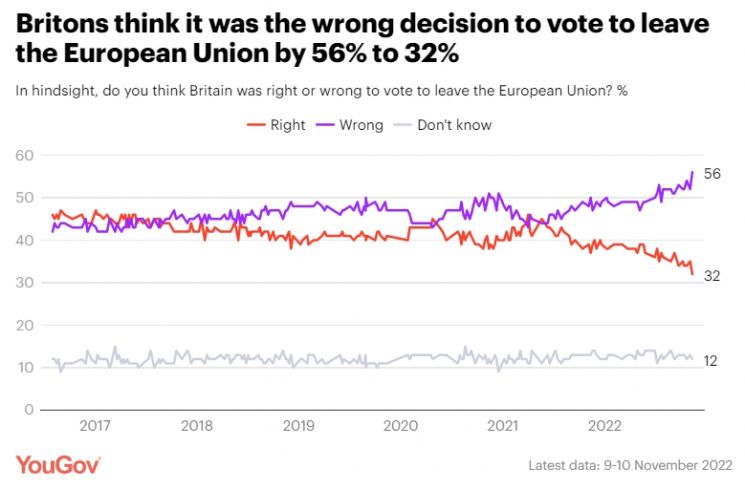
On the same day, UK polling firm YouGov released a survey showing that one in five voters who supported Brexit in the 2016 referendum now regret their vote. In the overall voter survey, only 32% said Brexit was the right decision, while 56% said it was the wrong decision. In the 2016 Brexit referendum, 72.2% of the 46.5 million eligible voters participated, with 51.9% (17.4 million) voting to leave the EU and 48.1% (16.1 million) voting to remain.
As grim forecasts predict that the UK economy will enter its longest recession since World War II, controversy surrounding Brexit is intensifying. Doubts are growing that the fundamental cause of the UK's economic difficulties is Brexit.
UK Chancellor Jeremy Hunt appeared on the BBC on the 13th and said, "Brexit can be a cost or an opportunity for the UK," emphasizing that "the final outcome is what matters." Hunt stated, "I do not agree with the claim that Brexit will make the UK poorer," adding, "While Brexit has been a cost to the UK so far, the UK can turn Brexit into a tremendous success."
Although Hunt's remarks seem to support Brexit, he actually advocated remaining in the EU during the 2016 Brexit referendum.
Like other countries, the UK is experiencing severe inflation. The UK's Office for National Statistics (ONS) reported on the 16th that the consumer price inflation rate for October was 11.1%, the highest since October 1981. Currently, the UK's inflation rate is the highest among the Group of Seven (G7) countries. The large-scale tax cuts proposed by the previous Liz Truss administration triggered a collapse in the pound's value, exacerbating fears of a recession caused by inflation. As confusion grows, criticism is mounting that Brexit is the root cause of the current UK economic crisis.
Former Bank of England (BOE) Governor Mark Carney appeared on BBC Radio on the 4th and argued that Brexit lowered the pound's value and fueled inflation, deepening the UK's economic crisis. Responding to the UK government's claim that inflation is due to COVID-19 and the Ukraine war, Carney added that Brexit is also a cause of inflation. He pointed out that after Brexit, the UK economy contracted and the pound's value fell, increasing inflationary pressures. Carney served as BOE Governor from 2013 to 2020.
Carney's remarks came shortly after the BOE warned of the longest recession on record. At its monetary policy meeting on the 2nd, the BOE warned that the recession had already begun last summer and could continue into the first half of 2024, potentially becoming the longest recession since data collection began.
Former BOE Monetary Policy Committee member Michael Saunders claimed in a Bloomberg interview on the 14th that Brexit caused permanent damage to the UK economy. Referring to the government's austerity plan announced at the time, Saunders argued that without Brexit, the austerity measures would not have been necessary. He said, "If we had not decided on Brexit, we probably would not even be discussing austerity. There would be no need to raise taxes or cut public spending."
Saunders pointed out that Brexit lowered the UK's potential growth rate and reduced corporate investment.
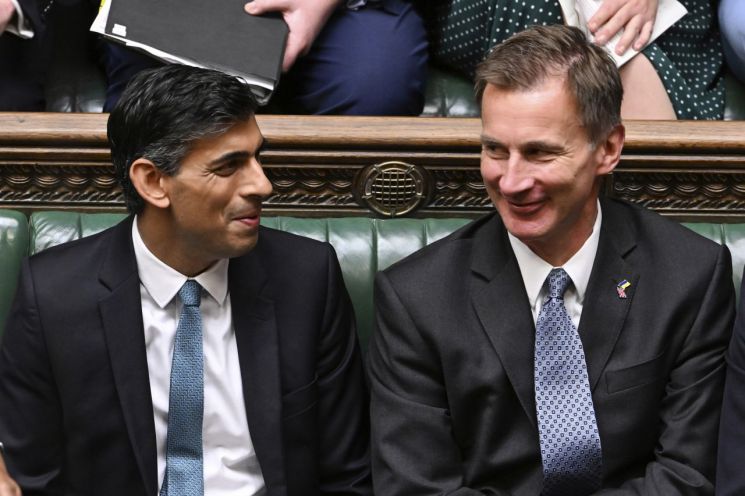 Rishi Sunak, Prime Minister of the United Kingdom (left), Jeremy Hunt, UK Chancellor of the Exchequer
 [Photo by AP Yonhap News]
Shevan Haviland, Secretary-General of the British Chambers of Commerce (BCC), made similar remarks. In an interview on the 7th, Haviland said, "UK businesses have yet to find positive effects from Brexit," and urged Prime Minister Rishi Sunak to renegotiate trade agreements with the EU. He emphasized, "The Sunak administration should reduce the complicated export documentation procedures and simplify tax regulations that have become more complex after Brexit through a new agreement with the EU."
George Eustice, who served as Environment Secretary in Boris Johnson's cabinet until September, stirred controversy by criticizing the UK's first free trade agreement (FTA) with Australia after completing the Brexit process.
The UK completed the Brexit process in January 2020 and signed an FTA with Australia in December 2021. The UK government hailed the first FTA after Brexit as a historic moment with great significance.
However, Eustice pointed out that the UK conceded too much and gained too little in the FTA with Australia. He suggested that the Johnson administration rushed to sign FTAs with other countries to offset the Brexit shock after losing the massive EU market, resulting in mistakes.
Eustice criticized the FTA as overall unhelpful to the UK, except for some provisions such as extending the safeguard period for certain agricultural products from 10 to 15 years.
© The Asia Business Daily(www.asiae.co.kr). All rights reserved.


















