Increase of 10.9 Trillion Won in Social Welfare Budget is a 'Fact'
Welfare Budget Growth Significantly Slowed Compared to Past Trends
Doubts on Welfare Commitment Considering It Is the New Government's First Budget
Detailed Project Analysis Shows Largest Cuts in Welfare Sector
Most of the Increased Budget Taken by Automatic Increases in Public and Basic Pensions
Claimed Increase in Basic Median Income Merely Applies 2020 Calculation Formula
[Asia Economy Reporter Naju-seok] The debate over the truth of the Yoon Suk-yeol administration's welfare budget for next year continues. While the opposition party criticizes it as a 'heartless budget,' the ruling party counters by calling it a 'kind budget.' We examined the direction of this budget, which will serve as a compass for the current administration's welfare policy over the next five years.
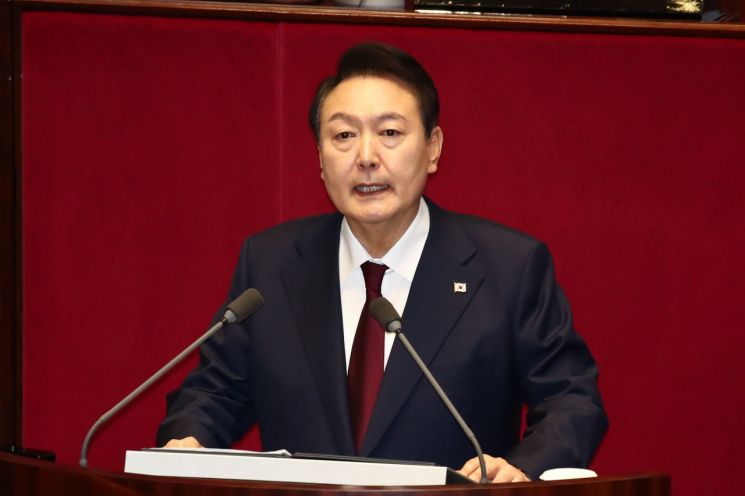
On the 8th, Sung Il-jong, Policy Committee Chairman of the People Power Party, criticized in a press conference on the 'Budget Review Direction' that "the total budget for social welfare for the livelihood and vulnerable under the Yoon Suk-yeol government increased by 10.9 trillion won compared to this year, but the Democratic Party continues to spread false propaganda that the budget for specific projects has been reduced." The next day, on the 9th, members of the National Assembly's Health and Welfare Committee from the Democratic Party and the Justice Party, along with the People's Solidarity for Participatory Democracy, issued a statement at the National Assembly Communication Office condemning the 'reduction of the Yoon Suk-yeol government's welfare budget.'
Earlier than this, Song Eon-seok, Senior Deputy Floor Leader of the People Power Party, appeared on MBC Radio's 'Kim Jong-bae's Focus' on September 2, right after the budget was submitted to the National Assembly, and countered the criticism of the next year's welfare budget as a 'heartless budget' by explaining, "I think it is a kind budget." President Yoon Suk-yeol also explained in his National Assembly policy speech on the 25th of last month, "Protecting socially vulnerable people who suffer greater hardships as the economy worsens is a fundamental duty of the state," and "The government pursues 'welfare for the vulnerable' by supporting low-income and socially vulnerable groups more robustly while promoting fiscal soundness."
What is the nature of next year's welfare budget?
To clarify the issues surrounding the welfare budget controversy, we will examine the actual budget size, comparisons with past budgets, and the characteristics of the budget proposal.
1) Changes in the Size of the Social Welfare Budget
Based on the total amount, it is clear that the welfare budget has increased, as the ruling party explains. Welfare-related budgets dispersed across ministries are consolidated and counted as the 'Health, Welfare, and Employment Budget.' Among the 15 categories classified in this budget, excluding the 'health budget' such as healthcare, health insurance, and food and drug safety, the remaining 12 categories?basic livelihood security, support for vulnerable groups (disabled), public pensions, veterans affairs, housing, general social welfare, child care, elderly, women, family and youth, employment, labor, general employment and labor, healthcare, health insurance, and food and drug safety?are classified as the 'social welfare budget.'
According to the analysis by the National Budget Research Institute, when comparing next year's budget proposal with last year's main budget, out of 869 welfare-related projects, 322 projects were cut by 13.2 trillion won. The projects that were increased numbered 414, totaling 24.1 trillion won. Considering both cuts and increases, it is clear that the welfare-related budget increased by 10.9 trillion won.
Looking at detailed classifications, the employment and housing sectors were cut by 2.3 trillion won and 2.4 trillion won respectively. On the other hand, public pensions increased by 8.3 trillion won, the elderly sector by 2.7 trillion won, basic livelihood security by 2.4 trillion won, and labor by 700 billion won.
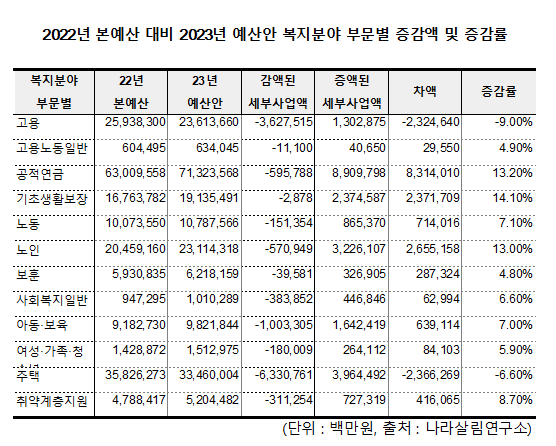
Although the social welfare budget increased overall, when compared to last year's main budget, cuts were made in the largest number of sectors. The budget changes by project were adjusted significantly. Following the social welfare budget, the industrial, small and medium enterprises, and energy sectors saw cuts of 8 trillion won, and defense saw 6 trillion won.
Comparing next year's budget proposal with this year's budget, the largest cut in the social welfare sector was in the rental housing budget. Most rental housing-related projects (multi-family purchase rental (loan), jeonse rental (loan), happy housing (loan), multi-family purchase rental investment projects, etc.) were cut, but only the integrated public rental investment project and integrated public rental loan project increased by 200 billion won each. As a result, the total rental housing-related budget decreased by 5.6 trillion won. Lee Jae-myung, leader of the Democratic Party, criticized immediately after the budget was submitted to the government, saying, "I truly thought it was heartless," and "I cannot understand how the budget was cut to an unimaginable extent instead of increasing it for the unfortunate low-income people suffering from housing difficulties."
Lee Sang-min, Senior Research Fellow at the National Budget Research Institute, said, "The ruling party emphasizes the overall welfare budget increase of 10.9 trillion won and calls it 'kind,' while the opposition points to the 13.2 trillion won cut and calls it 'heartless.' The important point is to see where and how the budget increased." He explained, "It is clear where the budget was cut and increased. The budget was cut in rental housing and employment, and increased in public pensions, reflecting the increase in the elderly population over 65 and inflation."
2) Proportion in the Overall Budget Flow
Next year's total budget is 639 trillion won, of which the social welfare sector budget is 205.8 trillion won. The proportion of the social welfare sector in this year's main budget was 32.1%, while next year's budget increased to 32.2%. The proportion of the social welfare budget in the total budget has increased. The welfare budget increased by 10.9 trillion won (5.6%) compared to the total budget increase of 31.4 trillion won (5.2%). The welfare budget's growth rate is 0.4 percentage points higher than the overall budget growth rate.
However, when compared to past trends, it is possible to see whether the social welfare budget was strengthened in this government's budget.
From 2012 to 2022, comparing the main budget growth rate and the social welfare budget growth rate, the years when the social welfare budget growth rate was lower than the main budget growth rate were only 2013 and 2022. On average during this period, the main budget increased by 6.4%, but the social welfare budget increased by 8.6 percentage points. The social welfare budget grew 2.2 percentage points faster. The increase in welfare demand and aging population combined to make the welfare budget growth rate exceed the overall budget growth rate.
In light of this, next year's budget proposal shows a significant slowdown in the increase of the social welfare budget's share.

As a result, due to the government's fiscal tightening policy, the overall budget growth rate has decreased compared to previous years, but the slowdown in welfare budget growth is even more pronounced.
Another point to note is that next year's budget is the first budget proposal of the Yoon Suk-yeol administration. In the cases of the Park Geun-hye and Moon Jae-in administrations, welfare budgets tended to rise in the early years of their terms to fulfill campaign promises, then slowed down in the later years. For example, in the Park Geun-hye administration's first budget proposal in 2014, the total budget increased by 4.0%, while the social welfare budget increased by 9.6%. Later, the welfare budget growth rate dropped to 5.5% in the final year. Similarly, in the Moon Jae-in administration, the first budget proposal in 2018 saw the total budget increase by 7.1%, and the social welfare budget by 12.1%. Subsequently, the welfare budget declined to 5.4%, lower than the overall budget growth of 8.9%. Considering the characteristic of past administrations actively promoting welfare strengthening early in their terms to fulfill promises, the first budget of the Yoon Suk-yeol administration does not appear to strongly support the social welfare budget.
Choi Hyun-soo, Research Fellow at the Korea Institute for Health and Social Affairs, said, "When a government is inaugurated, the first budget usually actively includes parts related to national tasks, but it is difficult to find such projects in this budget," adding, "(Next year's budget) mostly consists of naturally increased parts."
3) Characteristics of the Budget Proposal
As many social welfare-related budget projects increased and decreased, we examined major increased projects to understand the specific nature of the budget proposal.
The largest increase in this social welfare budget is related to public pensions. The public pension budget increases from 63 trillion won this year to 71.2 trillion won next year. The pension budget increased by 8.3 trillion won. This budget increase occurred naturally due to the increase in recipients of public pensions (National Pension, Government Employees Pension, Military Pension).
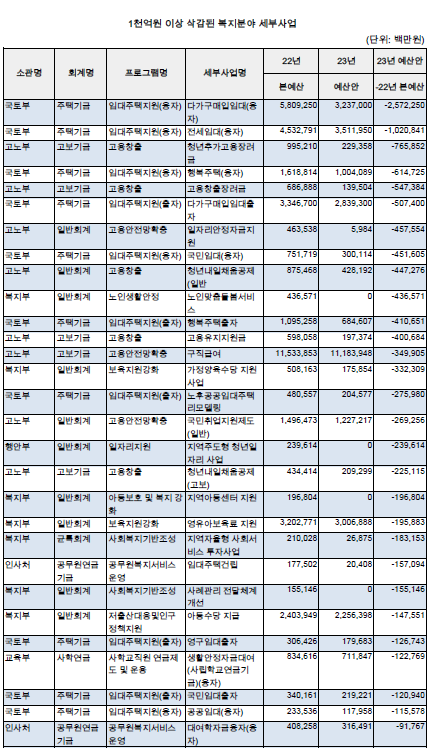
The Ministry of Health and Welfare's elderly-related budget also increased by 2.3 trillion won next year, much of which corresponds to the increase in the basic pension. The basic pension increased from 16.3 trillion won this year to 18.5 trillion won. The number of basic pension recipients rose from 6.31 million to 6.65 million, and the standard pension amount was raised from 301,500 won to 321,950 won considering inflation. Thus, 94.9% of the increase in the Ministry of Health and Welfare's elderly-related budget is due to the basic pension increase.
This 4.7% increase in the basic pension is based on the Basic Pension Act, which stipulates that the payment amount be raised annually reflecting inflation. During the presidential election period, President Yoon promised to gradually raise the basic pension to 400,000 won, but this increase was decided according to existing law, unrelated to his campaign pledge.
With the increase in public pensions and basic pensions alone, the entire increase in next year's social welfare budget is accounted for. All of this increase is mandatory under existing laws, regardless of the government's will.
Excluding these mandatory expenditures, the part emphasized as 'welfare for the vulnerable' in next year's budget is the 5.47% increase in the standard median income. The standard median income, which determines eligibility and benefits for livelihood benefits (below 30% of the standard median income) and medical benefits welfare (below 40% of the standard median income), has risen, expanding the number of eligible recipients. The increase in the standard median income is also the part most emphasized by the government as 'welfare for the vulnerable' in next year's budget. President Yoon also explained in his policy speech, "We pursue welfare for the vulnerable," and "By adjusting the standard median income at the largest scale ever and raising the maximum livelihood benefit payment for a four-person household, we reflected 18.7 trillion won in basic livelihood security support."
However, this increase in the standard median income is not a legal obligation but is difficult to interpret solely as a government policy intention. It is neither more nor less than the existing agreement to raise the standard median income.
The standard median income, which is key in determining eligibility for the basic livelihood security system, has been criticized for being lower than the median income from the government's official Household Finance and Welfare Survey. Therefore, since 2020, the government has decided to gradually adjust the standard median income. The 5.47% increase this time is based on the formula established in 2020. The Moon Jae-in administration did not apply this formula strictly, so this increase is the largest ever. However, recent inflation strongly influenced this increase. Even with the formula-based increase, there are criticisms that it does not guarantee real purchasing power.
Researcher Choi said, "The 5.47% increase in the standard median income is not something to boast about," explaining, "In the past, under the Moon Jae-in administration, the Ministry of Strategy and Finance did not agree to the principle and was dragged along, but now, due to high inflation and a weak economy, private committee members strongly insisted on adhering to the principle, so the Ministry of Strategy and Finance accepted it even though it did not want to."
Oh Geon-ho, Policy Committee Member of the Welfare State We Make, pointed out at the policy discussion hosted by the Inclusion Finance Forum on the 9th titled 'How Should the National Budget Change Amid Economic and Social Crises?' that "The increase rate was determined according to a roadmap to gradually adjust the gap because the standard median income is lower than the official median income from the Household Finance and Welfare Survey," and "Next year's increase rate is the largest since the introduction of the standard median income system in 2015, but considering recent inflation, it is still insufficient to secure the real purchasing power of existing welfare benefits."
© The Asia Business Daily(www.asiae.co.kr). All rights reserved.
![Clutching a Stolen Dior Bag, Saying "I Hate Being Poor but Real"... The Grotesque Con of a "Human Knockoff" [Slate]](https://cwcontent.asiae.co.kr/asiaresize/183/2026021902243444107_1771435474.jpg)


















