2018 Allocation 3rd Year Compliance Check
LGU+ and KT Allocation Canceled for Failing Minimum Standards
Only SKT Barely Passes Among 3 Telecom Giants
SKT Must Build 15,000 Units by May Next Year
December Hearing Procedure Remains, No Surprises Expected
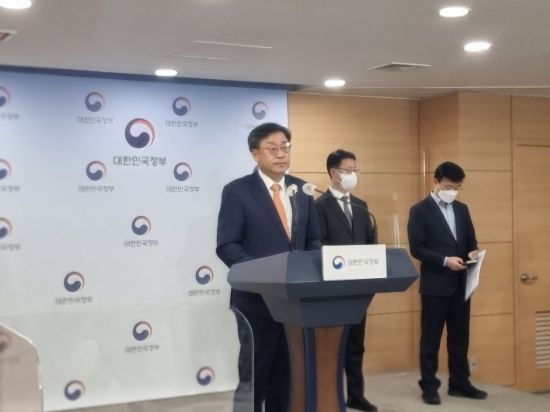 The Ministry of Science and ICT announced the results of the compliance inspection procedure for the allocation conditions imposed during the 5G frequency allocation in 2018 on the 18th. The photo shows Park Yoon-kyu, the 2nd Vice Minister of the Ministry of Science and ICT, conducting a briefing at the Government Seoul Office on the 18th. Photo by Cha Min-young
[Asia Economy Reporter Cha Min-young] The government has taken a tough stance by threatening 'frequency allocation cancellation' against LG Uplus and KT, which failed to meet the standard scores in the third-year performance review of the 5G 28 GHz frequency allocation. SK Telecom narrowly avoided cancellation by shortening the usage period by six months. The government plans to ease the entry barriers for new operators rather than existing telecommunications service providers to activate market competition.
'Failure to fulfill the allocation condition of building 15,000 base stations'
The Ministry of Science and ICT announced on the 18th the results of the implementation inspection procedure for the allocation conditions imposed during the 2018 5G frequency allocation.
Previously, when allocating the 5G frequencies in 2018, the Ministry of Science and ICT accepted requests from the three major telecom companies and allocated both the 3.5 GHz band and the 28 GHz band. At that time, the condition was imposed to build 22,500 base stations in the 3.5 GHz band and 15,000 in the 28 GHz band by the third year, but some operators failed to meet the minimum standards.
The Ministry received the implementation performance reports of the allocation conditions from the three telecom companies in April this year. The inspection procedure consisted of a written and on-site inspection by the Korea Communications Agency (KCA) on the submitted performance, followed by an evaluation by the evaluation committee. After the evaluation, the KCA reported the results to the Ministry of Science and ICT, concluding the process.
As a result of the inspection, all three operators scored over 70 points in the 3.5 GHz band, fulfilling the conditions. However, in the 28 GHz band, where all operators' network construction performance fell significantly short of the mandatory quantity, SKT scored 30.5 points, LG Uplus 28.9 points, and KT 27.3 points. SKT was the only operator to surpass the 30-point threshold, narrowly avoiding cancellation. However, SKT also faces a six-month reduction in the usage period (10% of the 5-year term) from the Ministry, and if it fails to meet the condition of building 15,000 devices by May 2023 before reallocation application, cancellation measures may be imposed.
Choi Woo-hyuk, Director of the Radio Policy Bureau, explained, "60% of the evaluation was quantitative, including past construction performance as of the end of December last year," and "40% included operators' plans and explanations such as service usage plans."
The construction and operation of 28 GHz Wi-Fi facilities and equipment in the subway will be handled by SKT, which avoided cancellation. Currently, the three telecom companies completed a demonstration to improve subway Wi-Fi performance using 5G 28 GHz on the Seongsu branch of Seoul Subway Line 2 last year and have been jointly expanding construction on Lines 2 and 5?8. However, the government drew a line between this sanction case and subway Wi-Fi, calling them 'separate issues.' Specific solutions will be decided through additional discussions with the operators.
One canceled band to be allocated to new operators... Competition activation
The government plans to attract new operators to the 5G 28 GHz band, which has been considered the 'territory of the three major telecom companies,' to activate market competition. The final disposition for the three telecom companies will be confirmed through a hearing procedure in December. If two operators are canceled after the hearing, the Ministry of Science and ICT will actively promote the entry of new operators for one of the canceled frequency bands.
Considering the uncertain domestic and international economic conditions, attracting operators to invest newly in the 5G 28 GHz band may be difficult, so support measures will also be devised. For example, the ministry plans to supply anchor frequencies necessary for signal control in the 28 GHz band in bands preferred by the market, and consider new allocation methods that allow operators to choose frequency usage units (nationwide, regional, etc.) to reduce investment burdens and help secure competitiveness for new operators. Support measures for interconnection and facility provision among existing telecommunications service providers will also be reviewed.
Furthermore, if the 28 GHz frequency is supplied to new operators, the remaining one band will be supplied through competition after a certain period, and one of the two operators whose allocation was canceled may face restrictions on frequency supply. Regarding speculation that SpaceX, a U.S. company operating the Starlink business, will be on the list of new operators, Jeong Chang-rim, Director of Telecommunications Policy, said, "Under the Telecommunications Business Act, foreign companies cannot register as telecommunications service providers but can invest in shares," adding, "Shareholding is limited to 49%, but indirect investment up to 100% is possible under the Korea-U.S. Free Trade Agreement (FTA)."
The Ministry of Science and ICT plans to announce policy directions for the remaining one band and measures to promote new operator entry for the two canceled bands during the final disposition in December to revitalize the domestic 5G ecosystem. It will also prepare institutional measures such as enforcement fines to impose economic disadvantages on operators who fail to fulfill allocation conditions, in line with promises made to the public.
Government expresses regret... Operators also express regret
The government expressed regret over the outcome despite various support efforts to revitalize the domestic 28 GHz band ecosystem. It judged that the immature domestic 28 GHz band ecosystem compared to overseas could be problematic, especially as millimeter-wave usage is expected to increase in future 6G mobile communications. While advanced countries like the U.S. and Japan have active business-to-consumer (B2C) services, domestic telecom companies are seen as having low willingness to activate the ecosystem due to cost reduction issues.
Park Yoon-kyu, Second Vice Minister of the Ministry of Science and ICT, said, "The government has continuously encouraged the three mobile carriers to fulfill allocation conditions and supported them in various ways, but we regret this outcome," adding, "Going forward, the government will promote new operator entry and implement 5G activation policies through competition by allowing frequency use to only one existing operator."
The three telecom companies have mixed reactions. Although the hearing procedure remains in December under the Administrative Procedures Act, it is practically difficult for operators to nullify the Ministry's sanctions. Choi Woo-hyuk, Director of the Radio Policy Bureau, said, "SKT will also be included as it had a six-month usage period reduction besides LG Uplus and KT," and "If there are significant reasons during the hearing process, they may be reflected."
An LG Uplus official said, "We regret the government's decision," and added, "If the allocation is canceled, customer damage is expected due to the suspension of 28 GHz services already provided in public Wi-Fi, subway Wi-Fi, sports stadiums, and public institutions," expressing hope for user protection measures.
An SKT official said, "We take the government's measures seriously and will consult with the government on future business directions." A KT official also said, "We regret that the infrastructure construction level did not meet the government's expectations due to the realistic limitations of the 28 GHz radio characteristics," and added, "We will continue to consult with the government to build 5G public networks and subway Wi-Fi."
© The Asia Business Daily(www.asiae.co.kr). All rights reserved.

















