Seoul National University Medical School 293 points, Yonsei University Medical School 293 points
Seoul National University Business Administration 288 points (Jongno), 280 points (Daesung)
Yonsei University Pre-Med 293 points, Korea University Medical School 290~292 points
Math influence increases due to lower Korean language difficulty
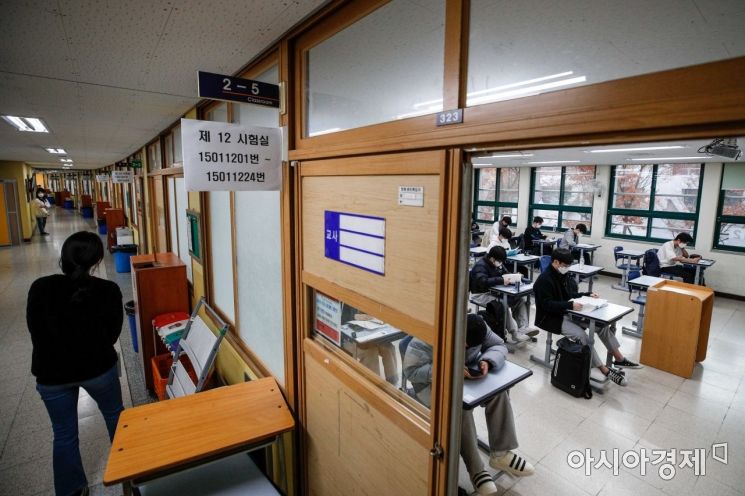 On the 17th, the day of the 2023 College Scholastic Ability Test, examinees are waiting for the exam to start at the testing site set up at Gyeongbok High School in Jongno-gu, Seoul. Photo by Jin-Hyung Kang aymsdream@
[Asia Economy Reporter Han Jinju] After the 2023 College Scholastic Ability Test (CSAT), the admissions industry set the expected top-tier cutoff scores higher than last year. For Seoul National University College of Medicine, the cutoff is expected to rise by about 3 points. The admissions industry anticipates that with increased differentiation in mathematics, cross-application will be more active than last year.
On the 18th, Jongno Academy analyzed the expected cutoff scores for major universities based on provisional scoring (raw scores). Seoul National University’s College of Medicine is expected to be 294 points, 3 points higher than last year, and the College of Business is 288 points, 2 points higher. The Department of Political Science and International Relations (286 points) and the Department of Korean Language Education (282 points) are each 1 point higher, while Pharmacy (281 points) and the Department of Chemical and Biological Engineering (280 points) are 5 and 6 points higher, respectively.
Yonsei University’s College of Medicine is expected at 293 points, and the Department of Business Administration at 280 points, 3 and 1 points higher than last year, respectively. Korea University’s College of Medicine is at 292 points, 3 points higher than last year, and the Department of Business Administration at 281 points, 1 point higher. In the top-tier humanities majors in the Seoul area, scores rose by 1 to 3 points, and the medical schools of Seoul National University, Yonsei University, and Korea University each increased by 3 points.
The expected cutoff scores for major universities in the Seoul area are projected to rise by 7 to 9 points based on raw scores, and natural science general majors by 5 to 8 points. In particular, Hanyang University’s Department of Policy Science (264 points) and College of Business (262 points) increased by 7 and 8 points, respectively, compared to last year.
Daesung Academy’s analysis of Seoul National University’s major department cutoff scores are ▲Medicine 293 points ▲Business 280 points ▲Electrical and Computer Engineering 279 points ▲Political Science and International Relations 278 points ▲Pharmacy 277 points ▲Korean Language Education 272 points. Compared to last year’s expected cutoff scores by Daesung Academy, Medicine is 3 points higher, Pharmacy remains the same, but humanities majors declined by 3 points in Business, 3 points in Political Science, and 1 point in Korean Language Education.
For Yonsei University, the expected cutoff scores are ▲Medicine 293 points ▲Dentistry 282 points ▲Pharmacy 275 points ▲System Semiconductor Engineering 272 points ▲Business 272 points ▲Political Science and International Relations 266 points ▲English Language and Literature 265 points. Compared to last year’s expected cutoff scores, Medicine and Dentistry rose by 3 points, Pharmacy by 2 points, while Business and Political Science dropped by 1 point, and English Language and Literature decreased by 2 points.
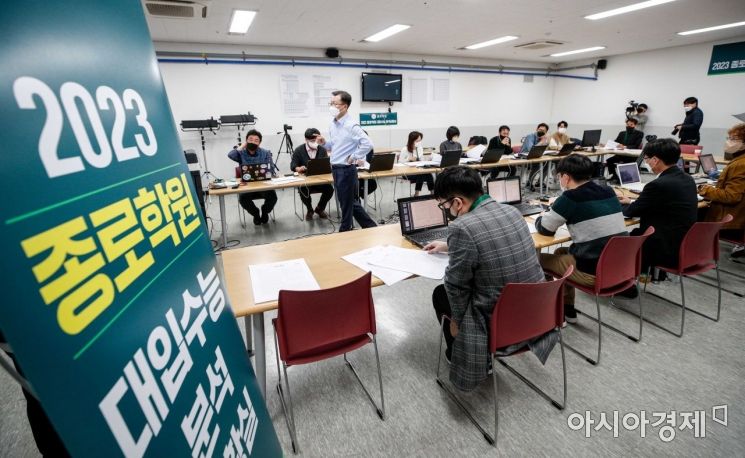 On the 17th, the day of the 2023 College Scholastic Ability Test, academy instructors are operating a problem analysis situation room at the Jongno Academy Gangbuk headquarters in Mapo-gu, Seoul. Photo by Jang Jin-hyeong aymsdream@
This year’s CSAT difficulty slightly decreased compared to last year’s ‘bul-sunung’ (extremely difficult exam), and the admissions industry expects the cutoff for grade 1 to rise. However, since calculus in mathematics was difficult, there are forecasts that scores may remain the same or decline.
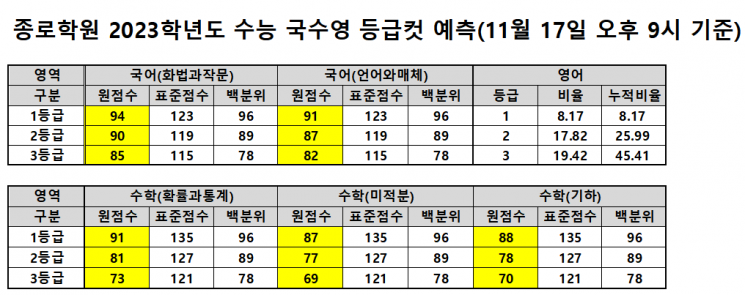
For Korean Language (Speech and Writing), the raw score cutoff for grade 1 is expected to be 94 points by Jongno Academy, 93 points by Jinhaksa, and 91 points by Megastudy. For Korean Language (Language and Media), Jongno Academy and Jinhaksa expect 91 points, and Megastudy 89 points. These are about 5 to 8 points higher than last year.
For Mathematics (Probability and Statistics), the grade 1 cutoff is expected to be 91 points by Jongno Academy, 89 points by Jinhaksa, and 88 points by Megastudy. Jongno Academy forecasts a 1-point increase, while the other two predict a 1 to 2 point decrease. For Mathematics (Geometry), Jongno Academy and Jinhaksa expect 88 points, and Megastudy 86 points. Only Megastudy predicts a 2-point decrease, while the others expect the same as last year. For Mathematics (Calculus), Jongno Academy expects 87 points, and Jinhaksa and Megastudy 85 points, which is 1 to 3 points lower than last year.
Lim Seong-ho, CEO of Jongno Academy, said, “Students in the 1st to 3rd grade range in Korean scored about 10 points higher than usual, meaning they answered 3 to 4 more questions correctly in the grade 1 range. While math scores in the grade 1 range were similar, since Korean was easier, the overall cutoff is expected to rise by 7 to 8 points.”
Lee Mangi, director of Uway Education Evaluation Research Institute, said, “Since Korean was somewhat easier this year, the differentiation in Korean among top-tier students has practically disappeared compared to last year, so the importance of mathematics will increase. Mathematics will have a significant influence not only in natural sciences but also in humanities.”
The percentage of students achieving grade 1 in English is expected to be 8.17% by Jongno Academy, and around 7% by Gangnam Daesung Academy and Megastudy. This is slightly higher than last year’s 6.25%. While the September mock exam saw an expansion to 15.97%, this year’s CSAT was as difficult as last year. The percentages for grade 2 (cumulative 25.99%) and grade 3 (45.41%) in English decreased compared to last year.
Lim said, “For English, the top-tier students who can enter grade 1 maintained last year’s level, but grade 2 dropped by 2 percentage points and grade 3 by 8 percentage points, making it difficult for students in the grade 2 to 3 range, so they may fall to grades 3 to 4.”
Although the integrated CSAT for humanities and sciences has entered its second year, the controversy over the advantages and disadvantages of elective subjects is expected to continue this year. The increased differentiation in mathematics has created favorable conditions for science students, and the likelihood of active cross-application has increased.
Lim Seong-ho, CEO of Jongno Academy, explained, “Humanities students should carefully check whether the math scores required for the departments they plan to apply to through cross-application have increased compared to before the integrated CSAT. Conversely, science students with good math scores but weaker science exploration subjects may find it advantageous to cross-apply to humanities.”
In July, Uway conducted a survey of 456 members, and 54.9% of those who took Calculus and Geometry responded that they intended to cross-apply. Among those who chose science exploration subjects, 56.5% considered cross-application.
Director Lee Mangi said, “This year as well, natural science students with excellent math scores are likely to lead fluctuations in cutoff scores by crossing between humanities and sciences. The business-related fields, which saw the most cross-applications from science students, require caution from humanities students. However, since the regular admission process calculates total scores by subject area rather than individual subjects, applicants should carefully consider the weighting of each area when deciding on universities.”
He added, “Due to the easier CSAT compared to previous years, the actual competition rates for essay-based admissions and student record-based admissions with minimum academic requirements are expected to rise somewhat. Therefore, it is necessary to carefully check whether minimum requirements are met and actively prepare for remaining university-specific exams such as essays and interviews.”
© The Asia Business Daily(www.asiae.co.kr). All rights reserved.
![User Who Sold Erroneously Deposited Bitcoins to Repay Debt and Fund Entertainment... What Did the Supreme Court Decide in 2021? [Legal Issue Check]](https://cwcontent.asiae.co.kr/asiaresize/183/2026020910431234020_1770601391.png)


















