Analysis of Cumulative Fatality Rate Over 3 Years... Fatality Rate Rises Again After 3rd Infection
US Study Shows Reinfection Fatality Rate More Than Doubles
[Asia Economy Reporter Jo In-kyung] The fatality rate of domestic COVID-19 reinfection cases was found to be lower than that of first-time infections. However, in cases of third-time infections, the fatality rate increased to about four times that of first-time infections.
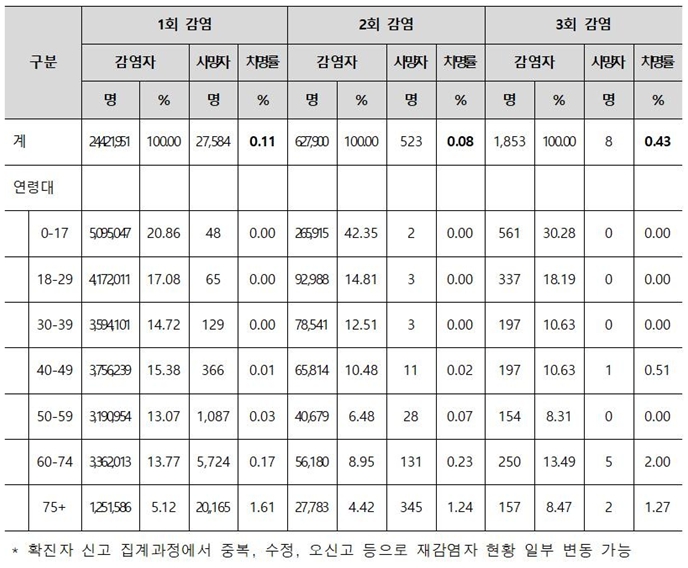
According to the Central Disease Control Headquarters on the 19th, since the COVID-19 outbreak began in January 2020 until the 5th of this month, 24,421,951 people were infected with COVID-19 once, among whom 27,584 died, resulting in a fatality rate of 0.11%.
The number of people infected twice was 627,900, with 523 deaths, recording a fatality rate of 0.08%, which is 0.03 percentage points lower than that of first-time infections.
However, among those infected three times, the fatality rate rose sharply: out of 1,853 people, 8 died, resulting in a fatality rate of 0.43%. This is four times higher than the 0.11% fatality rate of first-time infections and more than five times higher than the 0.08% of second-time infections.
The health authorities consider a case as reinfection if a positive result is confirmed by a polymerase chain reaction (PCR) test or a professional rapid antigen test (RAT) 45 days or more after the last confirmed positive test, regardless of symptoms.
Among the elderly, in the 60?74 age group, the fatality rate of second-time infections (0.23%) was higher than that of first-time infections (0.17%). Conversely, in those aged 75 and older, the fatality rate of second-time infections (1.24%) was actually lower than that of first-time infections (1.61%).
The Central Disease Control Headquarters explained, "Because the number of third-time infection cases is relatively small, the fatality rate fluctuates significantly. Also, since the distribution of age and vaccination status differs by number of infections, fatality rates between groups cannot be simply compared."
Meanwhile, this analysis contrasts with U.S. research findings that reinfected individuals have higher risks of death and severe illness than those infected once. On the 10th, researchers from Washington University School of Medicine in St. Louis analyzed data from the U.S. Department of Veterans Affairs (VA) and found that people infected two or more times had more than twice the risk of death and more than three times the risk of hospitalization compared to those infected once.
© The Asia Business Daily(www.asiae.co.kr). All rights reserved.


















