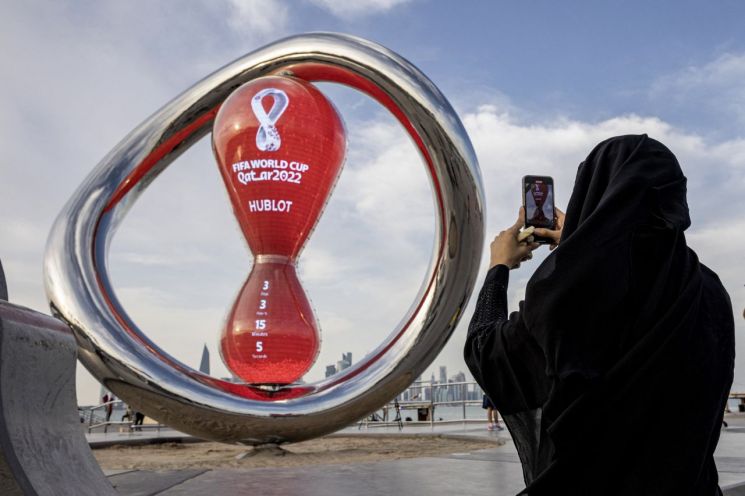
[Asia Economy Reporter Jeong Hyunjin] The '2022 Qatar World Cup' opens on the 20th (local time). The World Cup held in Qatar, a conservative Islamic country with a population of 3 million and summer temperatures exceeding 40 degrees Celsius, has attracted worldwide attention. Qatar, which received the title of 'the first World Cup held in the Middle East,' has devoted 12 years of preparation since being confirmed as the host in 2010. Although the profits expected from this event are estimated to be less than 9 trillion won, Qatar has invested 290 trillion won to build not only stadiums but also subways and hotels, effectively remodeling the city.
◇ Qatar Invested $220 Billion
According to Bloomberg and others on the 18th, the funds Qatar has poured into hosting this World Cup are estimated at $220 billion (about 296 trillion won). This is 20 times larger than the $11.6 billion spent on the previous event, the 2018 Russia World Cup. It is four times the total cost of $48.63 billion for all World Cups held from 1990 to 2018. Compared to other international sports events such as the Olympics, it is also beyond imagination. The cost of hosting the 2008 Beijing Olympics was $42 billion.
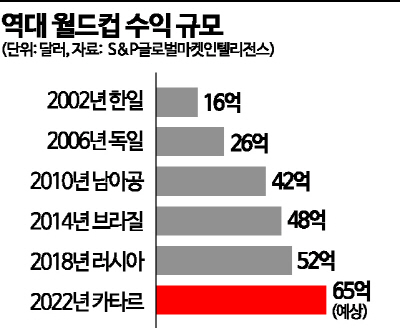
Qatar used these funds to build seven new stadiums. More than 30,000 new rooms were also secured. Additionally, three subway lines were constructed, highways and airports were upgraded, and various entertainment facilities such as golf courses and department stores were established in Lusail, Qatar's second city after Doha. Qatar stated that most of the infrastructure costs were part of the public investment project 'Qatar National Vision 2030.' Qatar explained that it had planned to invest in infrastructure for national growth, and the World Cup served as a catalyst in this process.
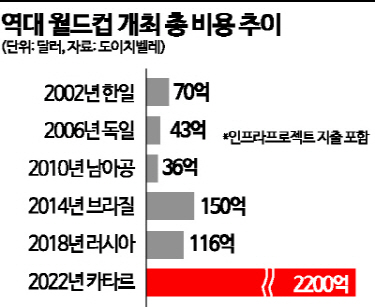
Market research firm S&P Global Market Intelligence analyzed that Qatar will earn $6.5 billion in revenue from this World Cup. The revenue generated by the last five World Cups has been increasing, and the Qatar World Cup is expected to set a record high. However, considering the astronomical costs of infrastructure investment, it is likely to place a considerable burden on Qatar's finances in the future.
CNBC stated, "Hosting the World Cup can attract attention to the host country in various aspects such as tourism, foreign trade, and jobs," but also pointed out, "Hosts may face difficulties due to excessive spending on infrastructure and stadiums." This has led to criticism that the World Cup is a 'white elephant' event, meaning it incurs high maintenance costs and leaves behind useless facilities. Bloomberg reported, "Qatar is expected to modernize its image through this tournament and help transform into a tourism and business destination similar to its regional rival Dubai."
◇ A Dry Country but... Sponsor Budweiser's Dilemma
The Qatar World Cup is expected to be an unfriendly host country for sponsor companies. An indispensable element of the World Cup event is sponsor companies and beer. Sponsors are an important consideration for both FIFA and the host country, and beer is an element that attracts the interest of spectators and viewers.
A representative FIFA sponsor is AB InBev. AB InBev's brand Budweiser has been the only official beer brand among World Cup sponsors since 1986. According to The New York Times (NYT), AB InBev has paid $75 million every four years related to the World Cup. AB InBev renewed its sponsorship contract to maintain it until 2022 after Qatar was confirmed as the host in 2011.
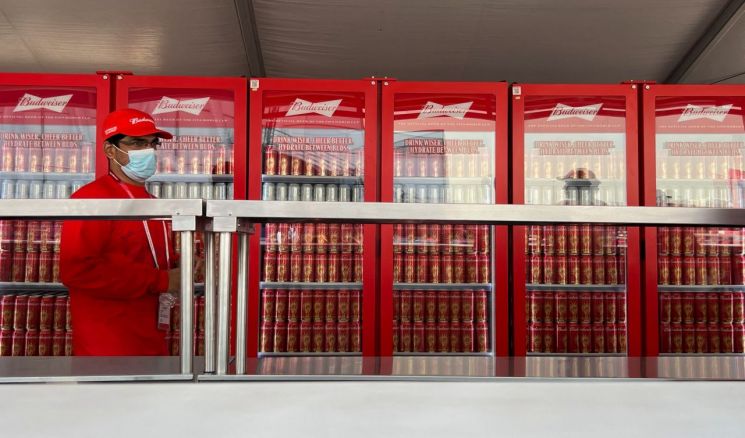
The problem was that the matches were held this year in Qatar, where Islamic law is strictly applied and alcohol consumption is conservative. The NYT reported that the Qatar World Cup organizing committee had difficulties coordinating between AB InBev and Qatar. Initially, Qatar intended to hold a dry World Cup without alcohol, but during negotiations with FIFA and others, Qatar backed down and only in September this year was an agreement reached to allow beer sales in some areas. AB InBev was allowed to sell Budweiser beer only before and after matches in certain areas near the stadium, and bringing beer into the stadium stands was prohibited.
However, just eight days before the World Cup, AB InBev was notified to move the beer sales booths to less conspicuous locations. AB InBev had already installed the booths last month, but recently a member of the Qatari royal family discovered them and requested their relocation. The NYT reported that "other long-time FIFA sponsors like McDonald's were also asked to move their booths to different locations," reflecting the atmosphere.
◇ Controversy Over Migrant Workers' Human Rights
Qatar has been embroiled in numerous controversies while preparing for this World Cup. Corruption was confirmed during the 2010 host selection, and related lawsuits are still ongoing. Former FIFA President Sepp Blatter recently claimed in a foreign media interview that "choosing Qatar as the host was a mistake," alleging corruption in the World Cup host selection process.
Moreover, human rights issues arose during the preparation process. Qatar actively brought in migrant workers from Nepal, the Philippines, and other countries to prepare for this World Cup. Currently, more than 80% of Qatar's 3 million population are estimated to be foreign workers. However, there has been strong criticism that these workers were employed in stadium construction under low wages and extreme heat. In particular, the death toll of about 6,700 migrant workers has been reported, drawing criticism mainly from Europe. Issues regarding the oppression of sexual minorities have also been raised.
© The Asia Business Daily(www.asiae.co.kr). All rights reserved.
![Clutching a Stolen Dior Bag, Saying "I Hate Being Poor but Real"... The Grotesque Con of a "Human Knockoff" [Slate]](https://cwcontent.asiae.co.kr/asiaresize/183/2026021902243444107_1771435474.jpg)


















