Multiple Accidents in Incheon Seo-gu Area Cause Distress
Inhalants Disappear After 3-4 Hours in the Air
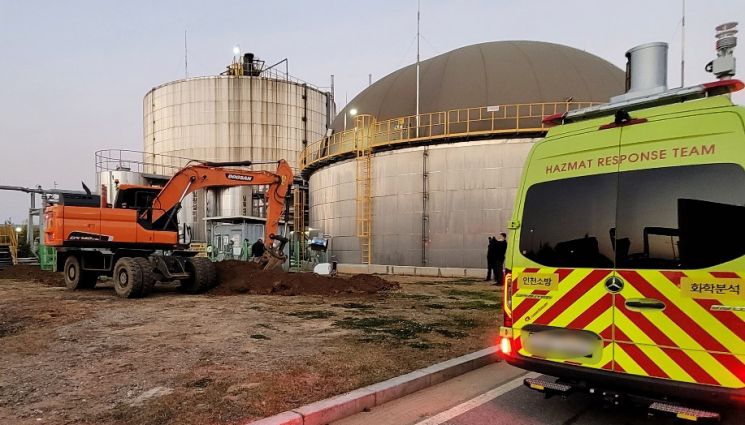
[Asia Economy Reporter Kim Hyunjung] A commotion erupted with hundreds of complaints about foul odors after an odorant leaked at the Sudokwon Landfill Site in Seo-gu, Incheon.
According to Seo-gu, Incheon, and the Sudokwon Landfill Site Management Corporation on the 17th, around 3 p.m. that day, approximately 30 liters of liquid odorant leaked at the sewage bio-gasification facility within the Sudokwon Landfill Site in Seo-gu, Incheon. Odorants are substances added to detect leaks of environmentally harmful, toxic, or explosive materials by smell, emitting a gas or rotten egg odor. Although odorants dissipate into the atmosphere within 3 to 4 hours and are known to be harmless to humans in small amounts, prolonged exposure to high concentrations can have adverse effects.
Immediately after the odorant leak, foul odors were detected not only in Seo-gu’s neighborhoods such as Geomam-dong, Gyeongseo-dong, and Dangha-dong but also in nearby areas including Gyeyang-gu, Gyeonggi Gimpo City, and Seoul Gangseo-gu. As a result, local mom cafes and online communities were filled with anxious and worried posts such as "The smell is causing dizziness and headaches" and "I opened the windows thinking the smell was coming from outside." Moreover, safety alert messages were not promptly sent to the affected areas, which increased public dissatisfaction.
Seo-gu, Incheon, sent a safety advisory text message at around 5:54 p.m. to inform residents about the odorant leak at the Sudokwon Landfill Site and announced that measures had been completed to prevent further leaks. The Sudokwon Landfill Site Management Corporation conducted containment work using absorbent pads and soil after the leak, followed by spraying deodorants and water cleaning. A landfill corporation official stated, "The leak occurred during the dismantling of odorant-related equipment," and added, "Based on the fire department’s on-site investigation, it is considered harmless to humans."
The Seo-gu area of Incheon, where the odorant leak occurred, previously experienced inconvenience during the 2019 "Red Tap Water" incident. At that time, red tap water (rusty water) flowed for over two months, causing some residents to be unable to properly wash dishes or shower, school meals were suspended, and small business owners suffered significant losses. In 2020, the same area faced a "tap water larvae" crisis when midges laid eggs in the activated carbon filter of the Gongchon Water Purification Plant, resulting in midge larvae being found in the tap water.
Odor problems caused by odorants have also occurred in the past in Busan. In July 2016, 256 reports of "gas smell" were received in the Busan area, but the government formed a joint investigation team only six days after the odor was reported, delaying immediate identification of the cause. Residents feared a gas leak. After an eight-day investigation, the joint team announced that "the odorant injected into city gas or waste containing odorant leaked during vehicle transport," but the exact leak route or vehicle was never identified.
© The Asia Business Daily(www.asiae.co.kr). All rights reserved.
![Clutching a Stolen Dior Bag, Saying "I Hate Being Poor but Real"... The Grotesque Con of a "Human Knockoff" [Slate]](https://cwcontent.asiae.co.kr/asiaresize/183/2026021902243444107_1771435474.jpg)











