Public Hearing on the Yellow Envelope Act by the Environment and Labor Committee on the 17th
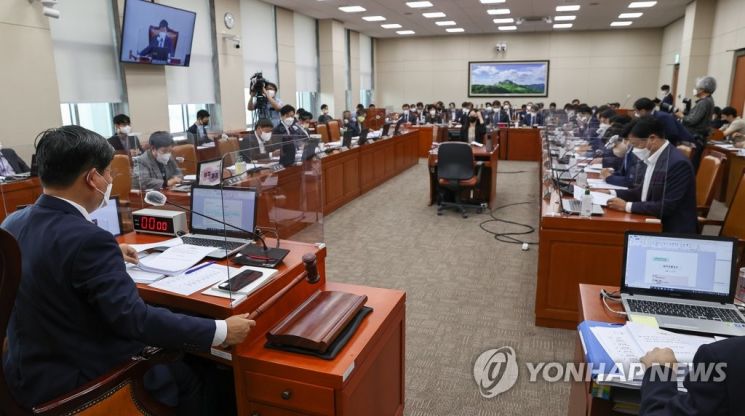
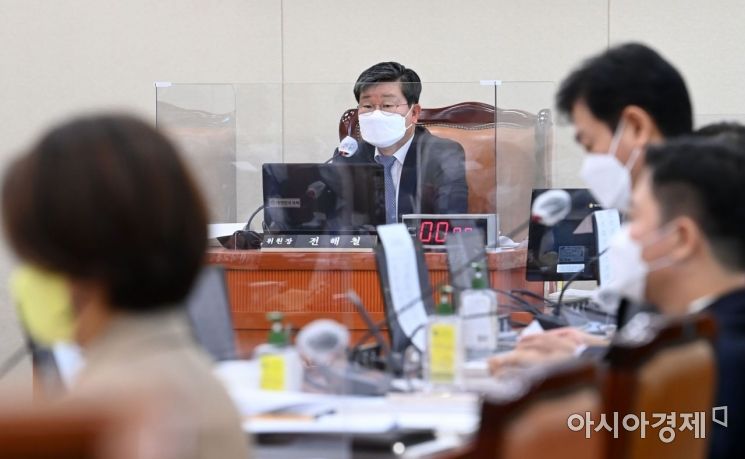 Jeon Hae-cheol, Chairman of the National Assembly Environment and Labor Committee, is speaking at the audit of 12 affiliated organizations including the Korea Workers' Compensation and Welfare Service held at the National Assembly on the 17th. Photo by Yoon Dong-joo doso7@
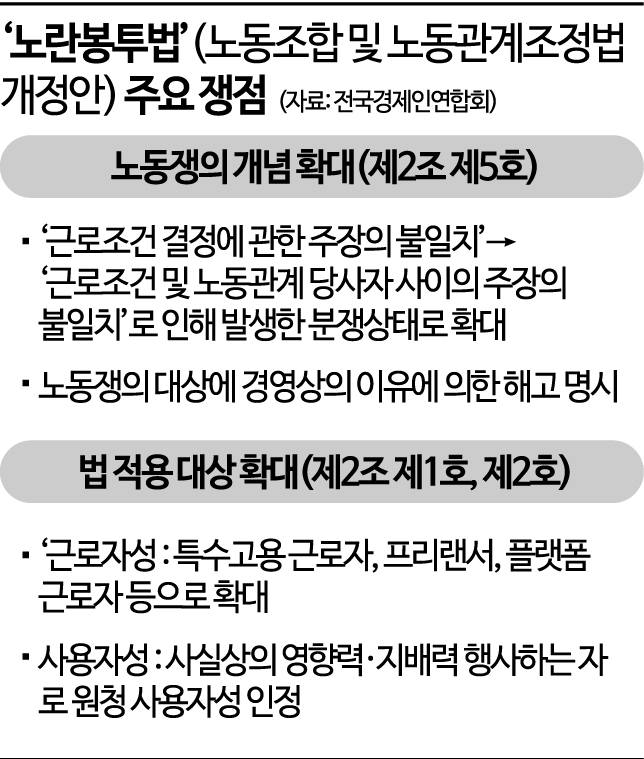
[Asia Economy Reporter Koo Chae-eun] At the public hearing on the "Yellow Envelope Act" (Amendments to Articles 2 and 3 of the Labor Union Act), which limits companies' claims for damages against striking workers, the arguments between supporters and opponents were sharply divided.
The opposition highlighted that the Yellow Envelope Act could encourage illegal strikes and conflicts, potentially stifle corporate management activities, and may be unconstitutional due to infringement on constitutional Article 23's right to private property. Supporters argued that claims for damages related to labor disputes lead to pressure on union members to withdraw, that primary contractors do not acknowledge employer status and refuse to come to the negotiating table, and thus called for the amendment of the Yellow Envelope Act.
Professor Lee Jung of the Graduate School of Law at Hankuk University of Foreign Studies, who testified on the opposition side, stated, "If the amendment to Article 2 of the Labor Union Act passes, collusive acts by professionals, lawyers, tax accountants, labor consultants, volunteers, and even self-employed individuals could be protected as collective actions under the Labor Union Act." He added, "The Constitution recognizes workers as the subjects of the three labor rights, so having self-employed individuals as subjects does not align with the constitutional intent."
Hwang Yong-yeon, Head of Labor Policy at the Korea Employers Federation, also mentioned, "If the amendment to Article 2 of the Labor Union Act passes, self-employed individuals will be able to form unions and demand collective bargaining with companies they do business with. Collusive acts by self-employed individuals would fall under the protection of collective action rights under the Labor Union Act, seriously disrupting market order."
Regarding the amendment to Article 3, Professor Lee cited, "There is no legislative precedent for granting immunity for illegal strikes. Even in France, known as a pro-labor country, the Socialist Party submitted a bill in 1982 similar to this amendment that prohibited claims for damages and provisional seizures for illegal strikes, but the Constitutional Court ruled it unconstitutional."
Yoo Il-ho, Head of Employment and Labor Policy at the Korea Chamber of Commerce and Industry, said, "With rising interest rates and economic recession, companies' financial strength has significantly weakened, and employment conditions are not bright. Foreign direct investment is decreasing, and overseas investment outflows are increasing." He added, "In this situation, if an amendment that completely changes the labor-management relations framework is legislated, it could accelerate investment outflows and increase confusion in the corporate field."
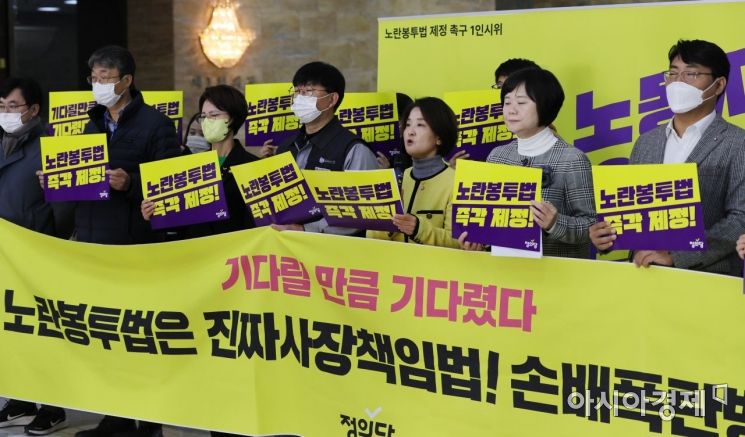 Eunju Lee, Floor Leader of the Justice Party, is attending and speaking at the "Justice Party Lawmakers' Relay Solo Protest to Urge the Enactment of the Yellow Envelope Act" press conference held at the National Assembly Roden Hall on the 16th. Photo by Dongju Yoon doso7@
On the other hand, Yoon Ji-young, a lawyer at the Gonggam Public Interest and Human Rights Foundation, who testified on the supporting side, mentioned that "when the party deciding labor conditions refuses to engage in dialogue," labor disputes become inevitable.
Lawyer Yoon stated, "Under the current Labor Union Act, the three labor rights are like a pie in the sky until the court's final ruling is made," adding, "When we talk to subcontractors, they say they have no decision-making authority. When we talk to primary contractors, they say they are not the employer. It takes 12 to 20 years for workers such as private tutors, substitute drivers, and in-house subcontracted automobile workers to register unions and have employer responsibility recognized."
He emphasized, "Delayed rights are not rights. In fact, it is not easy for unions to engage in physical struggle. No one wants to endure unpaid wages, dismissal, or losses." Lawyer Yoon argued for the legitimacy of the amendment to Article 2 of the Labor Union Act, saying, "The party deciding labor conditions refuses to engage in dialogue and keeps dragging matters that could be resolved through dialogue into the courts. The Labor Union Act is a law to activate an autonomous bargaining mechanism, but the management side is breaking this mechanism. To restore the bargaining mechanism, there is no other way but to make the bargaining counterpart respond to negotiations."
Voices were also raised that claims for damages are being abused as a means to pressure workers. Moon Sung-duk, a lawyer at the Central Legal Office of the Korean Confederation of Trade Unions, said, "Large claims for damages strongly deviate from the original purpose of exercising the right to claim damages and have a strong character of rights abuse," adding, "In fact, there are many cases where, after filing large claims for damages, withdrawal of the lawsuit is demanded in exchange for union members quitting the union."
Professor Yoon also said, "Companies know that just filing a lawsuit and applying for provisional seizure intimidates workers, so they intentionally file lawsuits," adding, "There are cases where lawsuits are selectively withdrawn only for those who quit the union and give up their rights." He particularly noted, "The fact that labor disputes are constitutional fundamental rights means that causing damage to employers is acceptable. Although this contradicts the tort law in civil law, Article 3 of the Labor Union Act was created. Immunity should be the principle and damages the exception. However, the current situation is completely reversed."
Meanwhile, based on the results of the public hearing, the Environment and Labor Committee plans to begin deliberations on the Yellow Envelope Act at the bill subcommittee on the 22nd.
© The Asia Business Daily(www.asiae.co.kr). All rights reserved.



















