Guam Deployment B-1B Moves to US Forces Japan Base for Hot Pit Refueling Training
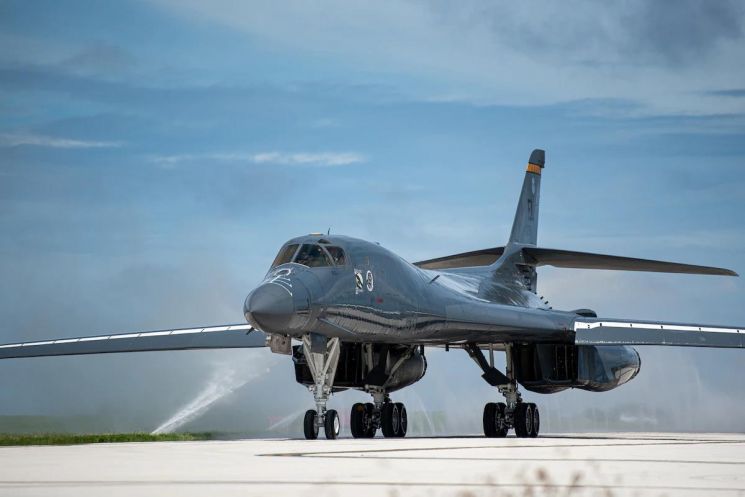
[Asia Economy Yang Nak-gyu, Military Specialist Reporter] The U.S. Air Force's B-1B 'Lancer' strategic bomber moved to a U.S. military base in Japan to conduct refueling training.
On the 17th, the U.S. Indo-Pacific Command announced that a B-1B Lancer from the 37th Expeditionary Bomb Squadron departed from Andersen Air Force Base in Guam and deployed to Misawa Air Base in Japan to conduct field emergency refueling (hot pit refueling) training in support of the Bomber Task Force (BTF) mission.
Hot pit refueling refers to the process of refueling an aircraft after it has landed on the runway without shutting down the engines. This reduces the time military aircraft spend on the ground, enabling rapid operations. Four supersonic strategic B-1B bombers were deployed to Guam, which is two hours away from the Korean Peninsula, for the BTF mission, and after takeoff, they conducted rapid refueling training just about 20 minutes away from North Korea’s doorstep. This is interpreted as a strong warning signal sent to North Korea, which has raised regional tensions through preparations for its 7th nuclear test and ballistic missile launches. It is also seen as an expression of the intention to strengthen the credibility of extended deterrence provided to allies South Korea and Japan, while also aiming to pressure China.
Colonel Christopher McConnell, commander of the 37th Expeditionary Bomb Squadron, stated, "Hot pit refueling is a means to quickly supply fuel to aircraft and enable them to take off again," adding, "The Bomber Task Force mission demonstrates the ability to integrate not only with U.S. joint forces but also with numerous allies and partners in the Indo-Pacific region."
The B-1B that conducted hot pit refueling training in Japan on this day is one of the four aircraft deployed from Ellsworth Air Force Base in South Dakota to Guam last month. The B-1Bs that arrived in Guam were deployed to the Korean Peninsula earlier this month to participate in the South Korea-U.S. joint air exercise 'Vigilant Storm' and subsequently conducted joint training with the Japan Air Self-Defense Force.
At a press conference following the 54th South Korea-U.S. Security Consultative Meeting (SCM) held in the U.S. earlier this month, South Korean Minister of National Defense Lee Jong-seop stated, "Secretary Austin decided to operate U.S. strategic assets in a way that expands the frequency and intensity of their deployment on and around the Korean Peninsula, effectively maintaining a near-permanent presence to respond effectively to any provocations from North Korea."
Furthermore, Jake Sullivan, White House National Security Advisor, explained the agenda of the U.S.-China summit on the 11th, stating, "I will convey to President Xi that if North Korea continues down this path, it means the U.S. will have no choice but to further strengthen its military and security capabilities in the region."
© The Asia Business Daily(www.asiae.co.kr). All rights reserved.

















