On the 16th, Korea International Trade Association Hosts the 1st Global Trade Forum
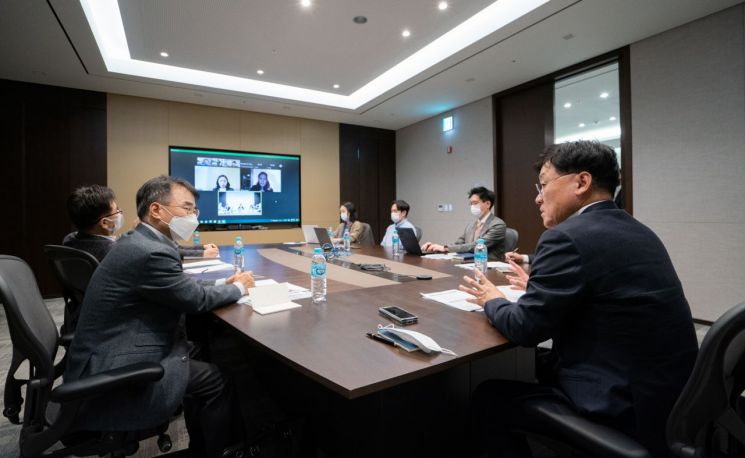 On the night of the 16th, the '1st Global Trade Forum' was underway at Trade Tower in Samseong-dong / Provided by Korea International Trade Association
[Asia Economy Reporter Kim Pyeonghwa] Opinions have emerged that, in order to respond domestically to the U.S. Inflation Reduction Act (IRA), focus should be placed on revising related implementing regulations by the U.S. Department of the Treasury. Since the opinions of relevant ministries are also reflected, it is argued that persuasion efforts targeting the U.S. Department of Commerce, the U.S. Trade Representative (USTR), and the Korea Customs Service are also necessary.
On the 16th, the Korea International Trade Association (KITA), together with the Korea Automobile Manufacturers Association and the Korea Battery Industry Association, held the “1st Global Trade Forum,” which connected the U.S. and Europe to discuss these issues, at the Trade Tower in Samseong-dong, Seoul. The forum was held to discuss the results of the U.S. midterm elections, the direction of the Inflation Reduction Act, and countermeasures.
In his opening remarks, Jeong Manki, Vice Chairman of KITA, said, "With the Democratic Party performing well in the U.S. midterm elections, the policy stance of countering China is expected to strengthen, so there is concern that additional U.S.-favoring systems similar to the Inflation Reduction Act may be added as part of a comprehensive supply chain restructuring strategy." He added, "We must establish a system to continuously monitor legislative trends and respond accordingly."
He also emphasized, “Although the possibility of repeal or full revision of the Inflation Reduction Act has decreased, considering the rising concerns from the European Union (EU) and Japan, efforts should be made to minimize side effects by strengthening public-private outreach activities targeting the U.S. Congress and government.”
Cho Sanghyun, Director of KITA’s International Trade and Commerce Research Institute, stated, “Most electric vehicle manufacturers find it difficult to meet the U.S. production requirements of the Inflation Reduction Act in the short term," adding, "Besides tax incentives for electric vehicles, there are various budget projects and benefits related to expanding eco-friendly energy and infrastructure such as wind and solar power, so our companies should make good use of these.”
Je Hyeonjeong, Head of KITA’s Washington Office, said, "When the U.S. Department of the Treasury prepares the implementing regulations for the Inflation Reduction Act, collaboration with other departments such as the Department of Commerce, USTR, and the Korea Customs Service is inevitable regarding local production requirements for subsidy payments. Therefore, outreach activities should be strengthened not only toward the Treasury but also these departments to ensure our opinions are reflected,” adding, “It is necessary to respond by submitting key opinions from industry and government during the second public comment period on the Inflation Reduction Act, which runs until December 3 this year.”
Kim Juhong, Operating Committee Chairman of the Korea Automobile Manufacturers Association, said, "If some companies from the U.S., Germany, and Japan receive subsidies through local production in the U.S. while our companies do not, a decline in price competitiveness is expected," adding, "Due to regulations that make local production impossible if the U.S. Corporate Average Fuel Economy (CAFE) standards are not met, our companies may face difficulties in expanding electric vehicle sales, and profitability deterioration is inevitable due to promotions offsetting competitiveness loss caused by subsidies.”
Jeong Sunnam, Vice Chairman of the Korea Battery Industry Association, stated, "Since Korean battery companies are essential for the U.S. electric vehicle industry ecosystem, grace measures are needed for battery minerals and component requirements," adding, "To expand the list of countries meeting core mineral requirements, it is necessary to extend the standards beyond U.S. free trade agreement (FTA) partner countries to potential members of the Indo-Pacific Economic Framework (IPEF) such as Indonesia, which has abundant mineral resources.”
Vice Chairman Jeong said, "We will continue to monitor the progress of the Inflation Reduction Act and continuously collect industry opinions to minimize damage to Korean companies," adding, "We will actively cooperate with relevant ministries and related organizations.”
© The Asia Business Daily(www.asiae.co.kr). All rights reserved.
![Clutching a Stolen Dior Bag, Saying "I Hate Being Poor but Real"... The Grotesque Con of a "Human Knockoff" [Slate]](https://cwcontent.asiae.co.kr/asiaresize/183/2026021902243444107_1771435474.jpg)
















