5 Types of Youth Spaces to Be Fully Merged into 2 Types, Metropolitan and Regional, by 2024
Seoul Youth Centers Aim to Establish One per Autonomous District...Standardizing Youth Services by Living Area
Metropolitan Youth Centers to Focus on Comprehensive Support and Policy Delivery for Seoul Youth Centers
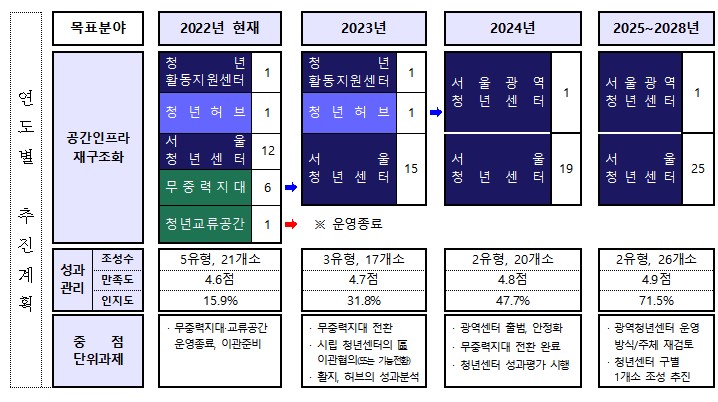
[Asia Economy Reporter Lim Cheol-young] On the 17th, the Seoul Metropolitan Government announced that as part of its rectification efforts, it will conduct a comprehensive review of the functions, performance diagnosis, and improvement directions of the Seoul Youth Vitality Spaces, which had been pointed out, and based on this, establish a “Comprehensive Plan for the Restructuring of Seoul Youth Spaces” that includes mid-to-long-term goals such as role redefinition and simplification of the delivery system, along with five major improvement tasks, and implement it.
The Seoul Youth Spaces were expanded to 21 locations across five types through the addition of various spaces after the establishment of the Youth Hub in 2013 to address youth issues and guarantee various youth activities. However, as the facilities expanded in line with the operational principle of guaranteeing youth autonomy, there were criticisms regarding overlapping functions between spaces, unclear hierarchy, limitations in policy delivery functions, and administrative and financial inefficiencies and unfairness in operation.
In response, since early this year, Seoul has launched a Seoul Youth Space Restructuring Planning Task Force (TF) composed of academics, experts, youth stakeholders, and social welfare facility practitioners to review past achievements and future directions. Collaborating with the Seoul Institute, they designed detailed projects concerning the efficient delivery system of Seoul Youth Spaces, preparing a comprehensive plan for functional reorganization and redefinition of Seoul Youth Spaces through a two-track approach.
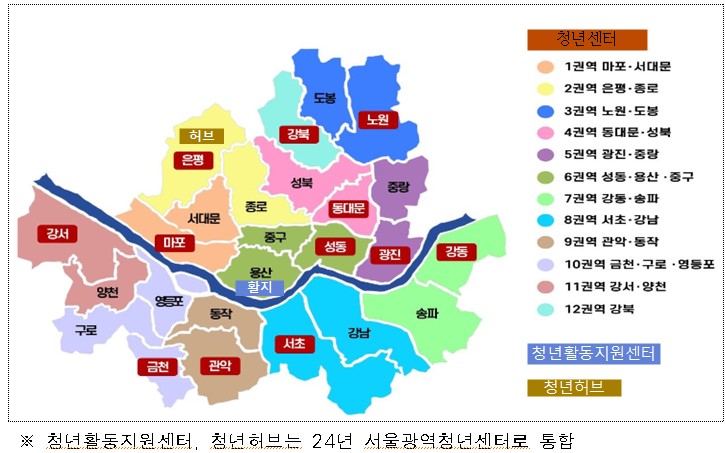
First, to provide universal policy services to Seoul youth, the city will consolidate the current five types of youth spaces into two types?‘metropolitan’ and ‘regional’?by 2024. The Mujungryuk Zone and Youth Exchange Spaces will cease operations this year, and from next year, facilities at the living zone level will be unified under the Seoul Youth Center. Additionally, the Youth Activity Support Center and Youth Hub will be integrated into the Seoul Metropolitan Youth Center, which will newly launch in 2024.
Through a streamlined delivery system, Seoul Youth Spaces will promptly provide practical policy functions that contribute to the lives of youth. At the living zone level, the Seoul Youth Center will execute and deliver youth policies and provide support for vulnerable youth, while the metropolitan center will focus on comprehensively supporting and standardizing the Seoul Youth Centers.
Furthermore, with the upcoming legal basis for the establishment and operation of regional youth facilities secured through amendments to the Youth Basic Act, the city plans to establish systems for objective and rational operation as public facilities, including securing staff expertise, unifying salary systems, and introducing evaluation systems. Related operational manuals will be published annually and applied accordingly.
The scope of youth spaces will be expanded to increase mutual cooperation with various youth networks active in the regions and significantly enhance communication with the field. Every year, in the first and second halves, a youth space council composed of 10 members?including representatives from Seoul City, autonomous districts, youth centers, national and regional youth organizations, academia, and experts?will be formed to perform functions such as establishing basic plans for youth policy support, coordinating opinions on various issues, and deliberating and deciding on cooperation matters. Additionally, a practical discussion body that manages the role definitions, goals, achievements, and fair management of youth spaces concerning Seoul’s representative youth policies will be operated as a TF within the Future Youth Planning Group on an ongoing basis.
Moreover, to enhance overall awareness and satisfaction with youth spaces, monthly youth space promotion working meetings will be held to communicate and share promotional items and achievements. Surveys and citizen opinion polls will be conducted regarding the brand and project names of Seoul Youth Spaces to reorganize terms and slogans that can foster greater public consensus.
Kim Cheol-hee, head of the Future Youth Planning Group, stated, “At a time when youth spaces are increasing nationwide and being elevated to public facilities, Seoul will strengthen operational standards to fulfill its role as a leading space model that provides tailored policy services to all youth without blind spots.”
© The Asia Business Daily(www.asiae.co.kr). All rights reserved.


















