Analysis of Financial Information of Top 5 KRW Market Virtual Asset Operators
Sufficient Payment Capacity Even if Bank Run Occurs
No Self-Issued Coins Like FTX, Leverage Investment Not Possible
[Asia Economy Reporter Ji Yeon-jin] As the shockwave of the global virtual asset exchange FTX bankruptcy spreads, attention is focused on the liquidity risks of domestic virtual exchanges.
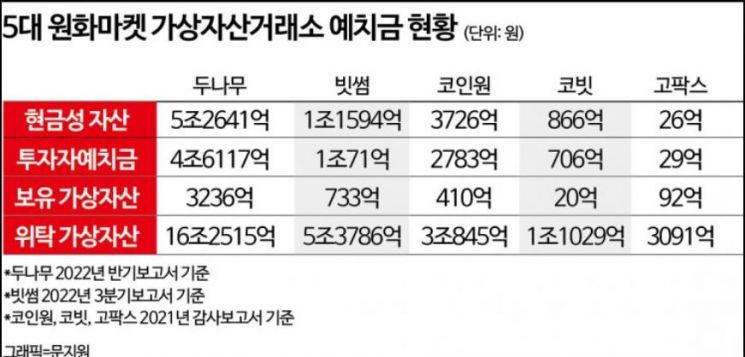
On the 15th, an analysis of the financial information of five domestic virtual asset exchanges operating won markets, posted on the Financial Supervisory Service’s electronic disclosure system, showed that the deposits entrusted by investors are kept in bank accounts, and even if a 'bank run' occurs where all deposits are withdrawn at once, the exchanges have the capacity to pay. However, some exchanges have liquidity assets that can be converted into cash within one year concentrated in coins, making them vulnerable to sharp price drops or coin accidents.
According to Bithumb’s recently disclosed Q3 report this year, the company holds cash and cash equivalents worth 929 billion KRW. Current liabilities, classified as funds to be repaid within one year, amount to 917.1 billion KRW, of which member deposits are 866.4 billion KRW. This means that even if investors trading virtual assets through Bithumb withdraw their deposits all at once, the company can pay them all.
In the case of Dunamu, since it prepares consolidated financial statements, the Q3 report has not yet been submitted. However, based on the half-year report this year, current assets that can be converted into cash within one year reached 6.0765 trillion KRW, and current liabilities were 4.9591 trillion KRW. Deposits from investors, meaning trust liabilities, amounted to 4.6117 trillion KRW, indicating sufficient capacity even if a large-scale deposit withdrawal event, a 'bank run,' occurs.
Coinone and Korbit, which are subject to audit report submission, had cash equivalents of 372.6 billion KRW and 86.6 billion KRW respectively as of the end of last year, exceeding investor deposits of 278.3 billion KRW and 70.6 billion KRW.
The problem lies with Gopax. Streami, which operates Gopax that entered the won market in April this year, had investor deposits of 2.9 billion KRW as of the end of last year, while cash equivalents were only 2.6 billion KRW. However, the company’s liquidity assets reached 35.2 billion KRW, so it appears to have sufficient payment capacity even if a bank run occurs. Yet, most of the liquidity assets were concentrated in virtual assets (9.2 billion KRW) and investment virtual assets (13.1 billion KRW), and Gopax was the only exchange where the scale of virtual assets exceeded cash equivalents.
Dunamu’s virtual assets held amounted to 323.6 billion KRW, including Bitcoin (11,248 units, 287.5 billion KRW), Ethereum (4,056 units, 5.5 billion KRW), and Tether (81.95 million units, 10.8 billion KRW). Bithumb held coins worth 73.3 billion KRW, with the largest holdings being Ethereum (12,952 units, 25.2 billion KRW), and disclosed 27 coins including Bitcoin (460 units, 12.8 billion KRW) and Ripple (691,865 units, 0.4 billion KRW). The number of Bitcoins sharply decreased from 1,419 units in Q3 last year, while Ripple increased by over 200,000 units.
The recent FTX incident that struck the virtual asset market involved the exchange repeatedly borrowing loans using tokens (FTT) it issued as collateral, increasing debt, which led to a liquidity crisis and bankruptcy filing. Additionally, it was revealed late that Crypto.com, the world’s 15th largest exchange, transferred large holdings of coins to other exchanges, raising suspicions of 'customer money recycling,' where customer funds were used to inflate the financial status of affiliates or other exchanges.
In the case of domestic exchanges, Dunamu and Bithumb undergo external audits quarterly, while the other exchanges are audited annually, so the risk from opaque financial structures is relatively low. A virtual asset exchange official said, "Domestic exchanges cannot conduct futures or derivatives trading, so they operate solely on commission revenue," adding, "Unlike overseas exchanges, they will not face liquidity crises caused by excessive debt."
© The Asia Business Daily(www.asiae.co.kr). All rights reserved.
![Clutching a Stolen Dior Bag, Saying "I Hate Being Poor but Real"... The Grotesque Con of a "Human Knockoff" [Slate]](https://cwcontent.asiae.co.kr/asiaresize/183/2026021902243444107_1771435474.jpg)
















