LVMH Group's Cumulative Champagne and Wine Sales in September Up 32% Year-on-Year
Luxury Brand Sales Including Apparel and Watches Also Surge... "Liquidity Expanded Due to Pandemic, Number of Wealthy Increased"
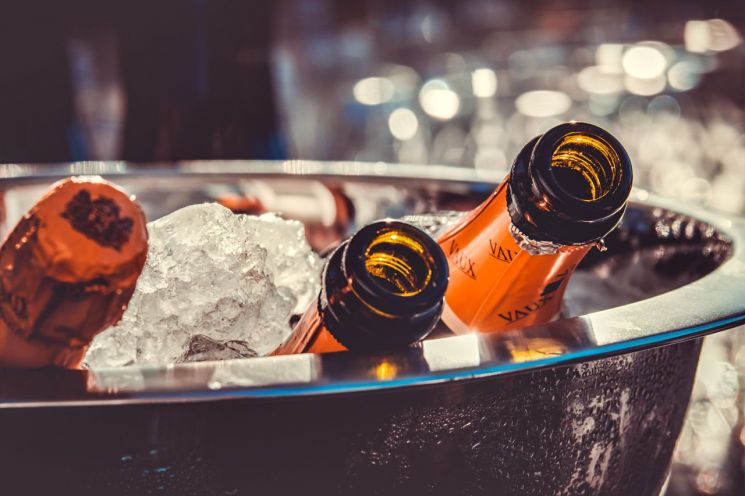
[Asia Economy Reporter Yoon Seul-gi] As the consumption sentiment of the wealthy, suppressed by COVID-19, bursts forth, the luxury goods industry is experiencing a boom, with sales of ultra-premium champagne soaring.
According to the UK Guardian on the 15th (local time), Louis Vuitton Mo?t Hennessy (LVMH) Group, which includes Mo?t Hennessy handling high-end champagnes such as Mo?t & Chandon, Veuve Clicquot, and Dom P?rignon, announced that champagne and wine sales increased by 32% compared to the same period last year through September this year. Especially, growth was notably strong in famous tourist destinations such as Europe, the United States, and Japan.
Philippe Schaus, CEO of Mo?t Hennessy, said, "This year is an incredible year," adding, "The best champagnes are running out of stock." He analyzed that this recent phenomenon is comparable to the "Roaring 20s" (the American economic boom period), explaining that 'revenge consumption' has explosively increased among the wealthy, who were confined during the COVID-19 pandemic, with pent-up demand for luxury goods, entertainment, and tourism.
Besides champagne, sales of luxury brands such as high-end clothing, bags, watches, and supercars have surged, bringing prosperity to related industries. LVMH, which owns fashion brands like Christian Dior, TAG Heuer, and Bulgari, saw its third-quarter sales increase by 19% compared to last year. During the same period, Kering, which manages brands such as Gucci, Balenciaga, and Bottega Veneta, recorded a 14% sales increase, and Herm?s, known for selling high-end handbags, saw sales jump by 24%.
The boom in luxury companies appears to be influenced by the global increase in wealthy individuals and the phenomenon of luxury consumption among younger generations. According to a Credit Suisse report, liquidity increased during the pandemic, causing asset prices to soar and triggering a "wealth explosion." The number of ultra-high-net-worth individuals (UHNW) with net assets exceeding $50 million (approximately 6.63 billion KRW) also surged. As of last year, there were 264,200 UHNW individuals worldwide, an increase of more than 40,000 from 218,200 at the end of 2020.
There is also an analysis that the growth trend of the luxury market will continue until 2030. According to a report by Bain & Company and the Italian luxury association Altagamma, luxury sales this year are expected to reach 353 billion euros (approximately 480 trillion KRW), up about 22% from 290 billion euros (approximately 400 trillion KRW) last year.
In particular, the report noted that the luxury consumer base is getting younger, predicting that younger generations will be the driving force behind luxury consumption. The report explained, "The Generation Z, emerging as the main consumer group, starts luxury consumption 3 to 5 years earlier than the millennial generation," adding, "By 2030, consumption by Generation Z and Alpha will increase about three times faster than other generations, accounting for one-third of the entire market."
© The Asia Business Daily(www.asiae.co.kr). All rights reserved.
![Clutching a Stolen Dior Bag, Saying "I Hate Being Poor but Real"... The Grotesque Con of a "Human Knockoff" [Slate]](https://cwcontent.asiae.co.kr/asiaresize/183/2026021902243444107_1771435474.jpg)











