Results of the 69th COVID-19 Awareness Survey Show Decrease in 'Will Get Vaccinated' Responses
Government Designates Intensive Vaccination Period from the 21st … Incentive Effect Uncertain
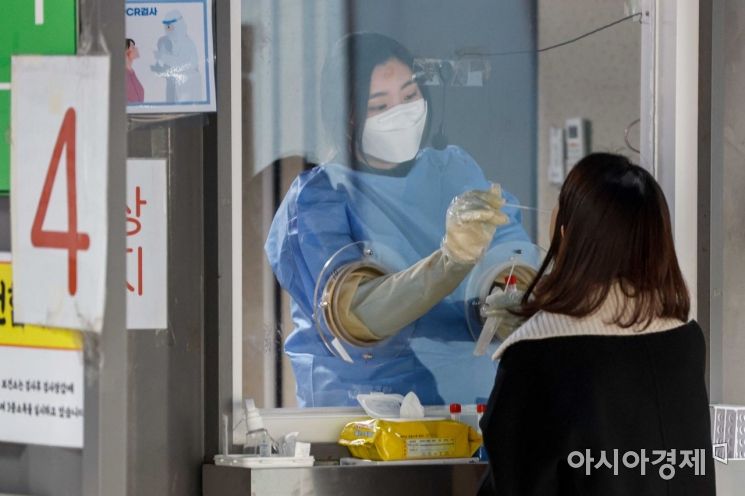 On the 15th, a citizen visiting the screening clinic set up at Yongsan-gu Public Health Center in Seoul is undergoing a test. Photo by Jinhyung Kang aymsdream@
[Asia Economy Reporter Yoon Seul-gi] Six to seven out of ten Koreans are hesitant to receive the COVID-19 vaccine due to reasons such as previous infection experience and concerns about adverse reactions. As the winter resurgence of COVID-19 intensifies, the government has taken measures to increase vaccination rates by offering incentives.
According to a survey conducted by the polling agency Korea Research from the 28th to the 31st of last month targeting 1,000 adults aged 18 and over nationwide, the 69th COVID-19 awareness survey (with a sampling error of ±3.1 percentage points at a 95% confidence level) found that 65% of those who completed at least two doses of vaccination responded that they would not receive the additional bivalent vaccine (updated vaccine) targeting the Omicron variant during the winter season.
The percentage of respondents unwilling to receive the bivalent vaccine was 58% in the third week of September and 63% in the last week of September, but recently rose to 65%. Only 35% responded that they had completed or intended to receive the additional bivalent vaccine.
The reasons for unwillingness to vaccinate included ▲'I can still get infected even after vaccination' (34%) as the most common, followed by ▲concerns about adverse reactions (28%), ▲burden of frequent vaccinations (24%), ▲fear that adverse reactions to the bivalent vaccine might be greater (22%), and ▲already having been infected and recovered (21%).
Among those who received two or fewer doses of the COVID-19 vaccine or were unvaccinated, the reasons for refusal included concerns about adverse reactions (43%), distrust in vaccine effectiveness (38%), and previous infection immunity (27%).
According to the Central Disease Control Headquarters (CDCH), as of the 16th, the additional winter vaccination rate among the eligible population is 4.8%. This is a low level compared to other countries implementing additional bivalent vaccine doses. Compared to the domestic population vaccination rate, the United States stands at 10.1% (as of the 9th), and Japan at 8.5% (as of the 10th).
In response, the government announced that from the 21st of this month, a one-month 'intensive vaccination period' will be designated, during which incentives will be provided to those vaccinated. The COVID-19 Vaccination Response Promotion Team plans to offer cultural experience benefits such as discounts on temple stays, free admission to palaces and royal tombs, and discounts on facilities managed by local governments. Additionally, awards will be given to infection-vulnerable facilities and local governments with high vaccination rates, and extra points and financial support will be provided during various evaluations.
© The Asia Business Daily(www.asiae.co.kr). All rights reserved.

















